

By Alfredo Fernández
Alfredo Fernández is a Peruvian biologist and a National Geographic Explorer (2017), recognized for his work on the lomas fog oases of the Peruvian coast. He leads birding and wildlife trips across Peru with Wild Andes Tours, where the eBird-backed field reports from the Lima coast behind this piece are published in full.
Pucusana is a fishing town an hour south of Lima, built around a harbour full of brightly painted wooden boats. A few hundred metres offshore sits Isla Pucusana, a small bare island streaked white with guano. There is nothing grand about it. Small boats leave the jetty, go round the island in about an hour, and come back. But it may be the easiest place in the world to see the seabirds of the Humboldt Current, and this spring it gave me something I did not expect: the same small piece of ocean, counted seven times in seven weeks, during a year when the ocean is not behaving.
Between 12 September and 30 October we put in seven eBird counts from boats around the island. They were not a designed survey. The boats left at different hours, some days the harbour was counted separately and some days it wasn’t, and on busy days a few species went down as “present” with no number. I’ll come back to what that means. But seven looks at one rock in one season is more than most places get, and in 2026 it is worth writing down.
The usual cast
To see why this year is strange, you need to know what a normal year here looks like.
The Humboldt Current carries cold water up the coast of Chile and Peru. Offshore winds push the surface water out to sea, and colder, nutrient-rich water wells up from below to replace it. The result is one of the most productive seas on the planet, and its foundation is a single small fish, the Peruvian anchoveta. Nearly everything at Pucusana is an anchoveta-eater.
At the top of the list are the three species that once built Peru’s guano economy: Guanay Cormorant, Peruvian Booby and Peruvian Pelican. Then come the specialties that draw birders: Inca Tern, a slate-grey tern with a white moustache that curls back from the bill; Red-legged Cormorant, nesting on ledges so narrow they barely seem to exist; and Humboldt Penguin, Vulnerable on the IUCN Red List, swimming low in the harbour.
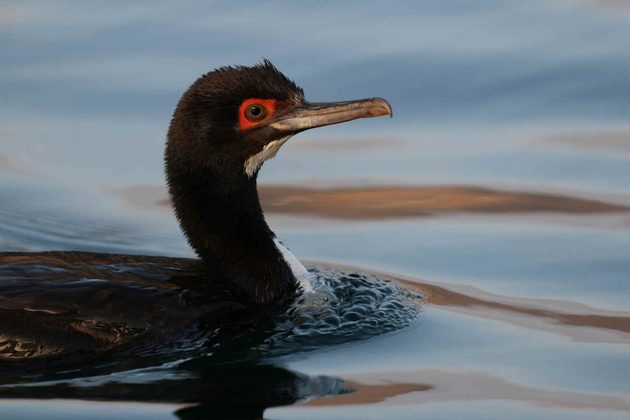
Guanay Cormorant, close up, showing the red eye-ring. Pucusana pelagic, 29 September 2026. © Vincent Sanders
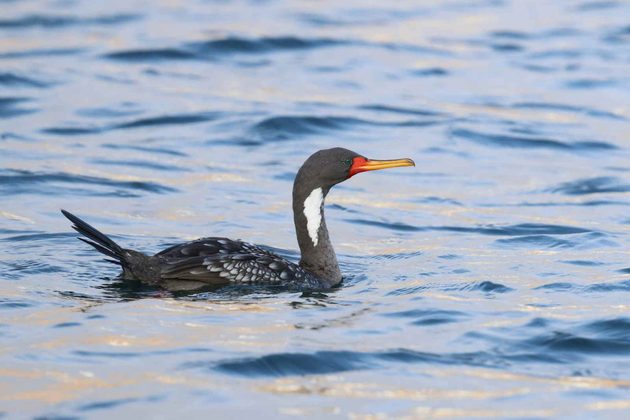
Red-legged Cormorant on the water. Pucusana pelagic, 29 September 2026. © Vincent Sanders
Further out you get the small tubenoses. There are Elliot’s Storm-Petrels, pattering over the swell in loose groups, and, if you are lucky, the Peruvian Diving-Petrel. On the rocks themselves lives the island’s one Peruvian endemic, the Surf Cinclodes. It is an ovenbird that feeds in the wash itself, on ledges the waves cover and uncover every few seconds.
What a warm year looks like
Peru’s El Niño monitoring committee, ENFEN, put the coast under a Coastal El Niño alert in February. By its late-September statement, it was calling the sea-surface warming “extraordinary.” When warm water sits on this coast, the anchoveta go deeper and further south, and the birds that depend on them have to follow, travel further, or go hungry. In the great El Niño events of the 1980s and 1990s, Peru’s guano-bird populations crashed.
So I expected the counts to show the Humboldt cast thinning out. Here is what they actually showed.
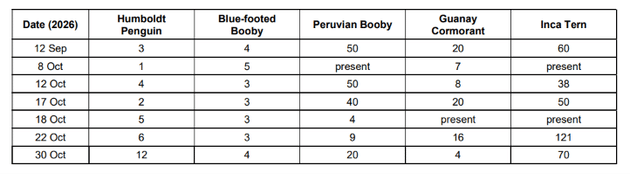
Counts from eBird checklists entered from boats around Isla Pucusana. “Present” means the species was recorded without a number. On 22 October, one of the six penguins was in the harbour rather than at the island.
Three things stand out.
The Blue-footed Booby never left. It turned up on all seven counts, three to five birds every time. This is a bird of Peru’s warmer north coast and the Gulf of California, and around Lima it is normally an irregular visitor, not a fixture. Seven out of seven is the clearest warm-water signal in the data. These birds came south with the water.
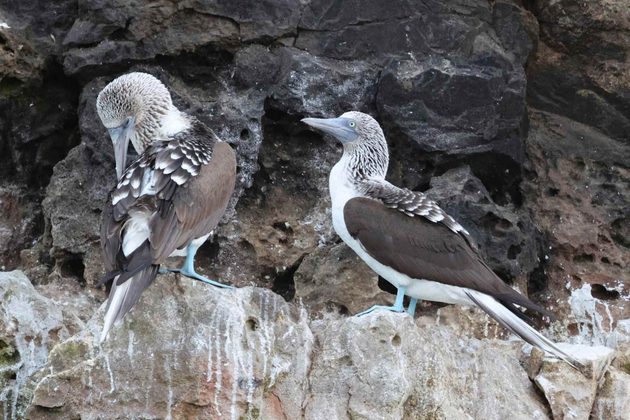
Two Blue-footed Boobies on the guano-streaked rock, two weeks before the first of the seven counts. Pucusana pelagic, 29 September 2026. © Vincent Sanders
The penguins went up, not down. This is the one I can’t fully explain. One, three, four, two, five, six, then twelve on the last day of October, twice any other count of the season. My guess is that this is not a healthier population but the same birds behaving differently. Humboldt Penguins are known to range more widely and forage closer to shore when food is short, so more birds may be passing through a sheltered bay. Twelve penguins is a good day out. It is not evidence of a good year, and I’d want to know what the breeding colonies further south are doing before reading anything more into it.
The Peruvian Booby numbers are noisy, and I don’t trust the drop. Fifty birds in September and mid-October, then four, nine, and twenty late in the month. That looks like a decline. But the 18 October count was made in the late afternoon, when many boobies are away fishing, and the 22 October boat was a quick one. The honest reading is “maybe.” This is exactly where opportunistic counts let you down, and where one standardized count a week would have answered the question.
Meanwhile, the Inca Terns seem barely bothered: sixty in September and a hundred and twenty-one around the island on 22 October. Terns can pick food from the surface rather than diving deep for it, which may help in a year like this.
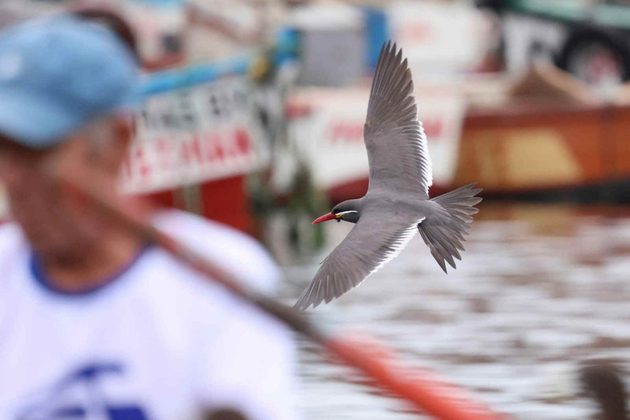
Inca Tern over Pucusana harbour, with the fishing boats behind. Pucusana pelagic, 29 September 2026. © Vincent Sanders
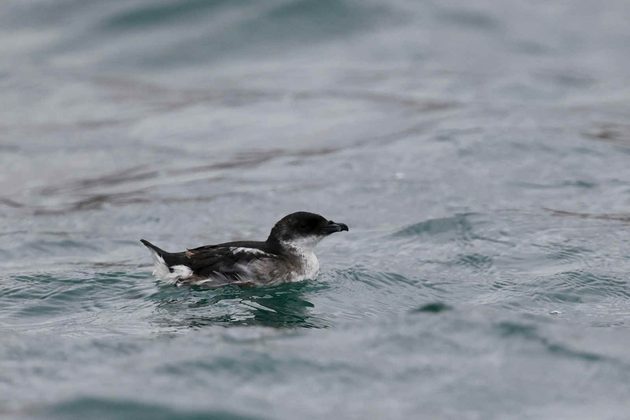
Peruvian Diving-Petrel on the water off Isla Pucusana, 12 October 2026. © Frank Pong
The Diving-Petrels That Stayed
The Peruvian Diving-Petrel is the bird I most want visiting birders to see here, and it is never guaranteed. It is a small, stocky, auk-like seabird that normally sees a boat coming and either dives or whirs away low over the water at range.
On 8 October, six of them did neither. They sat on the surface and let the boat work slowly towards them, close enough to watch them preen. Four days later, another sat still long enough for the portrait above. We recorded them on four of the seven counts, two to six birds at a time.
It is worth remembering how recently this bird was in serious trouble. It nests in burrows dug into guano on offshore islands, and for decades it lost those burrows to guano harvesting and its adults to hunting. It was listed as Endangered. In 2020, BirdLife moved it down to Near Threatened, crediting a population increase to conservation work at its breeding islands. Seeing six of them sitting calmly off a working fishing harbour is a small, real sign that the work paid off. Whether that holds through a strong El Niño is another matter.
Passing through
A rock like this one also catches birds on the move. On 12 September, an estimated hundred Sooty Shearwaters were offshore. By 8 October there were two, and after that none. That is the end of a passage, not a shortage. Elliot’s Storm-Petrels were on every October count, from a single bird to thirty. Late October brought Red-necked Phalaropes onto the sea, eight on the 17th and thirteen on the 30th. Close to shore, they are the scarcer of the two phalaropes on this coast, and good to set beside the Wilson’s Phalaropes that crowd the coastal lagoons inland at the same time.
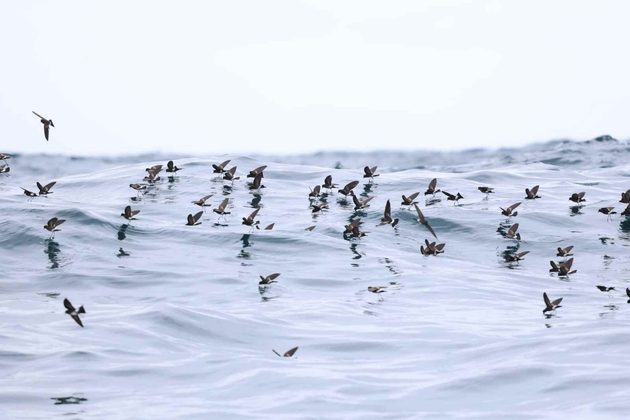
A flock of Elliot’s Storm-Petrels pattering over the swell. Pucusana pelagic, 29 September 2026. © Vincent Sanders
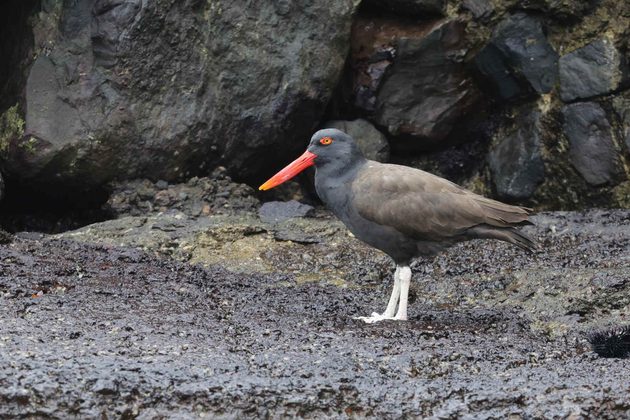
Blackish Oystercatcher on wet rocks at Pucusana, 12 October 2026. © Frank Pong
The ones that eat the birds
Not everything at Pucusana eats anchoveta. On 12 October, a South American Sea Lion surfaced beside the boat holding a seabird. It is a reminder that a seabird colony feeds more than seabirds.
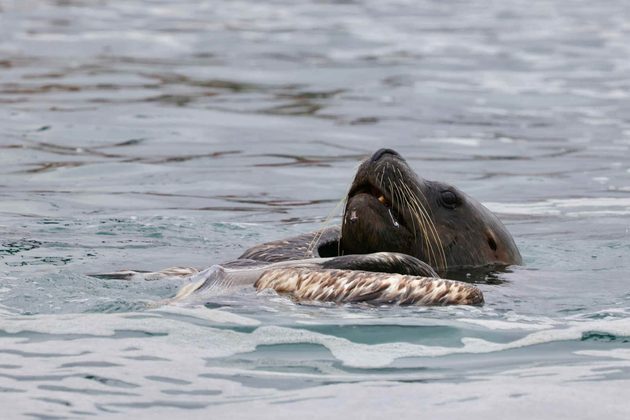
South American Sea Lion with seabird prey, Pucusana, 12 October 2026. © Frank Pong.
The rarest animal of the season was not a bird at all. On 17 October, a Marine Otter was feeding on the wave-washed rocks. It is endangered, and it is the hardest animal on this coast to find: you see one only by watching a stretch of surf until a piece of it moves. It shares that rock with the Surf Cinclodes, which turned up on five of the seven counts, always right in the splash zone.
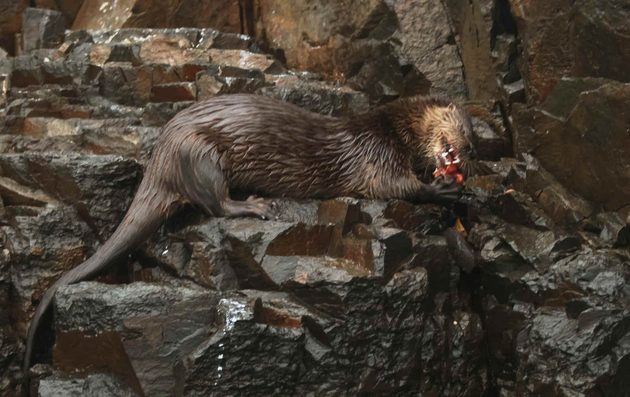
Marine Otter feeding on wet coastal rocks, Peruvian coast, October 2026. © Alejandro Tello
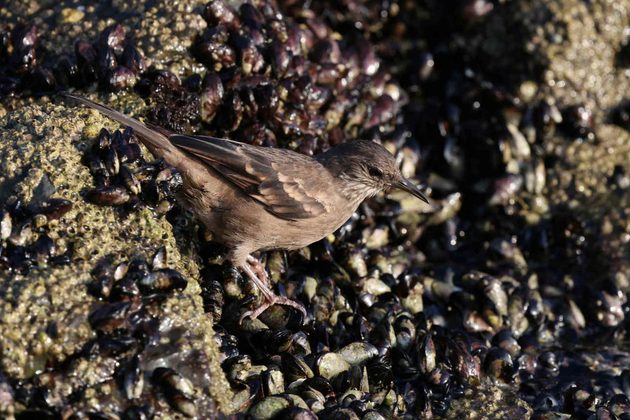
Surf Cinclodes feeding among mussels in the splash zone. Pucusana pelagic, 29 September 2026. © Vincent Sanders
Why count the same rock seven times
None of this is science. Seven counts by different observers at different hours is a diary, not a dataset. But it is a diary kept through a year that ENFEN calls extraordinary, and diaries like it are how a warm year gets noticed before anyone has run the numbers.
If I took one lesson from the exercise, it is that a fixed hour and a fixed route around the island, once a week, would have turned “maybe the boobies dropped” into an answer. If you are birding Lima, the boat at Pucusana is cheap, short, and open to anyone who walks down to the jetty. Every checklist you add from that rock makes the picture clearer.
And go for the penguins anyway. Twelve of them on a grey October afternoon is a fine thing, whatever the sea is up to.
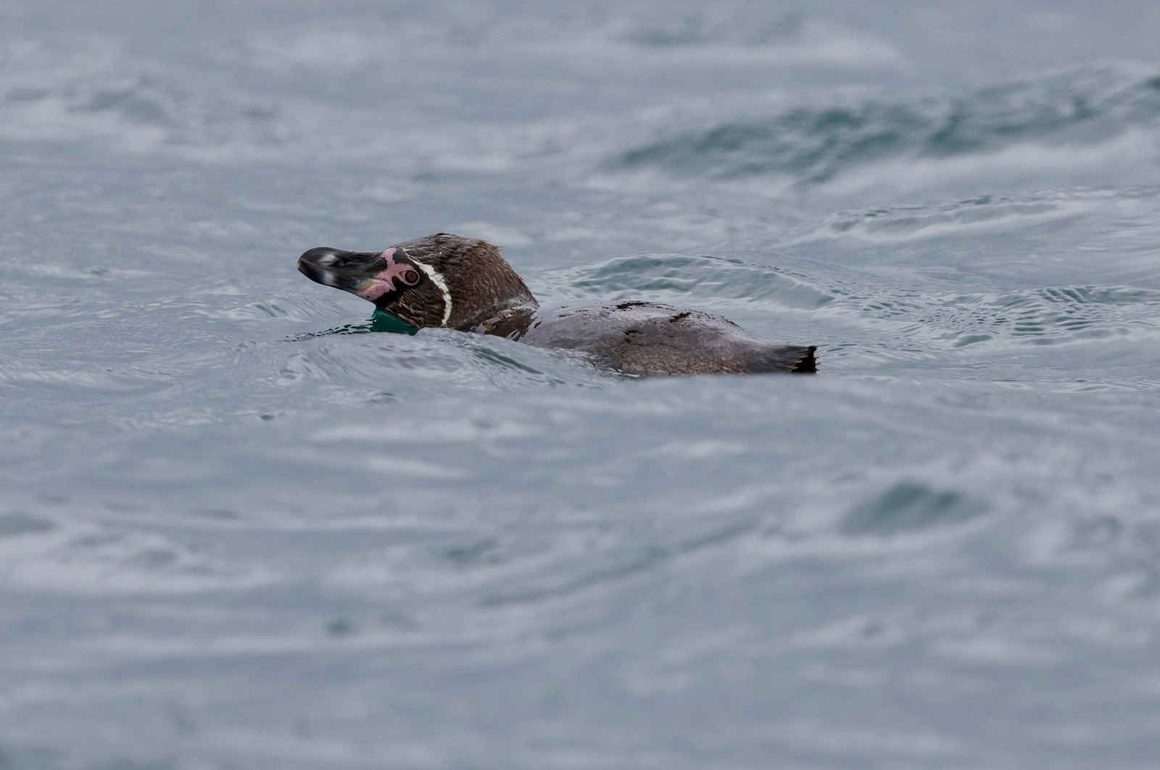
COVER — Humboldt Penguin swimming off Isla Pucusana, 12 October 2026. © Frank Pong









Leave a Comment