

Anton Schultz is a bird guide at Birding Ecotours. He is based in South Africa and recently completed his honours degree in Zoology at the University of Pretoria, studying Red Larks in the desert. In 2019, Anton completed a Big Year in southern Africa, recording 804 species in one calendar year at the age of 19. Since then, his yearning for adventure has only continued to grow.
For those who have experienced biological fieldwork, it can be a brutal affair. Hot temperatures and relentless sunlight define long days in the field, followed by late evenings back at camp where you scramble to prepare food and upload data before a meagre night’s rest, all to be repeated day after day. Such was my experience studying Red Larks in the Koa Dunes of South Africa’s Northern Cape for three months at the end of 2024.
My fieldwork largely consisted of following a lark for twenty-minute intervals, known as ‘focals’, during which I observed its behaviour. Because the project related to projected warming from climate change, I also recorded the type of shade each bird used for thermoregulation, particularly during the hottest parts of the day.
This was my first experience of academic fieldwork, and I often struggled to keep my head intact. The heat was challenging, and temperatures often exceeded 104°F (40°C) under cloudless skies, but I adapted to that more quickly than I thought I would. What weighed on me more was the pressure to collect enough data and to do so without error. Honors students are particularly prone to that kind of anxiety. Fortunately, I always had an incredible field assistant by my side who often caught the small (and big) mistakes I might have missed.
Not long after the fieldwork began, things started to settle. I found myself falling in love with aspects of it. There is something almost mystical about becoming absorbed into an ecosystem. Each species reveals its own character over time. Red Larks felt dainty and almost fairy-like, despite being relatively large by Lark standards.
Interactions between species became stories in themselves. A tussle between the focal Red Lark and a smaller Spike-heeled Lark always ended in favor of the latter. We dubbed them “mobsters” because of the way they patrolled the dunes in small family groups, pecking at anything in their path. Yellow-bellied Eremomelas were constant entertainers, mimicking sounds from their surroundings, while the desert, though sparse, remained alive with Fawn-coloured Larks, Bokmakieries, occasional flocks of Grey backed Sparrow Lark, and Namaqua Sandgrouse.
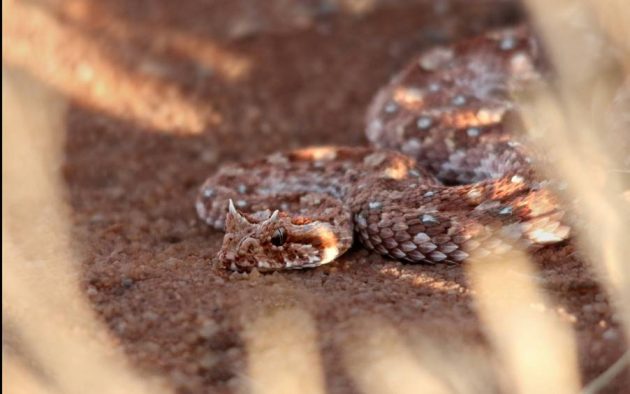
In addition to the feathered variety of creature, we also always had to watch our feet for Horned Adders in the field (photo by Bianca Koster)
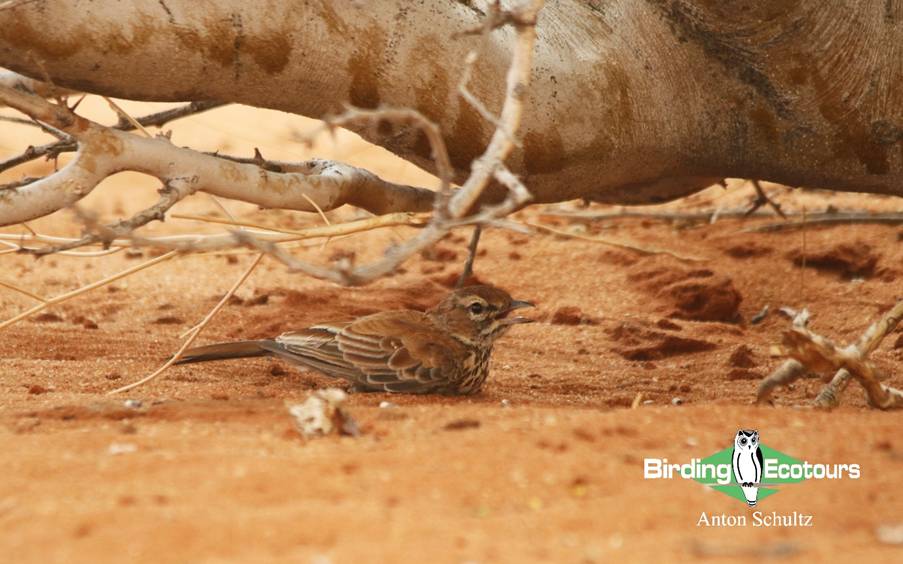
The most remarkable shift, however, was when species became individuals. You begin to recognize birds, to notice patterns, and to form attachments. One pair of Red Larks, recorded in the dataset as “RLSH 3 F” and “RLSH 3 M,” became “Pixie and Brutus” to us. The image above the article is of Pixie. I spent many midday vigils sitting nearby, watching her rest beneath a Parkinsonia tree.
Objectively, twenty minutes of watching a bird lie in the shade, panting and occasionally opening an eye, is not particularly exciting. But I grew to appreciate this stillness. As someone prone to overthinking, I found it unexpectedly meditative. Sometimes I would realize that I had drifted off for minutes at a time, and the feeling was oddly profound.
Later, I learned that this state has a name in Taoist philosophy, “Wu Wei”. It loosely translates to effortless action, a way of moving with life rather than against it, aligning with natural rhythms instead of forcing outcomes.
If you’d prefer to be less pretentious, athletes will often call it “The Zone”, a state where body and mind operate in quiet harmony. I found myself entering this space occasionally in the desert, whether watching a Red Lark or a Toktokkie beetle going about its day, leaving small footprints in the sand.
Tracking animal footprints often brought this feeling most strongly. One print leads to another, and suddenly a story begins to unfold, only to be erased again by the wind. Before leaving for the desert, I had listened to a podcast by an animal tracker named Boyd Varty that included a line which stayed with me. “I don’t know where I’m going, but I know exactly how to get there.”
I wish I could say I carried this philosophy with me completely after leaving the desert, and that I now move through life in perfect harmony with the universe. But reality has a way of returning. There are lectures to attend, tasks to do, and responsibilities to meet. Life moves quickly, often too quickly, and not everyone is interested in slowing it down.
Still, I think it matters that we try. That we look for those moments where time softens, where we are present not for any particular purpose, but simply because we are there.Wu Wei is probably not something you achieve once and keep forever, but rather something you stumble into, briefly, and spend the rest of your life learning how to return to.
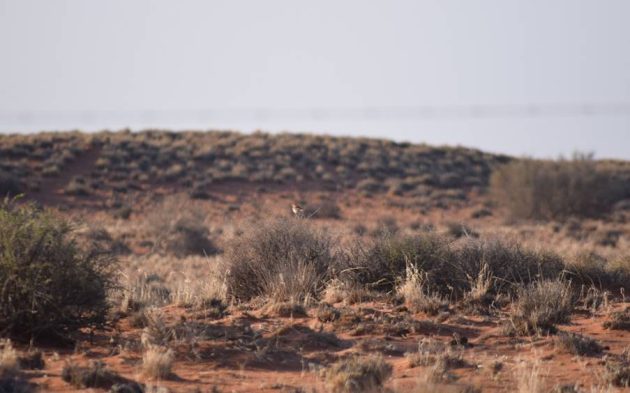
A typical view of a Red Lark for me on a typical day in the field, the memories have indeed become bittersweet.





Thank you for this interesting read Anton!