

In the recently concluded BirdsCaribbean International Conference set in Port of Spain, Trinidad, one of the presentations was entitled “Ghost Notes” – an obscure phrase with which those who know music would be familiar. The originator of said title was, of course, yours truly, and it has been an oft-discussed topic in certain circles over the past five decades in these parts. Not ghost notes in particular, but the implied ornithological parallel which I was referring to when naming my presentation.
In certain musical circles, a ghost note is a note that carries rhythm but lacks melody. I felt a strong correlation with the situation regarding the avifauna of Trinidad & Tobago, let me explain.
Historically, nine species of Sporophila seedeaters inhabited the grasslands, wetlands, and forests of Trinidad & Tobago. They were Great-billed Seed-Finch, Chestnut-bellied Seed-Finch, Grey Seedeater, Slate-coloured Seedeater, Wing-barred Seedeater, Lined Seedeater, Lesson’s Seedeater, Yellow-bellied Seedeater, and Ruddy-breasted Seedeater. Interestingly, in a human population that bore scant regard for the natural world, each of these birds had a local name. Well, sort of. Extremely similar species such as Lined Seedeater and Lesson’s Seedeater did not each carry unique names as locals were possibly unable (or unwilling) to tell them apart. It must also be said, that in fairness to all concerned, that they were both considered conspecific at one point.
Each of these seedeaters possessed a rich, melodious song, multidimensional additions to the soundscape of the habitat. Today, I must imagine how uplifting it must have been to be out in and among these varied trills and warbles, as they are now virtually all gone from the wild. Six of the previously mentioned nine species are locally extinct, and three others are limited to tiny, isolated populations in remote areas.
We truly, absolutely, without question, have a problem. While Steel Pulse was speaking about racism, fascism, and police brutality using these exact words in this performance, for T&T this is an issue that ornithologists and naturalists have been sounding the alarm about for an obscene amount of time. The first edition of A Guide to the Birds of Trinidad & Tobago by Richard ffrench was published in 1973 and includes the following passage:
In spite of official limitations, many people openly flout the law by trapping out of season, using bird-lime for trapping, and keeping birds in too small a cage. It seems that many of those in authority regard such offences as too trivial to merit more than occasional attention. Along with the constant encroachment on habitat, the unchecked trapping of male finches, both Sporophila and Oryzoborus, will undoubtedly result in the complete extinction in Trinidad within a decade or so of all these species, except perhaps S. minuta.
The exception to the extinction prophecy was Sporophila minuta, or Ruddy-breasted Seedeater, which was noted to be by far the most commonly occurring member of this family across T&T; its small size and sheer abundance would surely protect it, right? Well, for illustrative purposes, allow me to recount an interaction with a gentleman early one morning while birding the wetlands of Trinidad’s southwest.
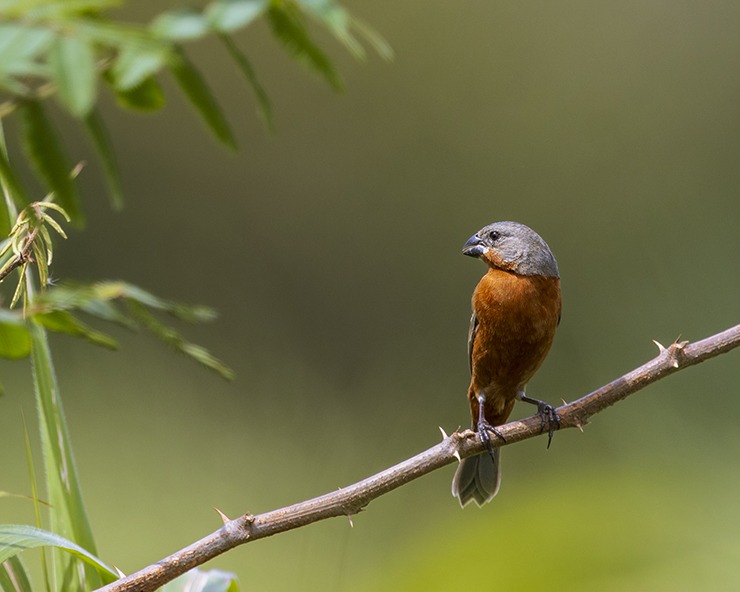
Ruddy-breasted Seedeater
It was no more than an hour after dawn, and I was enjoying the sights of Great Egrets, Snowy Egrets, Yellow-hooded Blackbirds, and Yellow-chinned Spinetails pottering about in the morning mist when I was approached by a man holding a small cage. Within said cage, was a tiny, round-headed, greyish bird with an entirely reddish-brown front. Its bill was distinctively conical, and it flit about between the two small perches so generously provided for it. He held up the cage for me to see and asked me if I knew what type of bird it was. I responded immediately, confidently: why yes, that’s a Ruddy-breasted Seedeater.
He shook his head disapprovingly and said nah, dis is ah Robin.
It was a live-action illustration of the local names for these seedeaters, a pseudoscience passed on from generation to generation of transplanted people taking the names of European birds and ascribing them to the local avifauna of interest.
I sighed, and conceded, admitting my ignorance. He then continued, gesticulating to the open wetland before us, that in times gone there would be thousands of these birds in the reeds – I knew this also from my understanding of the literature – and that they would trap them “by the hundreds” using mist nets.
But now it eh have none left – a lamentation by a man holding one of the same birds in a cage, a level of cognitive dissonance I had never previously encountered, nor have since.
Between that interaction and the present, that exact wetland has been entirely converted into agricultural land. Truckload after truckload of dirt was used to backfill all the waterlogged areas, so no more gallinules, bitterns, shorebirds, and most certainly, no more seedeaters. It is a tragedy that has become a hallmark of humanity, and I wonder if we will ever come to terms with it.
Richard ffrench predicted that the Ruddy-breasted Seedeater would be the least likely to go extinct given its abundance and the fact that in 1973 it was rarely caged despite being more accessible than some of the other species. However, once the other, larger species such as Chestnut-bellied Seed-Finch, Grey Seedeater, and Slate-coloured Seedeater disappeared, bird-trappers turned their attention to the smaller Ruddy-breasted Seedeater. Er, sorry, I mean Robin.
Today, even the remote forested areas that would be frequented by multiple seedeater species are devoid of their vibrant melodies. The ecological niche that some of the larger, forest seedeaters would have occupied is now vacant. Forest clearings that can easily be overrun by grasses now have no means to remove their seeds, and thus easily become inundated with two-metre “razor grass” stalks. Richard ffrench must certainly be rolling in his grave, as the people say, as this unfolds. Except that he was cremated, and his ashes scattered in an area of forest very dear to the man, a patch of mature montane rainforest where he spent many hours banding birds, contributing invaluable information to local ornithology. A patch of forest that is currently falling victim to the dreaded chainsaw, wielded by a man who has convinced hundreds of people that he is “protecting nature”. But I digress.
The local population of bird-trappers has consistently and confidently asserted that they are definitely not to blame for the disappearance of these birds. They, of course, blamed the government, who at the time was responsible for spraying the then active fields of sugar cane with several chemicals, many of which were toxic to birds. Logical, to an extent. T&T has a few other species of seed-eating birds that aren’t within the Sporophila genus: Black-faced Grassquit, Blue-black Grassquit, Sooty Grassquit, and Saffron Finch, for example. Somehow, despite cohabiting (and having the same diet) with the same species that are now absent, these species all survived, and continue to thrive today. For a toxin to be so selective in its collateral poisoning, this is a miracle of the highest degree that must be studied.
Alas, I don’t believe that any member of the bird-trapping and cagebird fancier fraternity is fond of entertaining any school of thought that may be detrimental to their precious hobby. Except that it isn’t just a hobby – it’s a business. Which is the primary reason why it’s persevered for so long. The main target of their obsession is the Chestnut-bellied Seed-Finch, known locally as a bullfinch, naturally. These birds have long been trapped out of existence on Trinidad, and any current sightings are most likely of escapee origin. In the 1980’s, local organisation Trinidad & Tobago Field Naturalists’ Club wrote an open letter to the then government petitioning them to clamp down on the practice, suggesting that if nothing was done, it would open the doors for wildlife trafficking from the very nearby South American mainland.
Unsurprisingly, nothing was done, and the wildlife trade is gushing like a busted water main. Birds are trafficked routinely, with an abysmal survival rate of approximately one in every six. Traveling with the birds are other animals including parrots, monkeys, and dead animals peddled as “wild meat”, drugs, ammunition, guns, and people. There is sadly, of course, a market for all of these things.
The dearth of seedeaters in the local landscape has also led to another phenomenon: the colonisation by invasive species. In the open grasslands and marshlands of Trinidad’s central and southern plains, one can easily pick up sightings of Common Waxbill and Tricolored Munia. Both species were imported specifically for the cagebird trade, but released upon the realisation that neither of these birds possess any type of notable song. Their notes are rhythmic, not melodious.
You see, dear reader, the purpose of trapping birds was apparently for the enjoyment of their beautiful songs. It may have started like this, but somewhere along the line, someone told someone else that their bird was better at singing, and this has led to a thriving, competitive community where hundreds of men get together on weekend mornings in an event known as a shy. It gets better. Here, they place their cages next to one another and someone who is skilled in the art of birdsong would evaluate – judge – the birds on their ability to out-sing the other. The prize? Hefty sums of cash and large trophies along with ego-fanning for the owner of the bird with the “best song”. The reason? These gents claim to have taught the birds how to sing. Yes, you read that correctly. Birds, with a lineage that runs alongside dinosaurs, need to be taught the art of birdsong by a few bipedal, hairless apes who are solely responsible for the destruction of their only home. That, my friends, is the pinnacle of intelligence.
I would go further in this analysis to assert that there is a serious problem within the diaspora involving men. Now, male hominids are widely regarded to be the most destructive force the world has ever known, and this surely has something to do with overcompensation. I asked the question when delivering this talk at the BirdsCaribbean conference: has anyone ever seen a woman with a bird in a cage? The answer was a resounding no. I’ve had conversations with some of these men and they claim to love their birds, surely there is another conversation brewing here about what actually is love? Have they ever heard of true love being freedom? Imagine if some of these men put the same level of care into their own families and relationships? Would there be a problem of absent fathers? The questions are raging.
Aside from this, the cagebird problem has brought with it other challenges. Recently there has been a sighting of a small flock of Plumbeous Seedeaters in Trinidad, and the requisite paperwork was brought before us at the T&T Birds Status & Distribution (Rarities) Committee. If accepted, it would be a new species for T&T. Despite there being no question regarding the identification of the species, the species’ provenance was certainly questionable – we could not agree whether it arrived naturally or was a consequence of the trade in wildlife. The species is relatively sedentary in northern South America, but is known to be traded.
Personally, this issue has stirred my ire since I was a child, and I can assure you that as I got older, it’s only gotten worse. I’ve recently tried to establish a business here in T&T, but was rejected by the authorities on the grounds of the word birding being problematic. Why? It’s far too similar to the Birding Association of Trinidad & Tobago, an organisation dedicated to the keeping of caged birds as pets.
You can find a recording of a previous delivery of “Ghost Notes” under “Talks, Webinars & Classes” on my media page.








Leave a Comment