

As I have often commented on this site, it is surprisingly easy to expand scientific knowledge in Mexico, simply by practicing careful and systematic birding. My 13 years of birding here, both alone and in the company of biologist friends, have produced a considerable number of discoveries. Most have to do with finding established populations that reproduce or migrate well beyond what their range maps would suggest.
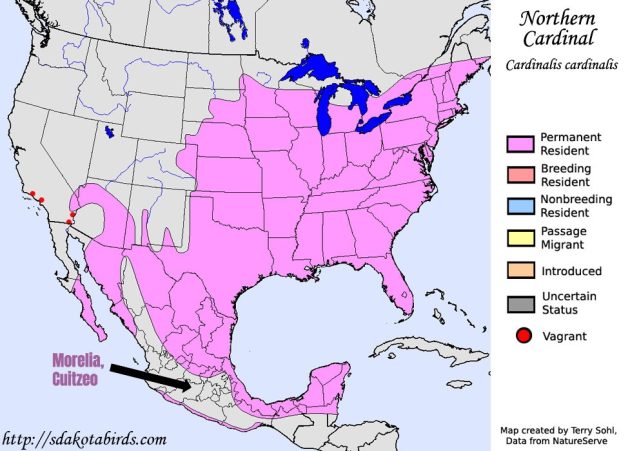
The Northern Cardinal is a beautiful and emblematic bird of North America. It is so emblematic that seven of the United States have named it their official state bird. It even has a passenger train route and an NFL team named after it! But the Northern Cardinal is also found throughout much of Mexico, especially in the north and along the Gulf (of Mexico, of course!) coast. There are also isolated populations in southern Baja California and along the southwestern Pacific coast, each with their own subspecies.
One place where it is not supposed to occur, however, is in Morelia, Mexico, and the surrounding region. Most range maps show a great band without Northern Cardinals between the Gulf coast Cardinals, which are part of the greater North American population, and the isolated Pacific “long-crested” population. In fact, according to these maps, I would have to drive three hours to see a Cardinal from the former group, and four hours to see one from the latter group.
And yet… In 2016, when I had only been birding (in Mexico) for three years, I saw a Northern Cardinal less than a kilometer from the church we pastored in Morelia. Admittedly, it may have been an escaped caged bird, since its idea of fleeing my observation was to slip under a garage door, into the garage. (Wild-caught colorful birds were once often illegally sold in Mexico. Now, that has fortunately become very rare.) Then, only seven months later, I discovered another Cardinal thirty minutes north of Morelia, at the archaeological site of Tres Cerritos. And while I have had only one more Cardinal sighting near our church in the following years, I have had a total of 15 sightings over ten years at Tres Cerritos.
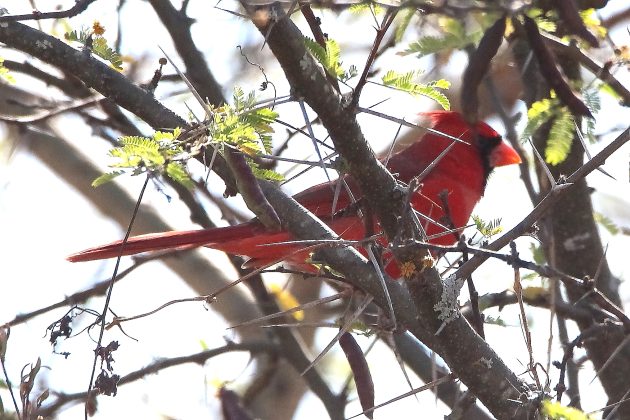
This was the second and most recent Cardinal which I have seen near our church, from 2021. It acted like a completely wild bird.
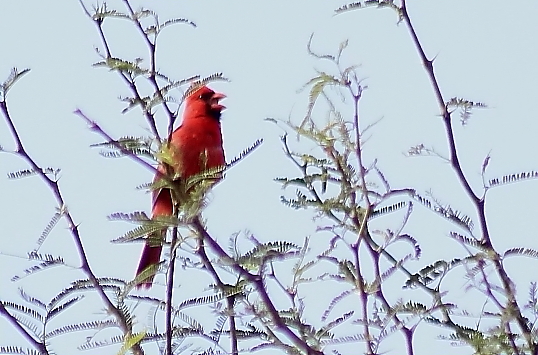
And this was my first of many Cardinal photos from Tres Cerritos, taken in 2016.
My question has always been as to which kind of Northern Cardinals I/we have been seeing at Tres Cerritos. For years, I assumed that they were winter migrants that went further south than ornithologists knew. After a bit of study and review of my own records, however, I can see two major problems with that theory. First, Northern Cardinals are not known to be migratory birds. I should have figured that out when I saw some in Ohio in the depth of winter, their spectacular color popping against a background of snow. And second, a full one third of my sightings occurred between May and August. I confess, sometimes I miss the most interesting information because I cling to what fits my pre-conceived notions.
But now that I have abandoned my “logic”, I am left with a mystery: Do the Tres Cerritos Cardinals (and the two seen in Morelia, and one seen east of Morelia) belong to the larger group which occurs continuously from north-central Mexico up to Canada? Or are they of the “long-crested” coastal variety?
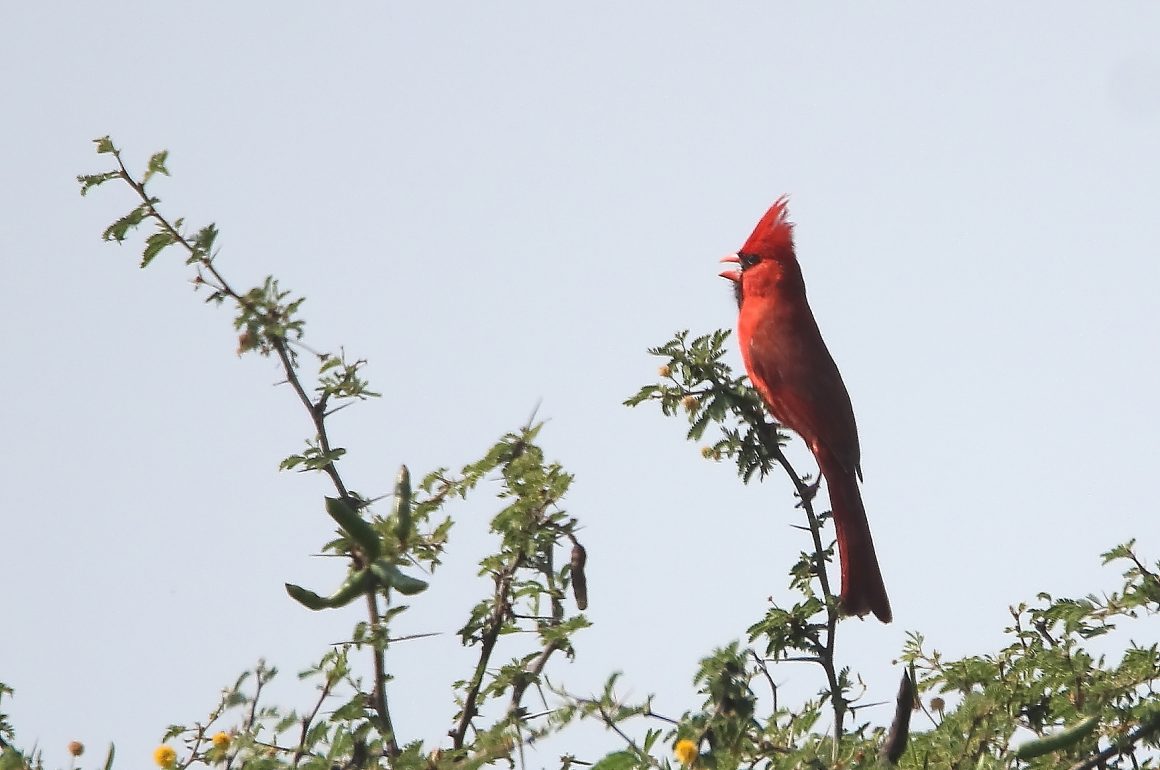
On May 25th of this year, I went with my ornithologist friend Jonathan Vargas to Tres Cerritos. We went hoping to see a Hudsonian Godwit there, since that is another species that I have seen very unexpectedly along the shores of Lake Cuitzeo. But while we did not manage to see a Godwit, we did have a wonderful encounter with a brilliant male Northern Cardinal. And I must say, this Cardinal had a very long crest:
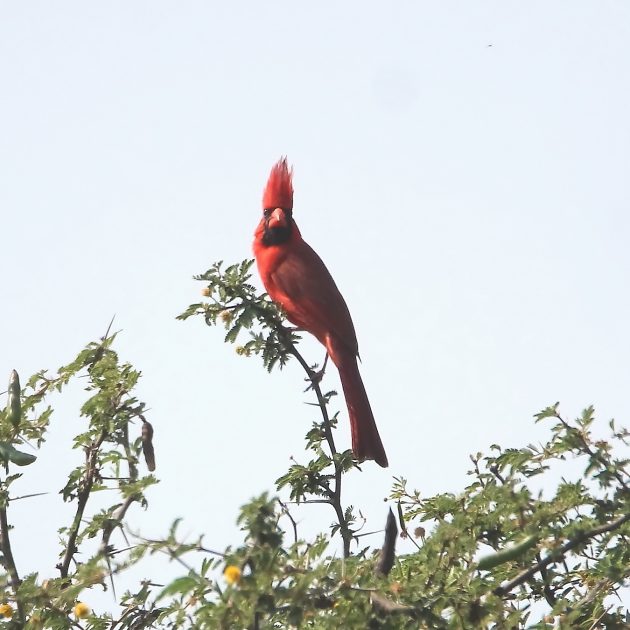
Not only that, the season happened to be right for this male to be singing… a lot! We were able to listen to it and record it for a considerable amount of time. And the verdict is in. In spite of Tres Cerritos being somewhat closer to the northern Northern Cardinal population, and in a habitat much more like the northern semidesert habitat where those subspecies occur, the Cardinals of Tres Cerritos are decidedly “long-crested”. There, surrounded by dry mesquite forest, you can find the same subspecies as along the tropical Pacific coast of Michoacán. (It’s good to have an ornithologist with you when you make this kind of decisions.)
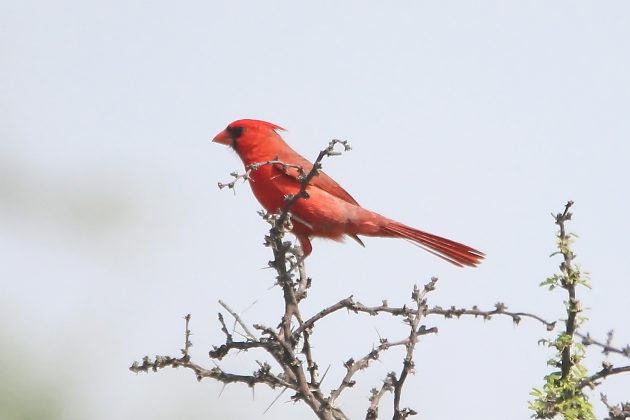
The very same bird did not, however, always keep his long crest erect.
That’s one less mystery for me to ponder at night.
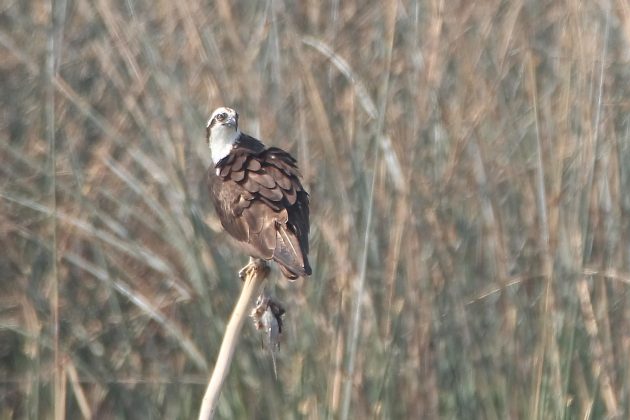
Now I can start pondering why it took me until this 2026 trip to see my first Osprey by Lake Cuitzeo, even though they are commonly seen in winter at the smaller nearby Lakes Queréndaro and Pátzcuaro. It was also a very late sighting, at the very end of this species’ northward migration period.
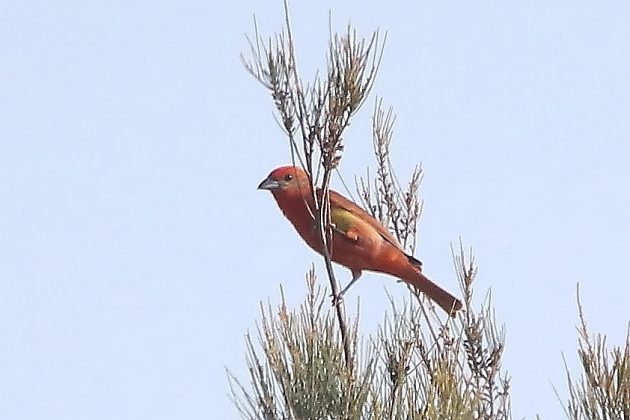
Or I can ponder why a Hepatic Tanager, which is a flagship bird for Michoacán’s pine-oak forest, would be found among the thorny mesquite trees of the Lake Cuitzeo shore. This one looked like a barely mature male, so perhaps he wanted to see the world before settling down.
When you bird in central Mexico, there are always new mysteries to solve.











Excellent post.
Fascinating, I always enjoy your posts.
We think we know common birds, but they always surprise us with new knowledge of them or interesting behaviours. Thanks for sharing this post.