

By Rebekah Doyle
Rebekah is a school-based physical therapist in Tucson who enjoys exploring by foot, pedal, and paddle. She is a contributor to Arizona Spotlight on Arizona Public Media. More of her writing can be found at rebekahdoyle.com
Birding was the last thing on our minds on a beautiful mid-October morning when my husband, Brad, and I first went mountain biking at Grindstone Lake near Ruidoso, New Mexico. We commented briefly about the commotion of coots in a cove below—but that was all. We were in South Central New Mexico to bike and enjoy the cool fall weather after a long Sonoran Desert summer in Tucson, Arizona. New to the trail system and rather rusty riding rocks, I was especially focused on remaining on my bike and took in the scenery less than usual.
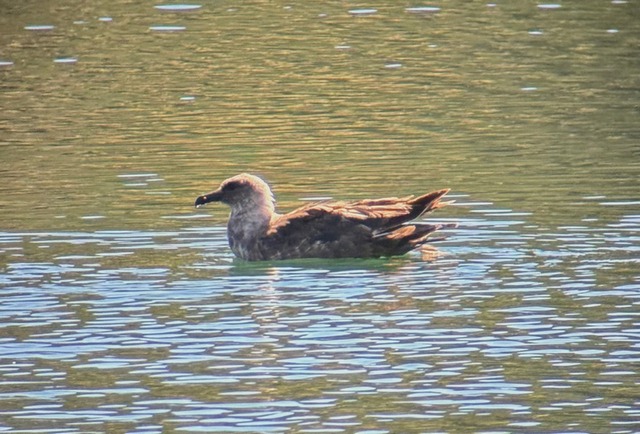
After the ride we headed to a camp on a rolling juniper mesa near Lincoln, an area known for Billy the Kid and, according to our riding app, mountain biking. The next day I wished I was on a horse and not my bike after rattling down horseshoe-pitted trails and fording the cold Rio Bonito. I did not think about Grindstone Lake until later that evening at camp, when Brad, idly checking eBird observations nearby, exclaimed, “You’ve got to be kidding me—there’s a South Polar Skua at Grindstone Lake!” I toggled back through mental snapshots from the Grindstone trails. Is it possible there among the mallards and coots was a skua? Is it possible I saw a skua—a SKUA!—lounging on the lake and dismissed it as a gull?! It was all rather distressing how completely I had tuned out nature while riding. Even more distressing, the skua had not been listed on eBird for the past several days. Had it finally departed for distant Antarctica? Rather than berating ourselves further, we resolved to return to Grindstone Lake the next morning.
It was another beautiful day at the lake, the autumn air cool, the water calm, the mountain sun strong. The ponderosa pines and Gambel oaks covering the hillsides and the vacation homes along the ridges seemed a world away from the volcanic slopes of Cape Crozier, Antarctica, where the skua breeds during the austral summer. The picnickers, dog walkers, and children playing in the sand seemed more than a world away from a skua’s life on the open sea, snatching fish from ocean swells (or stealing them from unsuspecting shearwaters and terns). Even more than most skuas, South Polar Skuas traverse vast stretches of ocean, ranging as far north as the North Atlantic and the Bering Sea during the boreal summer.
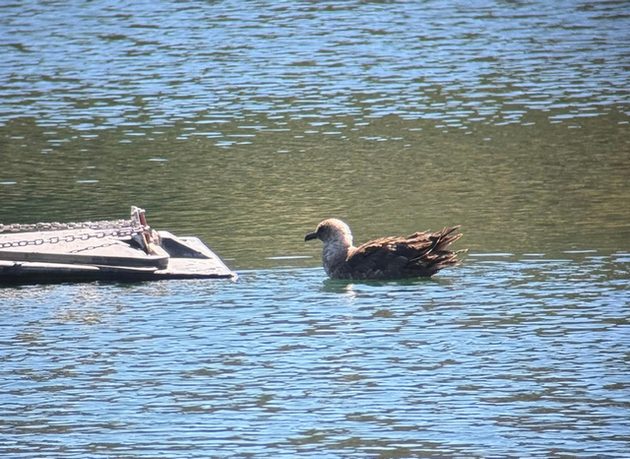
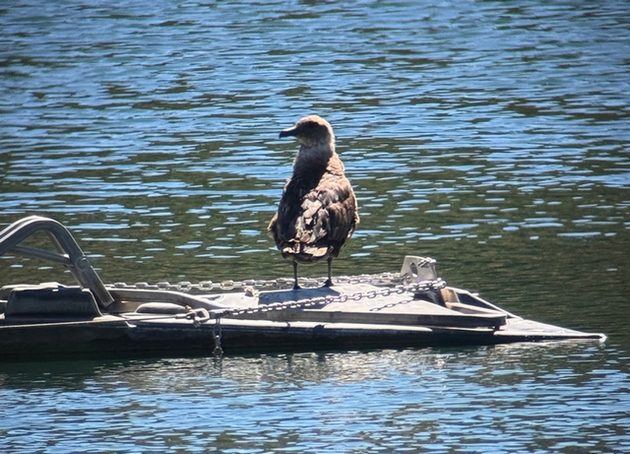
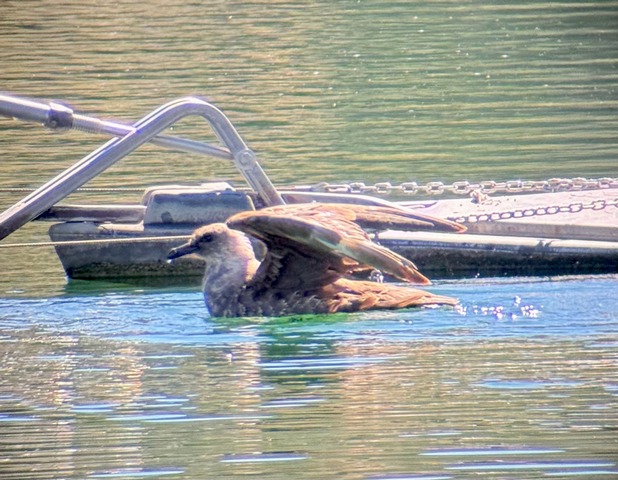
I approached the lake with binoculars in hand, mentally preparing myself for mallards. But there it was, a South Polar Skua, swimming steadily across the middle. After standing briefly on one of a cluster of small floating platforms that house solar panels near the dam, the skua abruptly rose into the air, its dark brown wings flashing a distinctive white band at the base of the primaries. Is it finally leaving, I wondered? But after a brief flight around the lake, perhaps testing its wings, the skua returned. Cape Crozier, apparently, was not top of mind this morning. Back in the water, the skua bathed vigorously with a rocking motion evocative of a 90’s dance move. After dousing its back and wings thoroughly, the skua hopped onto the platform to shake itself dry and bask in the sun. An angler asked what I was looking for and I told him about the skua. He glanced towards the bird and returned to fishing, but not before asking if I had seen any eagles lately.
The skua’s arrival on August 16, 2026, was a first state record and South Polar Skua is now an accidental species on the New Mexico bird list. Other inland sightings of the species are also exceedingly rare and include a one-day appearance in North Dakota in 1989 and another in Oklahoma for nearly a week in 2013. It is hard to imagine what perfect storm of weather, internal navigational glitches, and plain bad luck brought this particular bird to this particular lake. As in any mystery in which a stranger comes to town, equally mysterious is why they stay. By the time I saw the skua it had spent two months at Grindstone Lake. Was it recovering from the journey? An accident or illness perhaps? Is it unsure where to go? Or has the skua found Grindstone to be familiar enough to merit an extended stay after a long, unintended detour?
Grindstone Lake is stocked with trout. The anglers, young and old, stake their territories along the shoreline like Adélie penguins on the ice-free slopes of Cape Crozier at the edge of the Ross Ice Shelf. Does the platform near the dam evoke standing on floating sea ice? Is Grindstone Lake a gilded cage? Or is the skua resting just long enough to recover its strength before continuing south? Will it decide to over-winter? South Polar Skuas can live for several decades, some even longer. Grindstone Lake never freezes completely and the trout are active year-round—and tasty.
A while later, as Brad took photos through the scope and we watched the skua floating beside the solar platform, another angler nearby mentioned that his Biology class at the local community college spent a couple of hours observing and talking about the bird back in August when it first came to town. I mentioned I saw some online posts by birders who had made 500 or 1,000-mile trips to the lake. The undergrad commented that he had not seen many birders crowding the shoreline.
When it was time to leave, I took a last look knowing I would probably never see a South Polar Skua again. Of course, all birds deserve our attention. Yet everything about this experience of accidentally encountering an accidental felt special. Birds connect us to geography, to others, and even other parts of ourselves. Maybe I have read too many tales of Polar exploration. Passages about fierce gales and impossible seas. Cherry-Garrard’s winter journey to Cape Crozier. I admire the skua for the life it has lived, for somehow making it to Ruidoso, and wish it well wherever it may go. Luckily, in this digital age, there’s a chance we may be able to follow it further after it leaves. A skua touching down at a lake in Arizona or Texas is unlikely to go unnoticed. But the more probable sequel to this very chance encounter is also the one that appeals to me most: that I will never know what happens next. The mystery visitor may well remain a mystery.









Leave a Comment