

Once, when working for several weeks on a particularly boring consulting project, I tried to learn to use the computer mouse exclusively with my left hand. Alas, this turned out to be much more difficult than preparing the content for my required quota of PowerPoint slides. And of course, on the football field, I am even more hopeless with my left foot than with my right one. But how about birds?
One might think that the equivalent of handedness in birds would be a preference for one wing over the other. However, research has found very little preference for one wing over the other. The preferred explanation is that flight requires highly symmetrical movements, which does not favor a preferred wing (a bit like “one hand clapping”, I guess).
It is quite different for feet, at least in several parrot species. Many of them consistently favor one foot for holding food – and in contrast to humans (of which 90% are right-handed), some species show a strong preference for their left foot on the population level (source). Apparently, like humans, birds have two brain hemispheres with different specializations (source). As each hemisphere controls primarily the opposite side of the body, this results in a preference for one foot over the other.
Among Australian parrots, larger species show much stronger foot preferences than smaller ones. One proposed explanation is that large parrots gain more from using one foot consistently while extracting seeds from pods with coordinated foot-and-beak movements, whereas smaller species feeding on tiny seeds or blossoms have less need for such specialized manipulation.
Bonus information for those readers who like (indoor) cats as well: They show paw preferences as well, with females favouring the right and males the left (source).
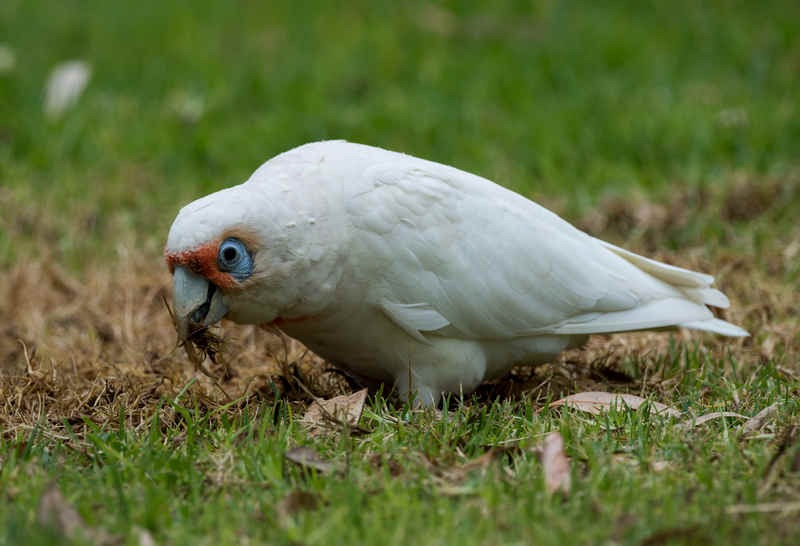
Photo: Long-billed Corella, Melbourne area, Australia, Dec 2016








Leave a Comment