

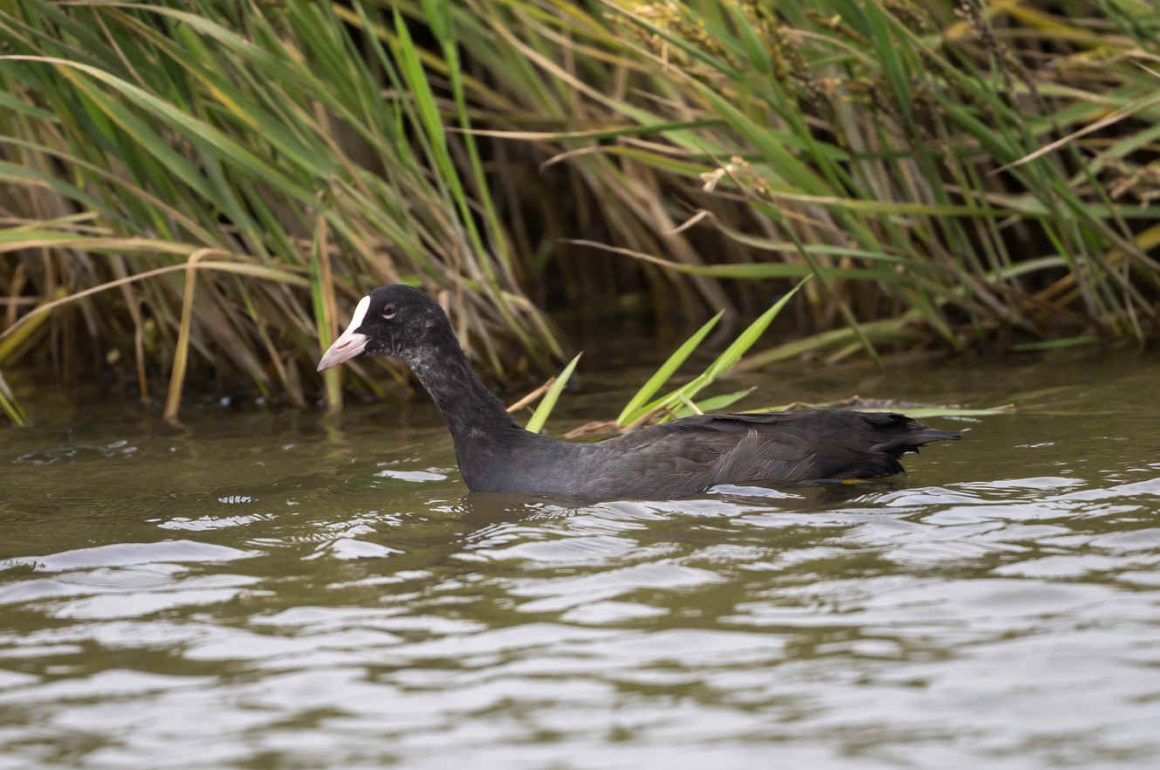
Admittedly, I would be rather surprised if anybody ever asked me that question. Imagine doing some birdwatching, perhaps in a city park next to a lake, and somebody walking up to you and asking you about the above.
Nevertheless, I think it is always good to be prepared for as many eventualities as possible. So here is the answer, based on a recent paper.
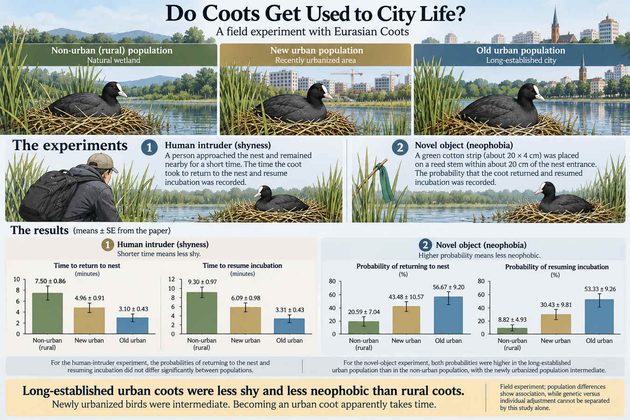
The researchers looked at Eurasian Coots in three different environments: rural, established urban, and newly urban. They then tested the coots’ reactions to two things: a human intruder appearing at the nest and a novel object being placed there. The first was intended to measure shyness; the second, neophobia (the birds’ reluctance to approach something unfamiliar).
The results were clear. Coots from the long-established urban population were quicker to return to their nests after a human intruder appeared and more likely to return when confronted with a novel object. The recently urbanized birds were somewhere between the established urban and rural populations.
Are these behavioural differences the result of individual birds adjusting to their surroundings, or do urban populations gradually evolve different behaviour?
The distinction is important. A bird that moves into a city might simply learn that humans are generally harmless and adjust its behaviour accordingly. But if birds that have lived in cities for many generations become genetically less wary of humans and unfamiliar objects, then urbanization could actually be changing the behavioural characteristics of the population.
While the study cannot distinguish between these two possibilities, it does show that the long-established urban coots behaved differently from the rural and recently urbanized birds. Becoming an urban coot apparently takes time.














Leave a Comment