

By Faisal Rehman
Faisal is the founder of BirdFeedly (birdfeedly.com), where he has published 48 in-depth articles on backyard bird feeding. His writing blends practical feeding advice with ornithology research, written from his home in Pakistan — where summers reach 45°C and the birds still come to drink.
Almost everything written about feeding backyard birds is about winter. Keep the feeders full through the snow. Offer suet when it’s freezing. Break the ice on the birdbath. Winter gets all the poetry.
But I live in Pakistan, where summer arrives like a furnace door opening. In June, the thermometer in my town pushes past 45°C (113°F), and parts of the country have touched 50. And I have learned something the winter-feeding guides never mention: extreme heat is just as dangerous to backyard birds as extreme cold — and almost nobody talks about how to help. Consider this a letter from the hot side of bird feeding.
First, understand what heat does to a bird
Birds are tougher than they look, but heat pushes them frighteningly close to their limits. A bird’s normal body temperature already runs around 40–42°C — hotter than ours. As ornithologists point out, the proteins that keep a bird’s organs working begin to break down at temperatures only slightly higher than that. There is not much margin.
Unlike us, birds cannot sweat. They have no sweat glands at all. Instead, they cool themselves by evaporating water — through panting, and through something called gular flutter, a rapid vibration of the throat tissues that works like an avian version of panting. A House Sparrow’s breathing rate can jump from about 57 breaths per minute at 30°C to 160 per minute at 43°C. Doves have been measured fluttering their throats more than 680 times per minute.
Here is the cruel tradeoff: every cooling breath costs water. Research on small desert birds found that near 50°C, a tiny bird can lose roughly 7% of its body mass per hour through evaporative cooling alone. That is why heat and dehydration arrive together — and why everything in summer bird care starts with one thing.
Water is everything — ten times more important than food
In winter, food is the gift. In extreme summer, water is. A bird can survive days of thin pickings at the feeder, but in 45°C heat, a few hours without water can be fatal. The researcher Blair Wolf, who has studied birds in extreme heat for over two decades, puts it plainly: water and shade are the two most important things any person can provide.
So I run my summers around water, not seed. Here is what works:
- Go shallow and wide. A dish an inch or two deep is ideal — deep enough to drink and splash, shallow enough that small birds feel safe. I set out several wide clay saucers rather than one deep bowl. Clay stays cooler than metal or dark plastic, which can turn bathwater scalding in direct sun.
- Multiply the stations. One water dish in extreme heat is a single point of failure — it evaporates, gets fouled, or gets monopolized by the boldest birds. Three or four small dishes in different spots serve far more birds than one big birdbath.
- Use the ice cube trick. On the worst afternoons, I drop a few ice cubes into the dishes around midday. It is a small thing, but it buys an hour or two of cool water when birds need it most. Audubon’s own guidance mentions this trick — if the water warms too fast, ice is a perfectly good answer.
- Shade the water, always. A dish in full sun can heat past 40°C within an hour and becomes useless. Tuck every dish under a bush, a wall overhang, or a tree.
- Change it daily. Heat turns a birdbath into a soup of algae and bacteria shockingly fast. Dump, scrub, and refill every day in a heatwave. A neglected dish is worse than no dish at all.
Rethink the menu completely
Here is a mistake I made for years: I kept filling the feeders exactly as I did in the milder months. In extreme heat, that is wrong twice over.
First, some foods become hazards. Suet — the winter hero — melts into a greasy mess above 35°C or so, coating feathers and going rancid. Hummingbird-style nectar (if you offer it) ferments within hours in high heat; fermented nectar can harbor molds that harm birds. I simply stop offering both once the real heat arrives.
Second, dry seed works against the birds. This surprised me when I first read it, but it makes sense: digesting dry seed actually draws moisture out of a bird’s body. In extreme heat, when every drop of water counts, a belly full of dry millet is a liability. Moisture-rich foods are the summer answer — overripe fruit, soaked raisins, chopped grapes, a few mealworms. In my yard, the sparrows and bulbuls go straight for fruit on hot afternoons and ignore the seed tray entirely. The birds know.
I still offer some seed — birds with nestlings need the protein — but less of it, refreshed often. Heat and humidity turn a feeder into a mold factory within days.
Feed at dawn, then let the feeders rest
In winter I keep feeders stocked all day. In summer I run a different rhythm: fill at first light, and let the feeders empty — or even bring the most perishable offerings in — by late morning.
There are two reasons. The practical one is spoilage: seed, fruit, and anything moist turns in the midday furnace. The kinder reason is the birds themselves.
By late morning in a Pakistani June, the yard goes quiet — the sparrows vanish, the doves melt into the shade. For a long time this silence worried me. Then I learned they were doing exactly what ornithology textbooks describe: resting through the hottest part of the day. No foraging flights, no wasted energy, just stillness in the deepest shade available. It is the avian siesta, and it is completely normal. The yard comes alive again toward evening. If your feeders go silent at noon in a heatwave, don’t panic — the birds are waiting it out, exactly as they should.
I feed the morning shift and the evening shift, and I don’t fret about the quiet middle. Working with the birds’ rhythm beats fighting it.
Shade is the other half of survival
If water is the first gift, shade is the second. Temperatures under a dense bush or tree can be dramatically cooler than in the open — these little microclimates are where birds spend the furnace hours.
A few things I have learned about shade:
- Position feeders and water under cover from the start. Don’t make birds cross open, baking ground to reach food or drink. A feeder hanging at the edge of a tree canopy, with branches overhead and open sightlines around, is ideal — shade plus safety.
- Don’t trim trees in summer. I know the urge to tidy up, but every branch you cut is shade destroyed at the moment birds need it most. Audubon makes the same point: holding off on pruning also protects nestlings that haven’t fledged yet. Let the garden go a little wild until autumn.
- Create shade where none exists. No big trees? A simple shade cloth, an old bedsheet strung between poles, even a large umbrella staked over the feeding station — all of it helps. It doesn’t need to be beautiful. It needs to be shady.
Learn the signs of heat stress
- Most of the time, birds manage heat on their own. But in truly extreme conditions, it helps to recognize when a bird is in trouble:
- Panting with the beak held open — the first and most common sign. Some beak-open breathing on a hot day is normal cooling behavior; constant, labored panting is a warning.
- Wings held drooped away from the body — the bird is trying to dump heat from the less-feathered skin under the wings.
- Lethargy or unresponsiveness — a bird sitting fluffed and still in the open, not reacting as it normally would.
- If you see a bird in real distress, the help is simple: water and shade, nearby and accessible. A shallow dish of cool water placed a few feet away — not right on top of the bird — gives it the choice to drink without feeling cornered. Never chase, catch, or douse a wild bird; the stress of handling can finish what the heat started. In the vast majority of cases, accessible water and a shady refuge are all they need to recover.
The summer deserves its own respect
- I used to think of summer as the off-season for bird feeding — the feeders half-empty, the yard quiet, nothing much to do until the pleasant months returned. I was wrong. Summer is when birds need us most urgently and most specifically. A dish of water in 45°C heat is not a nicety. For the panting sparrow on the wall, it might be the difference between surviving the afternoon and not.
- Winter bird feeding has its rituals, and I love them. But there is something deeply moving about the summer version too: the quiet yard at noon, the rush at the water dish when the evening cools, the small daily discipline of fresh water in a merciless season.
- If you feed birds, don’t pack it in when the heat comes. Just change the game. Water first, shade second, food rethought — and trust the siesta. The birds will thank you the only way they can: by coming back, morning after morning, to the coolest corner of your yard.
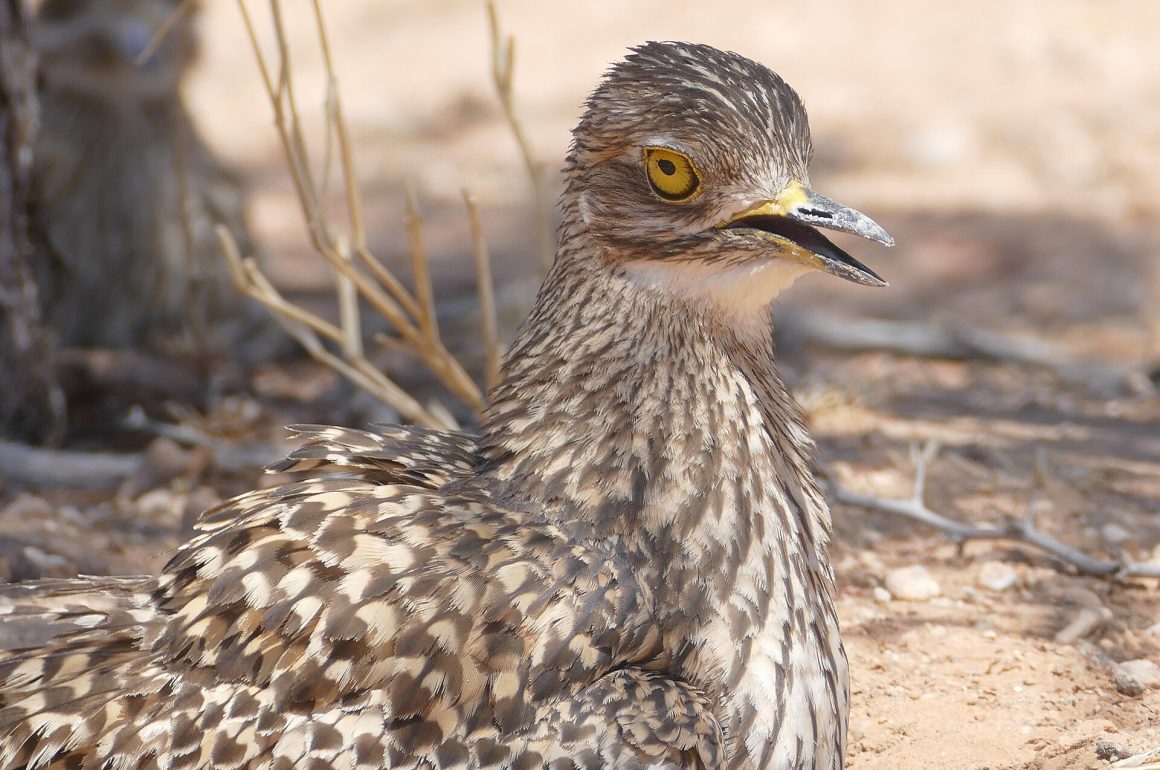
Cover: Spotted Thick-knee in the arid Kgalagadi (Kalahari)
Credit: Bernard Dupont, CC BY-SA 2.0











Leave a Comment