

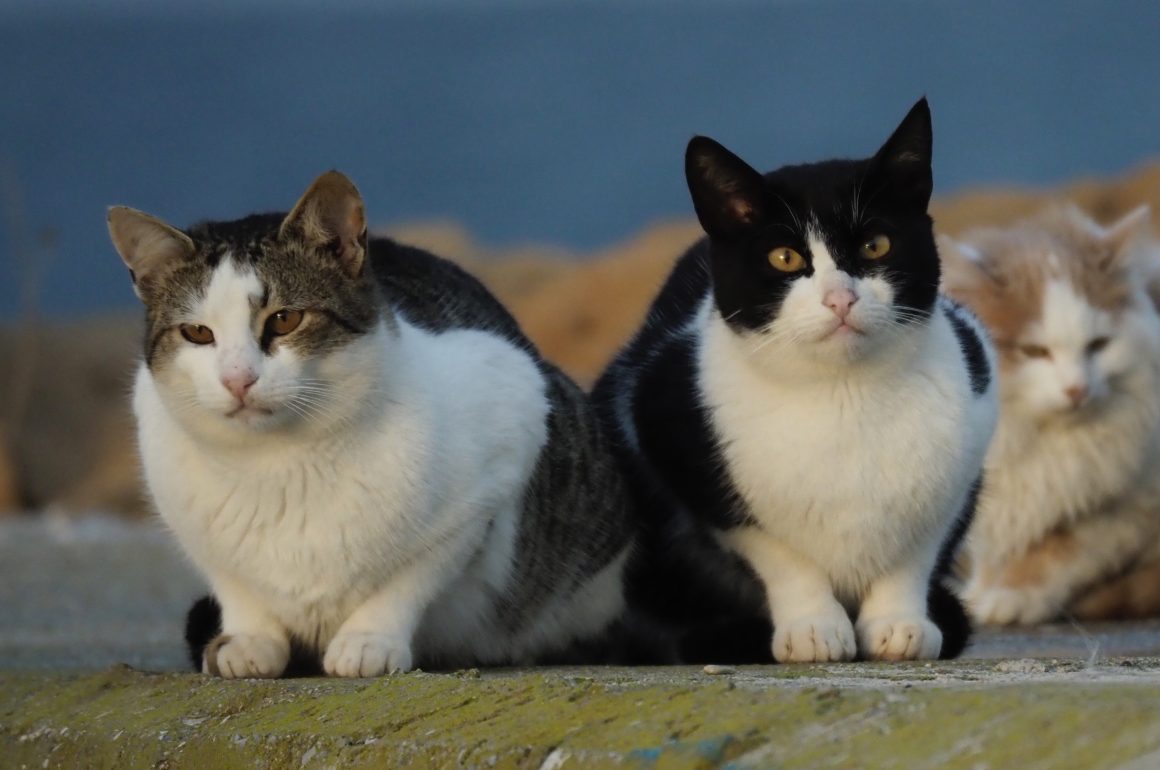
If you want to provoke an argument among birders, simply mention the word cat. One of my regular birding companions is a cat lover who dislikes dogs. In contrast, I have always had dogs, and do not share his enthusiasm for felines. We agree on most things, but we never discuss cats.
Some years ago I wrote the following article for the newsletter of my local wildlife group. The group was affiliated to the county’s wildlife trust. My article proved highly controversial, leading to cat lovers resigning from the trust. As a result the latter stopped the group publishing any more newsletters. Re-reading it after a gap of several years, I still feel that is an honest, factual article. Please feel free to disagree in the comments.
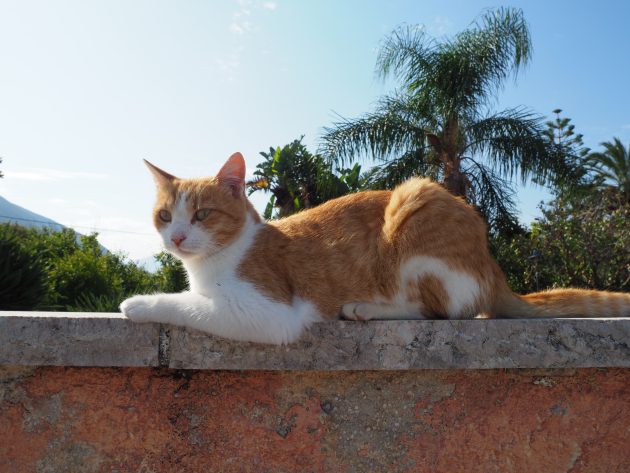
Feline friends or foes?
I may be principally a birdwatcher, but over the years I’ve had some memorable feline encounters. It all started with an Iberian Lynx in Spain over 50 years ago, and since then I have been lucky enough to have seen Wild Cats in Greece, Bobcat in Texas, Jaguar in Belize, plus Lions, Cheetahs and Leopards in a variety of African countries, from Uganda to Namibia. My unexpected sighting of a Tiger in Satpura, Madhya Pradesh, was one of my most exciting wildlife encounters.
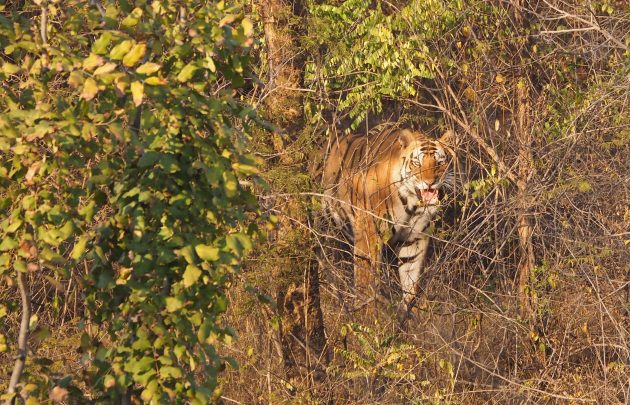
This Tiger in Satpura, central India, was one of my most memorable wildlife encounters
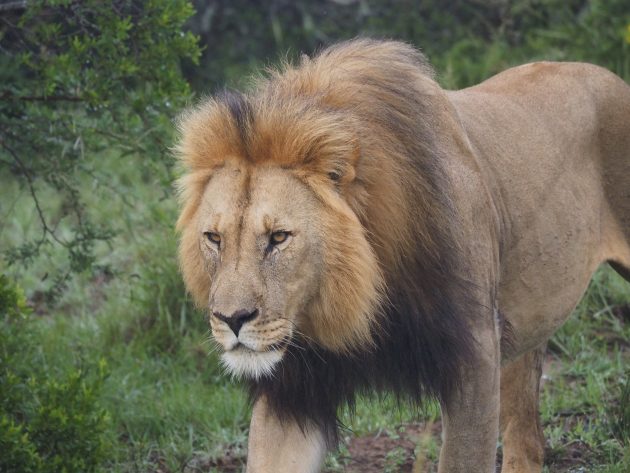
I have seen Lions many times in several African countries. This one was in South Africa
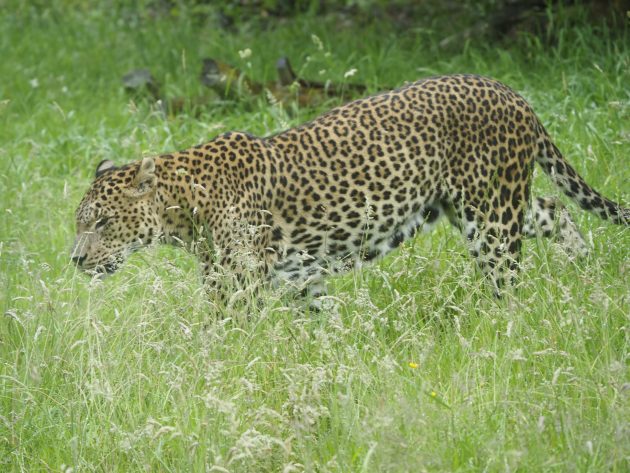
As they are chiefly nocturnal, it’s always exciting to see a Leopard
However, despite all this, I’m not a cat lover, a confession that won’t endear me to many readers of this piece. Yes, I admire the wonderful slinky grace of the domestic cat, and I have many friends who keep them as pets, but they are not animals that I have ever liked. My first memory of a cat was a huge black and white tom that belonged to our next-door neighbours. Called George, it was an arrogant beast that I was afraid of (I wasn’t very big then); it was a proficient killer of birds in our garden. I remember watching it climbing a tree trying to catch a roosting Tawny Owl, but I’m pleased to say that it failed.
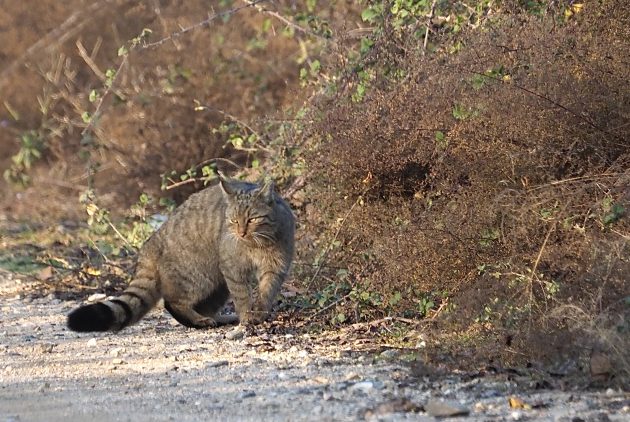
Wild Cat, photographed in northern Greece. Note the distinctive bushy tail
Current estimates suggest that there are around 10 million domestic cats in the UK, while research undertaken by the BTO has found that as many as 180 million small birds and mammals a year are taken by these predators. Whatever way you look at it, that’s an awful lot of wildlife. True, most of the creatures taken are common species such as Blackbirds, Robins and Woodmice, but cats certainly catch more than their fair share of rarer birds, too, from Wrynecks to Corncrakes. Every year cats kill Corncrakes summering in the Western Isles of Scotland. They are apparently attracted by the male Corncrake’s rasping calls.
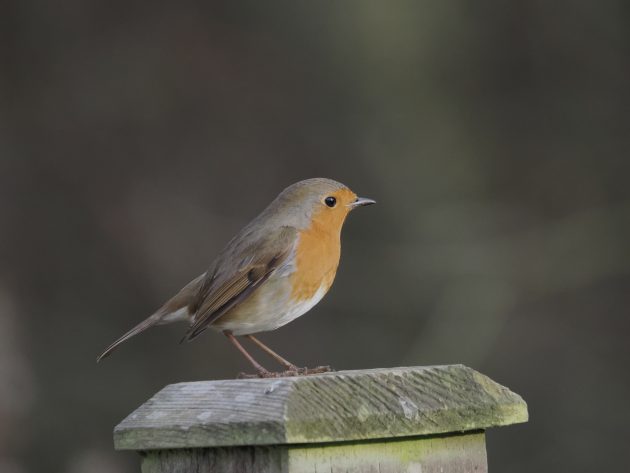
Robin, a frequent victim of the domestic cat in the UK
At least cats have never been implicated with any avian extinctions in the UK. The general reckoning is that domestic cats have exterminated 63 species worldwide, including 40 birds. One of the classic cases of cat extermination was that of the flightless Stephens Island wren. Restricted to a small island in New Zealand’s Cook Strait, the wren was wiped out by the lighthouse keeper’s cat.
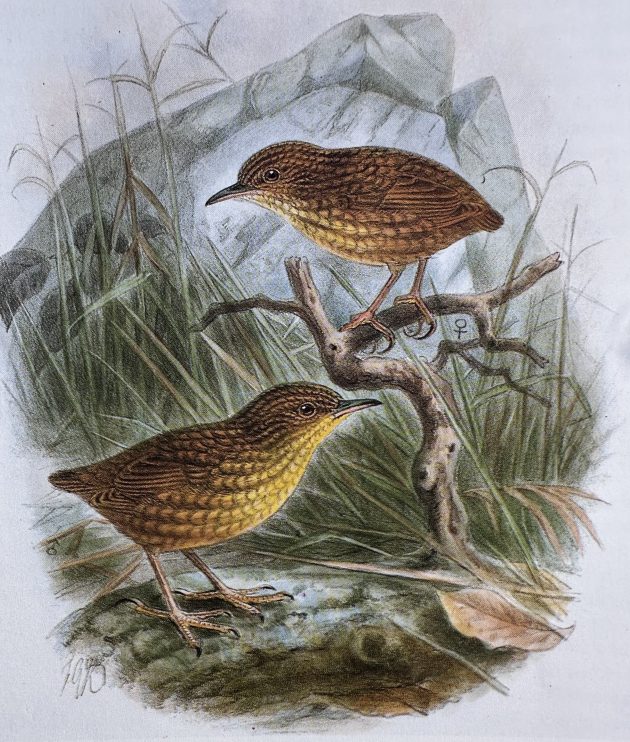
The Stephen Island Wren was wiped out by the lighthouse keeper’s cat in 1894. This is a hand-coloured lithograph by J.G.Kuelemans
The RSPB, mindful of the fact that many of its supporters have pet cats and that it would be financially unwise to upset them, does its best to avoid the issue. According to its website, “Despite the large numbers of birds killed, there is no scientific evidence that predation by cats in gardens is having any impact on bird populations UK-wide. This may be surprising, but many millions of birds die naturally every year, mainly through starvation, disease or other forms of predation. There is evidence that cats tend to take weak or sickly birds.”
It goes on to say “It is likely that most of the birds killed by cats would have died anyway from other causes before the next breeding season, so cats are unlikely to have a major impact on populations. If their predation was additional to these other causes of mortality, this might have a serious impact on bird populations.” If that’s not a political whitewash I don’t know what is. According to the BTO, which doesn’t appear to be afraid of offending its cat-owning members, “the impact of cats could be even greater than just what they are killing; research also shows that cats are scaring birds, reducing their populations indirectly by reducing their breeding success.”
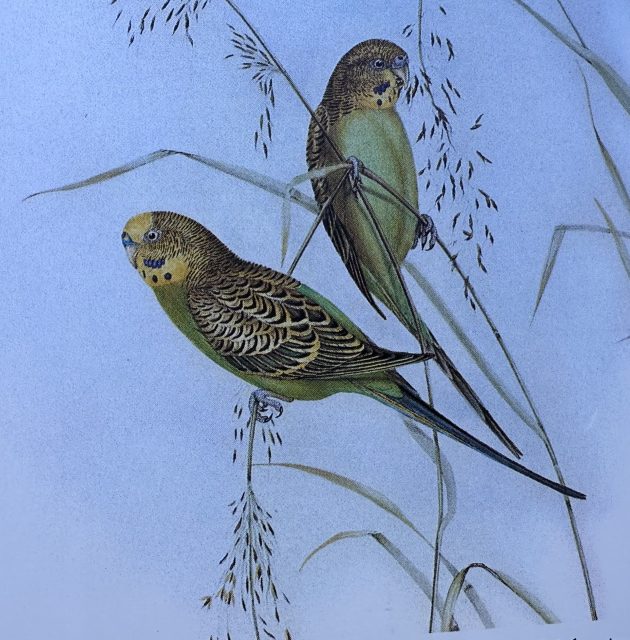
Budgerigars, a 19th-century lithograph by Elizabeth Gould. It has been estimated that feral cats in Australia kill around 316 million birds a year
A study of the impact of cats on Australian birds, published in the journal Biological Conservation, estimated that feral cats kill 316 million birds a year in Australia, while pet cats kill 61 million birds annually. More than 99% of these birds are Australian natives. “Everyone knows that cats kill birds, but this study shows that, at a national level, the amount of predation is staggering, and is likely to be driving the ongoing decline of many species,” said the lead researcher, Prof John Woinarski of Charles Darwin University. Worryingly, feral cats now can now be found over 99.8% of Australia.
Feral cats, once established, are extraordinarily difficult to eradicate, though there have been a number of success stories, such as Baltra Island in the Galapagos, where the aim was to help the land iguanas, not the birds. Cat eradication is often controversial, as the usual methods of removal are poisoning, gassing, trapping and shooting: all are lethal for the cats concerned. The technique called Trap-Neuter-Return, the method preferred by cat lovers, has never proved effective.
Here in the UK there’s unlikely to be any reduction in the cat population in the foreseeable future. If you suffer from cats raiding your garden, then you should position feeding stations in the open, well away from cover that might hide an ambushing feline. Raised feeding platforms off the ground are also a good idea. Planting dense thorny shrubs such as Pyracantha is also recommended. I have a friend who swears by a powerful water pistol as a deterrent.
If you own a cat (and there’s a 50% chance that you do), then you should consider fitting it with a bell. A New Zealand study found that belled collars reduced rates of predation by 50% for birds and 61% for small mammals. Keeping cats in overnight is also recommended, as birds are apparently particularly vulnerable around dawn when they start feeding. For more than 40 years I’ve kept spaniels, and can highly recommend them as most effective cat deterrents.
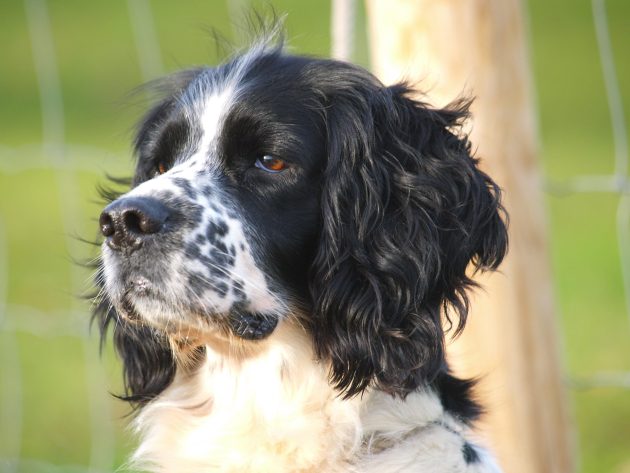
The ultimate cat deterrent?











Leave a Comment