

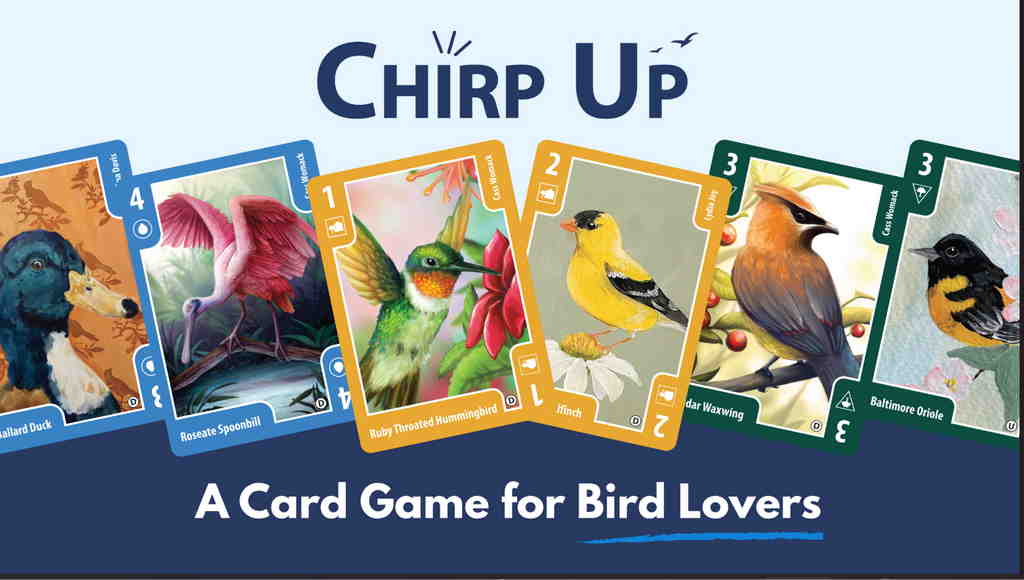
An Interview with William Jemas, one of the creators of ChirpUp
How did the idea for Chirp Up come about? What inspired you to combine birds and card games?
The idea of Chirping Up, no doubt, came about when the earliest birds started chirping important information to the flock.
The idea of publishing card games to communicate pro-bird and pro-eco information came about when my friends and I, mostly from Marvel and the NBA, started migrating our media and merchandising skills to promote positive changes. Anyone can play the online version of the game for free at chirpupgame.com, and while they play, they can’t help but see ways to help save billions of birds. And we’re donating 10% of every print run, for our inaugural edition, that’s 2,000 decks of cards (aka, “Starter Decks”), to pro-bird organizations to give or sell to their members and supporters, no strings attached.
Who are the people behind Chirp Up and what are your individual backgrounds?
Frank Fochetta and I ran NBA Photos, and along with digital database expert Chelsie Alvin we compiled a free-online avian art and photo gallery. Angelina Davis, Cass Womack, Denise Adams, Jody Powers, Julie Kitzes, Kathleen Telesco, Kelly Ryan, Lydia Joy, Matt Star, Stacey Lokey and Tiffany Michael contributed art for all 144 cards for the two Starter Decks in our Inaugural Edition, titled Diversity and Unity.
Jeff Simons, Kathy Probe, and I designed and marketed Marvel’s mighty popular Overpower game. With help from Cass, Kelly, Matt and Stacy, Tom Marvelli (another Marvel alum), and Andrew Fishberg (our MIT PhD), we designed the Chirp Up game, and Erich (Woody) Wood, founder of digital card platforms Quid and Tibles, programmed the online version of the game. Now, Josef Katz (Kaplan Test Prep), Julia Tomesello (FIT Senior), Lisa Dolen (Penguin/Random House), and Meghan Partridge (Tibles too) are all working on sales and marketing.
How did you decide on gameplay mechanics and what were the challenges?
The challenge is pursuing and balancing so many aspirations.
First, it must be easy to learn, because we want millions of people to play, and challenging, because great games get you thinking. But games like Go Fish and Chutes & Ladders that are easy to learn are not very challenging, while games like Magic: The Gathering and Wingspan are challenging but very hard to learn.
It should be beautiful to behold, because birds are beautiful, and immersive, like popular role-playing games. But games like Chess and Go have simple rules but are not very pretty and don’t support role-playing.
Meaningful, because we started Chirp Up to do some good, and profitable, because money comes in handy when you are trying to do some good. But it isn’t easy to make a game that’s a play product that makes you learn important facts.
Anyway, our guiding principles turned out to be simple: you just fill natural habitats with native species; challenging: you must fight perils that kill billions of birds; beautiful, featuring amazing avian art; and fun, of course. So, Chirp Up is simple, challenging, beautiful and fun, just like birding.
What threats to bird populations and to the environment do you want to highlight?
Some of the causes of the horrible losses of bird populations, like outdoor cats and brightly lit picture windows, are specific to birds and needlessly result in the death of billions of birds. Others are the same causes of the increasingly horrible losses of human populations: pesticides, herbicides, plastics and other toxins in our air, water, and food, along with deforestation, desertification, and climate catastrophes. IMO, these are all symptoms of the same sickness: collectively, people don’t know and care enough because our deranged modern media fills our bubbles with fear, fluff, and nonsense. So, we’re publishing games designed to inject important information into our bubbles as we play.
Who do you see as the main audience?
Audience targeting is the flip side of game design. For this game to matter, to make meaningful change, we need millions of players, and we need to make and deploy millions of dollars. For that, we need to reach multiple targets, and that means risking diluting and dispersing our marketing so much that we miss all of them.
With fingers crossed, here’s the plan. We have a wide-open funnel; in addition to the 2,000 free Starter Decks for pro-bird organizations, we’re making the online version free for all to play. We are running a Kickstarter campaign to raise enough money to manufacture and market many more Starter Decks. And, of course, we’re working with birding and gaming specialty distributors and maneuvering through various corporate labyrinths to get to mass-market buyers.
Why create two decks, Diversity and Unity? How did the Unity concept, three artists interpreting one species, come about?
With two decks, players can mix, match and stack custom decks. Gamers love to do that. My team started commissioning three artists to draw one character back around 1995 when we were publishing Marvel Masterpiece Trading Cards. Fans loved it.
Have you noticed any overlap between birding and tabletop gaming?
Wingspan, the board game, the 400-pound ostrich in the room, sold 2.6 million copies, generating more than $100 million in retail sales and still going strong. But Wingspan costs $65, with rules that take 45 minutes to read. Chirp Up costs $8, and our instructions take 5 minutes. Moreover, for many players, in many ways Chirp Up is more fun and more challenging.
What are your plans for expansion decks?
Of course, I’m excited about our 10,000 Birds game, featuring your beautiful bird photos and focusing on your pro-bird messaging. We’re also ready to publish three more Starter Decks: one, Living Colors, featuring photos from Seth Barr, another amazing avian photographer, and two featuring Audubon’s classic illustrations.
And, of course, I’m hoping your subscribers and contributors will follow our preliminary campaign on Kickstarter. That would be helpful, even if they don’t end up purchasing anything.
If Chirp Up inspires someone to pay more attention to birds outside their window, would that count as a success for you?
Yes, a bit, but for Chirp Up, significant success would be millions of people paying more attention to billions of birds crashing into brightly lit picture windows, to billions killed in their neighborhoods by outdoor cats and dying from toxins, oil spills, deforestation, and wetland destruction, all Perils in the game, and, more importantly, doing whatever they can to help mitigate those causes.












Leave a Comment