
Ever wondered if chickens could write poems? Today I’m picking some of my favourite haiku-writing tips from J. W. Hackett (an American poet) and will document just how – in my opinion – chickens show extraordinary inclination. If you are a scientist, feel free to use these findings in future studies.
“The present is the touchstone of the haiku experience, so always be aware of this present moment.”
I recited this point to my flock. Henrietta gave an approving nod, before darting off into frantic chicken zips, then screeched to a halt mid-race, and pretended she’d been standing there the whole time. The “carpe diem” sparkle in her eyes was half-dare, half-invitation.
“Choose each word very carefully. Use words that clearly express what you feel.”
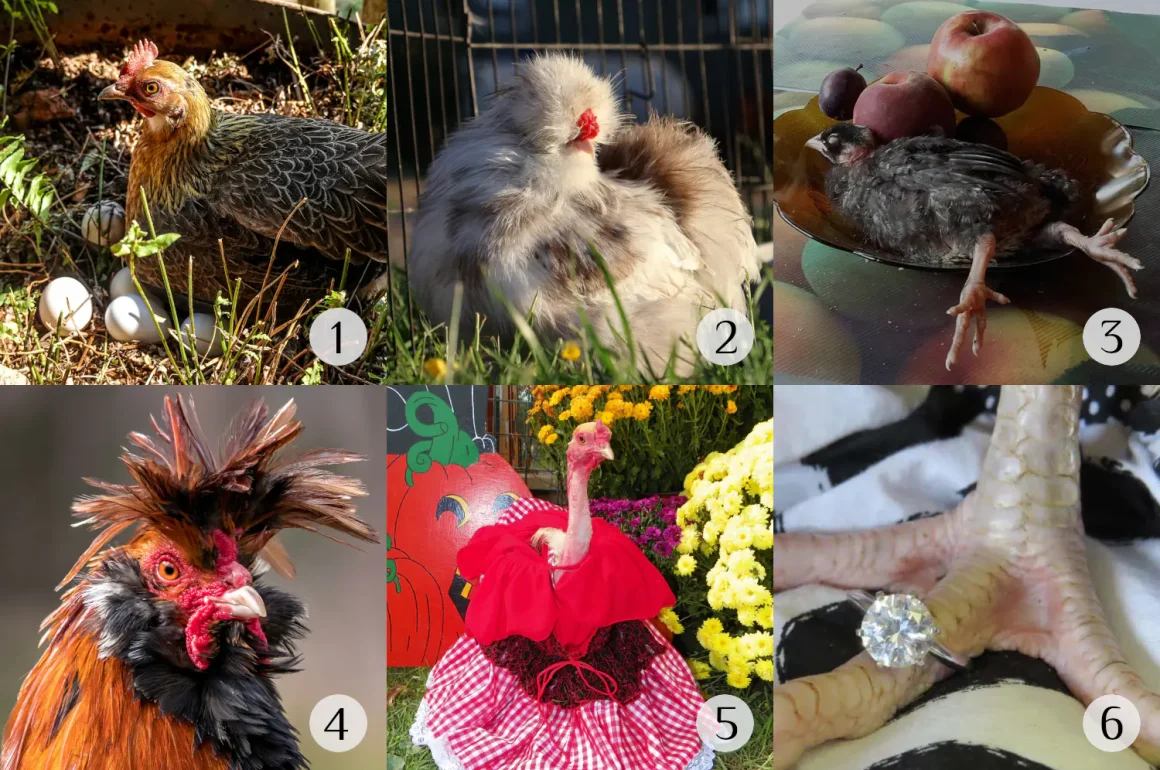
Dare I add – even when what you feel is slightly contradictory. For example (Picture 1): “Go away! I’m sitting on eggs. Also, keep bringing me treats. They’re delicious!” – theorise all broody hens (every single one I’ve ever met).
“Remember that nature is the province of haiku.”
I’ve never seen a chicken book a trip to Europe, just to spend the whole day indoors, doing nothing but sorting their postcards by colour and rewinding a music box.
“Use verbs in the present tense.”
Can you imagine your chicken exclaiming: “It’s time for trick-or-treating! (Picture 5) I’ll sew a costume to spook Henrietta. Will she peck at the seams and unravel it in front of the whole flock? Then I’m gonna be spooked!” No, they wouldn’t worry about that!
“Reflect upon your notes of nature in solitude and quiet. Let these be the basis of your haiku poems.”
So deeply focused was one of my chicks (Picture 3), that he fell asleep in my fruit salad in the middle of praising the raked earth. When he woke up, he gave the plum a polite peck, then wandered off to finish the poem in the sun.
“Use only common language.”
Haiku are generally more observational than analytical. There is no hard focus on departing from dialectical illusion and self-contradiction, that otherwise contribute to producing antinomies and paralogisms which would, in turn, perplex and mislead the understanding (loosely paraphrasing Kantian ideas). Have you ever heard a chicken speak like that? Neither have I.
“Contemplate natural objects closely… unseen wonders will reveal themselves.”
Have you ever seen a chicken marvel at the sky? That little head-tilting when they examine anything new with bright curious eyes and the surprised “awwwk” that seems to say: “What’s that flying thing slipping in and out of clouds?”…
“Write in three lines.”
That’s why chickens have three toes pointing forward, to count the three lines. The one toe pointing back is to remind them it’s OK to break the pattern: substance over form. A few breeds, however, such as the Dorking and Silkie Bantams, have five toes on each foot, so their haiku tend to be more eccentric, sometimes blooming into an authentic tanka. The waka or tanka is the ancestor of haiku: they have five lines or verses.
“Remember that haiku is a finger pointing at the moon, and if the hand is bejewelled, we no longer see that to which it points.”
This quote is so beautiful, that it makes me pause and ponder. Indeed, I fear a brightly shining ring (Picture 6) might eclipse the whole celestial crew. Being aware of this, chickens rarely wear jewellery, except on special occasions.
Of course, the poetical inclination is only one of many qualities of the winged miracles that freely roam our gardens. The benefits of being around them are felt and appreciated by many. Perhaps a future article will shine a light on the chickens’ ability to provide a feeling of well-being and confidence to people who need it – there is a whole science behind bird-assisted therapy in general, so interesting! You can anticipate where I’m headed: A world of surprises awaits, if we open our hearts to them – these sentient beings with unique personalities.
As I love birds and poetry, I decided to fuse these two passions and that is how Poesavia was born. At Poesavia, we offer bags, stationery and decor featuring personally crafted bird poetry. From bird lovers for bird lovers, each product we create supports bird conservation.
Image attribution:
- “A hen with eggs” by Magda Ehlers
- “Silkie with chocolate spots” by Divagirlsilkies
- “Asleep in the fruit salad” by Rhea Alaudra
- “Red and black rooster” by Michael Anfang
- “Cheep Cheep in her Halloween dress” by Holly Olejnik
- “Engagement photo” by Holly Olejnik





Love this, I had a chuckle (or a cackle, more appropriately). I live next door to several hens, I’ve learned that their pet peeve is discourteousness. I can never pass by preoccupied.
Thank you, Faraaz! Wow, that is very special. I also factor in whether potential neighbours are owned by chickens before deciding where to move next. Top of the list of criteria.