
By Jan Broberg
Jan runs Birdfolio, free guides and records for US birders, from state birds and species by state to Audubon’s plates. Jan works from the original records wherever they survive, which is how a story like Chicken’s gets sorted into fact and lore.
Drive the Taylor Highway into Alaska’s Fortymile Country and you will reach a tiny gold-mining town called Chicken. Almost everyone who stops there hears the same story about the name.
It goes like this. Back in the gold rush days, the miners met to choose a name for their camp. Someone suggested Ptarmigan, after the plump grouse that lived all around them. Everyone liked the idea. The trouble was that nobody could agree on how to spell it, so they settled on a word they could all spell: Chicken.
I love this story. I have even passed it along to other birders myself. So when Kai asked me whether it is actually true, I went looking for the oldest records I could find.
Gold brought prospectors to the Fortymile River in the 1880s, and to Chicken Creek in the 1890s. The U.S. government opened a post office called Chicken in 1903, and a small village grew up around it.
The oldest written explanation of the name I found is not about birds at all. In 1898 the U.S. Geological Survey published a report by the geologist Josiah Spurr, based on notes he gathered in the district in 1896. As quoted by the Alaska historian David Reamer, Spurr wrote: “The creek is so named from the size of the gold, which is about that of chicken feed (corn).”
In other words, the miners on Chicken Creek were finding nuggets about the size of corn kernels, the kind of thing you would toss to hens.
The ptarmigan story shows up much later. Reamer traces it in print to a 1942 piece in the Anchorage Daily Times, more than forty years after Spurr, and calls it almost certainly an apocryphal tale. When the town was nominated to the National Register of Historic Places in 2001, the nomination took a diplomatic line: “There are several stories about how the town got its name.” It lists both.
So the honest answer to Kai’s question is: probably not. The paper trail points to chicken feed. The spelling story is local lore.
Why the story stuck
Lore is not the same as nonsense, though. The ptarmigan version was clearly alive among the people of the Fortymile. Anne Purdy, Chicken’s best-known resident, tells it in Tisha, the book about her life, and credits it to an old-timer the book calls Uncle Arthur.
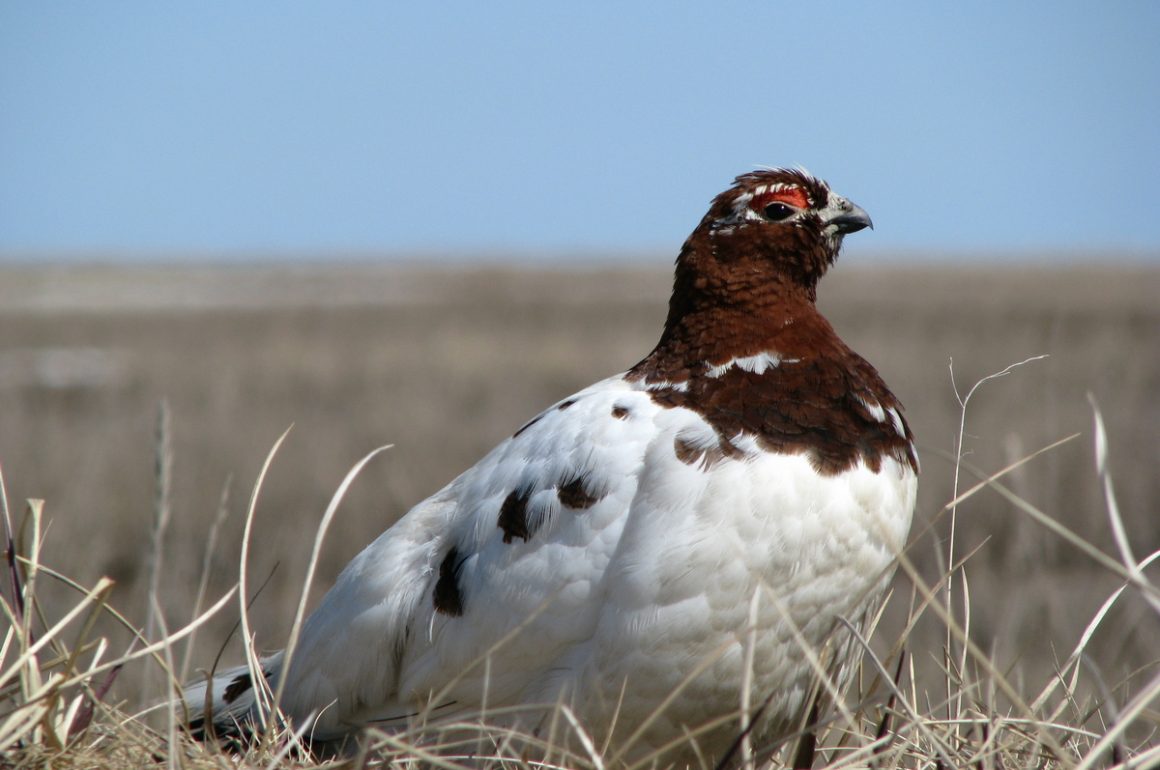
It also makes sense on the ground. A willow ptarmigan really does look a bit like a small, round, feathered-footed chicken, and the birds are a familiar sight in that part of Alaska. A joke about miners who could find gold but could not spell ptarmigan is simply a better story than a note in a geology report. Good stories win.
And there is a happy irony here. Whatever the miners were thinking, the bird they supposedly could not spell went on to become the symbol of the whole territory.
How the willow ptarmigan became Alaska’s bird
Before 1955, Alaska was still a territory, and it had no official bird. A contest was run through the schools by the Territorial Department of Education and the Education Section of the Alaska Native Service. Schoolchildren across Alaska voted, about 6,000 of them according to a 2019 history in the Peninsula Clarion, and the willow ptarmigan won easily.
The sportsmen’s groups got behind the result. Territorial Sportsmen, Inc. sponsored the bill, and the Alaska Sportsmen’s Council supported it. The 22nd Territorial Legislature passed it as House Bill 2, and it became the very first law of 1955, approved on February 4, 1955. The whole act is one sentence long:
“The Alaska Willow Ptarmigan (Lagopus lagopus alascensis Swarth) is hereby declared the official bird of the Territory of Alaska.”
Its preamble records the children’s vote plainly: the willow ptarmigan “received by far the greatest number of votes.”
That timing surprises people. Alaska did not become a state until January 1959, so its bird was chosen about four years before statehood. The choice carried straight over, and the willow ptarmigan is still Alaska’s state bird today. I wrote up the full story of the school contest and the 1955 act on Birdfolio’s Alaska state bird page, along with a short section on Chicken.
A bird that stays for winter
Governor B. Frank Heintzleman signed the bill, and his statement explains the choice better than I can. He noted that “the schoolchildren of Alaska have shown a great interest in selecting an official bird,” and he pointed to one quality in particular: “It does not fly south in the fall as do most of the ducks, geese, swans and song birds.”
For a territory that measured itself by its winters, that mattered. The willow ptarmigan turns white, grows feathers on its feet, and stays put through the dark months while most other birds leave. In 2019 some Alaskans floated the raven instead, but the ptarmigan has held the title for seven decades.
Back to Chicken
So Chicken, Alaska was almost certainly named for gold nuggets the size of chicken feed, not for a bird nobody could spell. But the town’s most famous story is still about the state bird, and I think that is fitting. In a place this small, the ptarmigan probably outnumbers the people, and the bird and the town have been tied together in Alaskan storytelling for as long as anyone has been telling stories about either.
If you ever drive the Taylor Highway, look for ptarmigan in the willows. Just don’t ask anyone to spell it.
Cover photo: Willow ptarmigan on the Yukon Delta National Wildlife Refuge, Alaska. Photo by Nathan Graff, U.S. Fish and Wildlife Service (public domain).
Sources: Laws of the Territory of Alaska 1955, Chapter 1; Josiah Spurr’s 1898 U.S. Geological Survey report, as quoted by David Reamer in the Anchorage Daily News (2024); the National Register of Historic Places nomination for the Chicken Historic District (2001); John Morton, Peninsula Clarion (2019).


Leave a Comment