


By Marco
Marco writes birdshistory.com, where he builds small, fully sourced datasets about extinct and endangered birds — last confirmed records, the lag before a formal declaration, the founder populations behind recoveries — and writes them up as reference pages. Every figure on the site is traceable to a primary source.
On 10 October 2025, the Slender-billed Curlew was moved to Extinct on the IUCN Red List. Its last irrefutable record was at Merja Zerga in Morocco on 25 February 1995.
Thirty years. In between, a great many people looked, including some who are probably reading this.
That gap is not an administrative failure. It is the predictable cost of a standard that birders apply every week, in a slightly different form: a record has to be good enough. Extinction declarations run on the same logic as a rare-bird committee decision, with one difference that changes everything — the thing being assessed is an absence, and no amount of absence is ever conclusive.
I have been building sourced timelines for extinct and threatened birds for a while, and for thirteen species I have both dates documented from primary sources: the last confirmed record, and the first formal declaration by a recognised authority. That is a small and deliberately narrow sample — the birds I have written up, not a global census — but the pattern in it is sharp enough to be worth putting in front of this audience.
The median gap is 36 years. The mean is 47.5. The range runs from three years to 124.
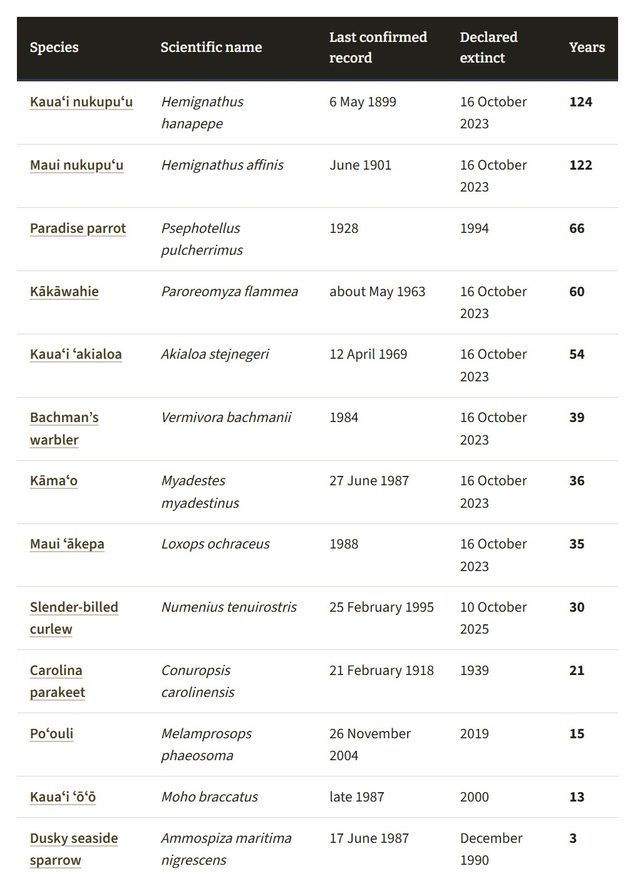
Two things fall out of that table that I did not expect when I started assembling it.
THE PAPERWORK MOVES FAST WHEN THERE IS A BODY
Look at the bottom four rows. Three years, thirteen, fifteen, twenty-one — and every one of them is a bird whose story ends with a known individual.
The Dusky Seaside Sparrow’s last bird was called Orange Band, for the marker on its leg, and it was found dead on 17 June 1987 at a Walt Disney World attraction where it had been living. Three years later, the species was delisted.
The Po ouli’s last known individual died in captivity at the Maui Bird Conservation Center on 26 November 2004. Fifteen years to a declaration.
Incas, the last captive Carolina Parakeet, died at Cincinnati Zoo on 21 February 1918. Twenty-one years.
And the Kaua i oo ends with David Boynton’s recording of the last male singing the duet of a pair that no longer existed. Thirteen years.
Now look at everything from thirty years upward. Not one of them ends with an individual. They end with a last confirmed sighting, the last substantiated observation, the last two specimens, the last birds reported — the vocabulary of a population thinning out until nobody can find it anymore.
The IUCN’s test is that there should be no reasonable doubt that the last individual has died. When you watched the last individual die, that test is trivially satisfied. When the bird simply stopped being met with, there is no moment to point at, and the doubt is not unreasonable at all — it is exactly the doubt a competent observer ought to have.
SEVEN OF THE THIRTEEN WERE DECLARED ON THE SAME DAY
The other thing in that table is less about biology than about filing cabinets.
Seven of these thirteen declarations happened on 16 October 2023, when the US Fish and Wildlife Service finalised the removal of 21 species from the Endangered Species Act on the grounds of extinction. The lags on that single day run from 35 years to 124.
The Kaua i nukupu u was last collected by George Munro near Makaweli on 6 May 1899. It was federally listed as endangered in 1967 — one year after a Fish and Wildlife publication had already described it as extinct. Both positions stood simultaneously for over half a century, and the contradiction was resolved not by new evidence but by an agency working through a backlog.
So part of what the “median 36 years” measures is not how long it takes to be sure. It is how long it takes for someone to get round to writing it down. Those are different things, and they get conflated constantly in coverage of extinction announcements.
THE CAUTION IS CORRECT, AND THE CAHOW IS WHY
It would be easy to read all this as institutional sluggishness. The best argument against that reading is a bird that was written off and came back.
The Bermuda Petrel was abundant enough at settlement to feed a colony through a famine, and by 1621 nobody in Bermuda could find one. It stayed that way for three centuries. Then dead birds began turning up around Castle Harbour — June 1935, June 1941, March 1945 — and on 28 January 1951 Robert Cushman Murphy and Louis Mowbray, with a fifteen-year-old Bermudian called David Wingate, pulled a living Cahow out of a rock burrow. There were thirteen or fourteen pairs.
At the end of the 2024 nesting season, there were 165 breeding pairs and an estimated 425 to 450 birds.
Three hundred years of absence, and the species was there the whole time. Any standard that would have declared the cahow extinct quickly would have been wrong for three centuries. The slowness is the price of not being wrong in that direction, and most birders, asked to choose, would pay it.
FOUR THAT NOBODY HAS BEEN WILLING TO CALL
The other end of the same caution is a set of birds that are almost certainly gone and still officially are not.
The Pink-headed Duck was last recorded on 21 June 1935 — ninety-one years ago. The Ivory-billed Woodpecker, April 1944. The Imperial Woodpecker, 1956. The Eskimo Curlew, 1963. All four remain on the books as Critically Endangered (Possibly Extinct), or in the Ivory-bill’s case as Endangered after a delisting proposal was withdrawn.
Each of those is a bird where somebody, somewhere, is still prepared to argue, and the rules are built so that argument wins by default. The ivory-bill in particular has consumed more field effort than almost any other North American species precisely because nobody can prove a negative.
WHAT IT MEANS FOR THE RECORD YOU SUBMIT
The reason I think this belongs on a birding site rather than a conservation one is that the input to all of it is us.
Every entry in that table rests on a record somebody made, and somebody else accepted: a specimen with a label, an observation written up carefully enough to survive scrutiny, a tape recording made because the observer had a machine with them. The 124-year Kaua?i nukupu?u lag exists because Munro collected two birds in 1899 and because nothing subsequently met the same standard.
When a rare-bird committee turns down a thin description, the complaint is usually that the standard is too high. The declaration table is what that standard looks like applied at the far end, where the question is not whether a bird was there but whether it exists at all. It is the same instinct, and on the evidence of the cahow it is the right one.
The uncomfortable part is only this: the slowness that protects the birds that come back also means that for decades we carry species on the books that are not there, and the formal date of an extinction tells you more about the authority than about the bird.
The figures here are drawn from thirteen species documented individually at birdshistory.com, each with its sources, and the arithmetic is reproducible: birdshistory.com/how-long-to-declare-a-bird-extinct
Cover Photo: Slender-billed Curlew specimen ZMA.AVES.1670, Naturalis Biodiversity Center, via Wikimedia Commons, CC0.










Leave a Comment