

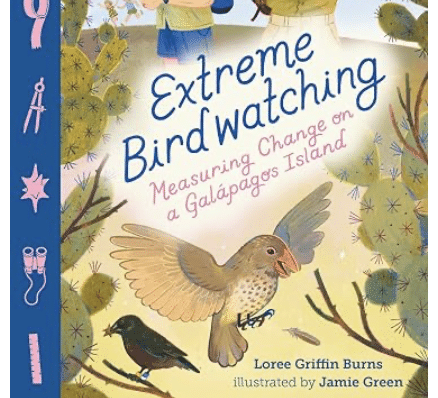
What’s extreme birdwatching? How about getting to know every single one of hundreds of individual birds! Author Loree Griffin Burns tells the story of scientists Rosemary and Peter Grant in her new chapter book for children: Extreme Birdwatching: Measuring Change on a Galápagos Island.
Books cover of EXTREME BIRDWATCHING by Loree Griffin Burns and illustrated by Jamie Green.
For forty years, evolutionary biologist Peter and Rosemary Grant studied the fortis and scandens finches of Daphne Island in the Galápagos—and the path to publication for this book, telling their story to children, was a twenty-year odyssey.
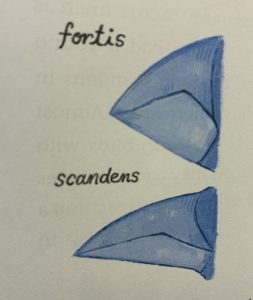
Beak differences between the two types of finches studied by the Grants on Daphne Island.
When Loree was a graduate student in biochemistry back, she read Jonathan Weiner’s The Beak of the Finch (Knopf, 1994). It was the first she’d heard of the work of Peter and Rosemary Grant—and was also the moment she realized that one could tell stories of science that read like novels. She later reached out to Peter Grant to ask if it might be possible to shadow his team on Daphne. Peter rejected the idea. They were extremely busy and spaces on the island were very limited.
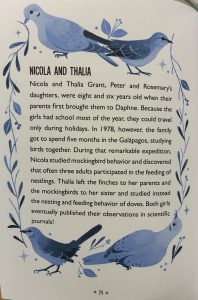
The Grant’s young daughters conducted their own research in the Galápagos, studying mockingbirds and doves.
Loree continued to follow the team’s work. Twenty years later, she had the opportunity to launch a nonfiction chapter book series for young readers with illustrator Jamie Green. Since the series would spotlight stories of science (told like novels!) and since she knew the Grants were now retired from their research and might have the time to talk, she pitched a book on them and their work. This time he and Rosemary both agreed to an interview, and Extreme Birdwatching was finally published in 2026 by MIT Kid’s Press.
The book is part of “The Discovery Chronicles” series, with the first in the series titled One Long Line (MITKids Press, 2024). It shares the story of a French naturalist, Jean Henri Fabre, and his close study of the herds of processionary caterpillars that were living in his backyard pine trees.
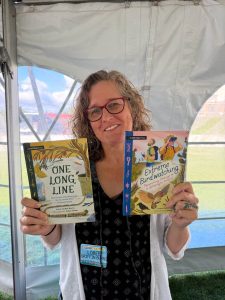
Author Loree Griffin Burns with ONE LONG LINE and EXTREME BIRDWATCHING. Photo by Kate Messner.
As Loree talked with Rosemary and Peter Grant about their decades of studying the finch populations on the island of Daphne, she was “floored by how closely they got to know the families across many generations. Their detailed and relentless observational work (often followed up with blood samples and, eventually, genetic studies) allowed them to follow families of finches across generations. This is astonishing when you realize the finches in question sometimes numbered in the thousands in a given season … and that those thousands of birds looked nearly identical.”
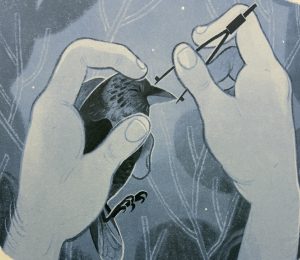
Illustration by Jamie Green in EXTREME BIRDWATCHING of measuring a finch’s beak
The Grants were exploring the question of how species change—and a drought in 1977 demonstrated how quickly natural selection could work. A chapter in EXTREME BIRDING explains that without rain, many of the plants on the island died, and many of the birds starved. The birds that lived were eating dry, hard seeds left over from previous years. The Grant’s measurements showed that the average beak depth (the distance from the top to the bottom of the beak) was larger after the drought. The tiny change had been enough to make the difference between life and death.
For Loree, the main takeaway of her book is “the power of extremely detailed observations, especially when paired with extremely careful record-keeping. In the 1970s, no one believed it was possible to observe the evolution of species over time; instead, everyone thought such changes must require eons. And because of the Grants and their team and the finches of Daphne Major, we know now that we were all wrong!”
Backmatter includes Loree’s Author’s Note, a glossary, source notes and bibliography, and a variety of resources for additional exploration.
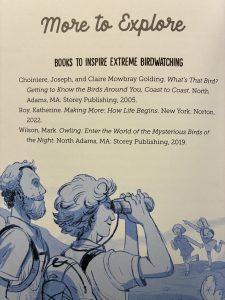
Some of the additional resources for readers in the backmatter of EXTREME BIRDWATCHING.
One of the unexpected joys of reading EXTREME BIRDWATCHING was theat some of the chapter ended with observations such as “It’s not an impossible trip. Just a complicated one.” or “It wasn’t an impossible task, just an ambitious one.” This is a book that leaves the readers infused with hope.
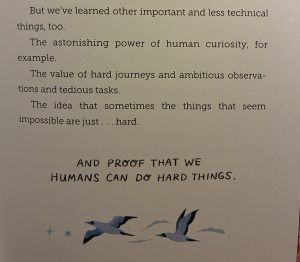
From the conclusion of EXTREME BIRDWATCHING: “We’ve learned… The idea that sometimes the things that seem impossible are just… hard. And proof that we humans can do hard things.”
Illustrator Jamie Green’s artwork appears on nearly every page, and the blue of the single color illustrations gives a welcome, friendly feel to the book. The focus on data and observation also makes this a natural fit for STEM/STEAM classrooms, as well as in the lead-ups to science fairs. For homeschoolers, parents and teachers, it is also a book to read aloud. The author’s technique of asking questions in the text (for example, “What, exactly, do finches do all day?”) makes perfect spots to stop and initiate a discussion. This book’s a natural fit for school, public and home libraries—and is just a delight to read.
Extreme Birdwatching: Measuring Change on a Galápagos Island, written by Loree Griffin Burns, illustrated by Jamie Green
MIT Kids Press, 2026; ISBN: 978-1-5362-3280-6
$16.99 US; $23.50 CAN; 63 pages, ages 7-10




Leave a Comment