

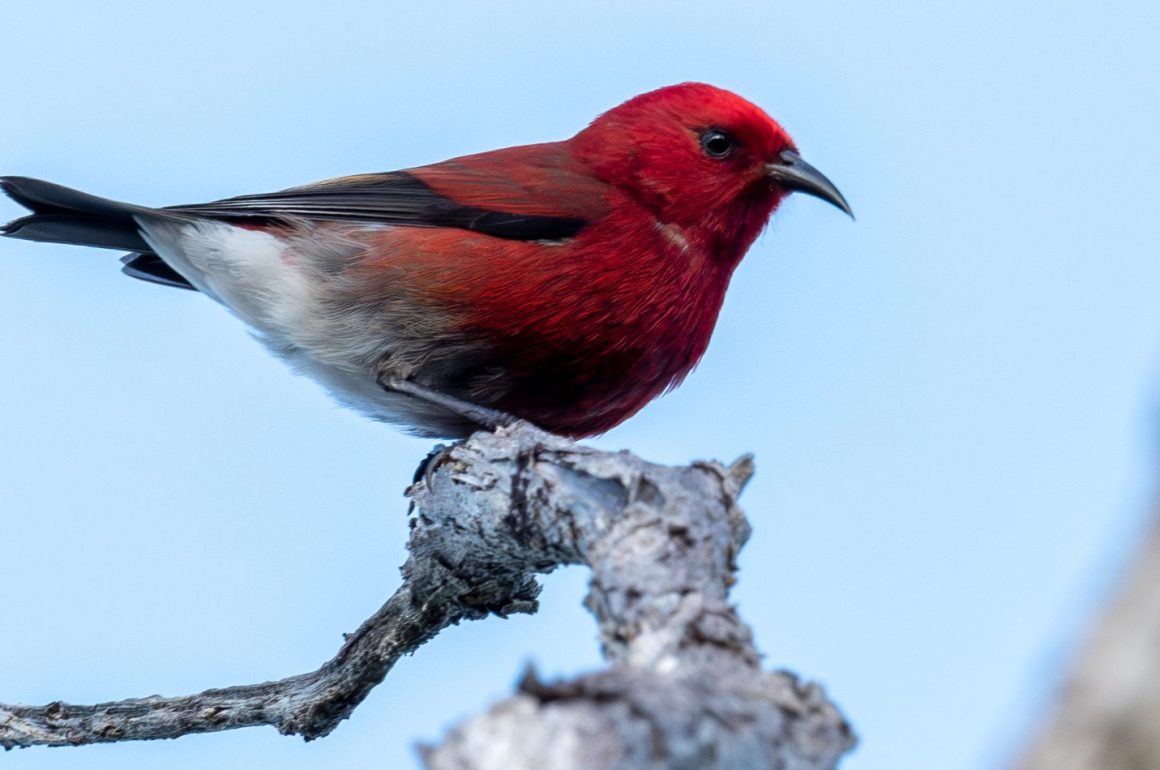
There are many reasons to go to Hawaii: the beach, the surf, the vibe, and, of course, the birds! Hawaii has many non-native bird species, but the real draw is the endemic honeycreepers, whose great diversity results from adaptive radiation. Today, we only have the potential to see 17 species of honeycreepers; however, prior to human colonization in Hawaii, it’s thought that over 60 species persisted. After colonization, numbers have dwindled because of habitat destruction, invasive species, climate change, and, most recently, disease.
Our most recent sojourn to Hawaii wasn’t primarily for birds; it was to get recertified in SCUBA diving…but, of course, a true birder takes every opportunity to explore and see birds, so we also planned time for that. After a little eBird sleuthing, it looked like our best bet for pristine honeycreeper habitat was to visit a few hotspots along Saddle Road, which has several trails that lead away from the highway.
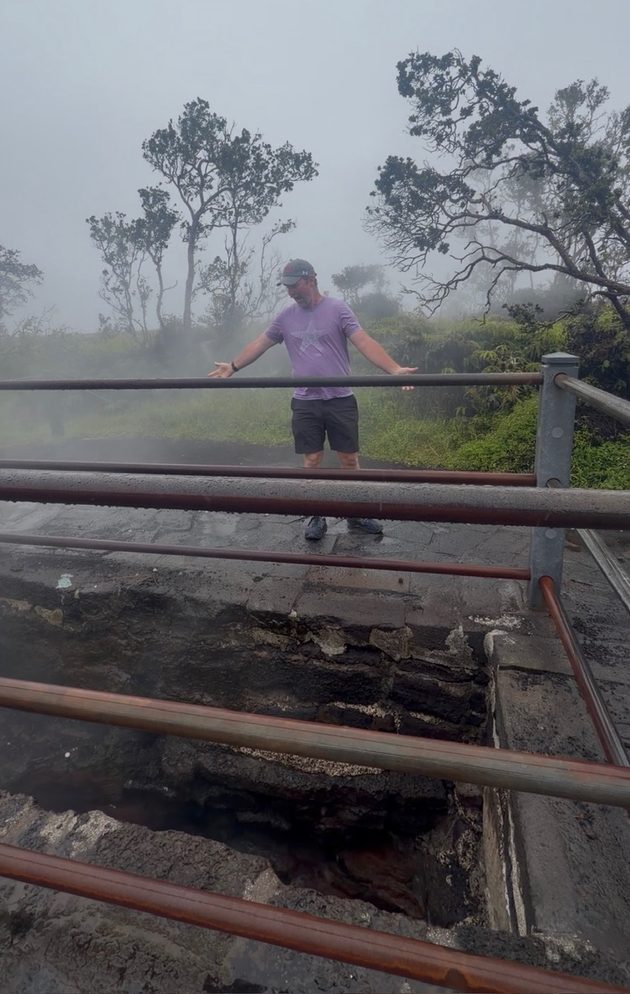
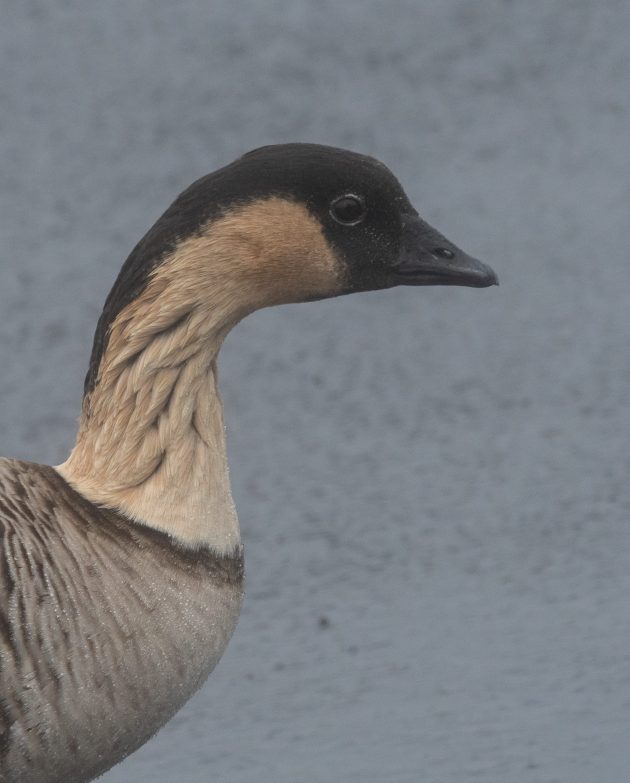
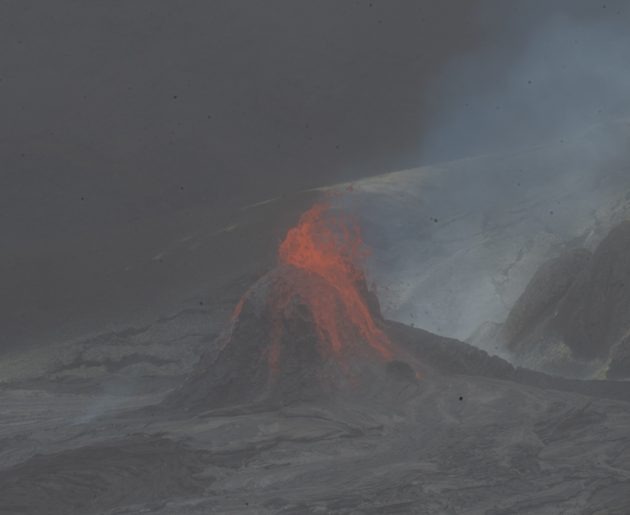
However, our first stop that morning was Hawai’i Volcanoes National Park to see some lava. Hurricane Nolo was on the horizon, so we had to go check out the national park before it closed for the storm. On the entrance road into the park, we saw a pair of Nene, Hawaiian Geese, our first endemic species! Then, along the trail to the eruption viewing area, was an Apapane in the ohi’a trees. But we didn’t see much else on this route, and we were eager to get to higher elevation for more honeycreepers.
Our first stop was the Kaumana Trail where I’iwi had been reported recently. We heard a few calling but couldn’t spot anything, and the road noise was so loud it was hard to hear much; otherwise, the trail is lovely, with large volcanic rocks and vegetation sprouting between them. Just as we were deciding to move along, a very vocal group of Apapane had a few other birds join in – Hawaii Elepaio and Hawaii Amakihi!
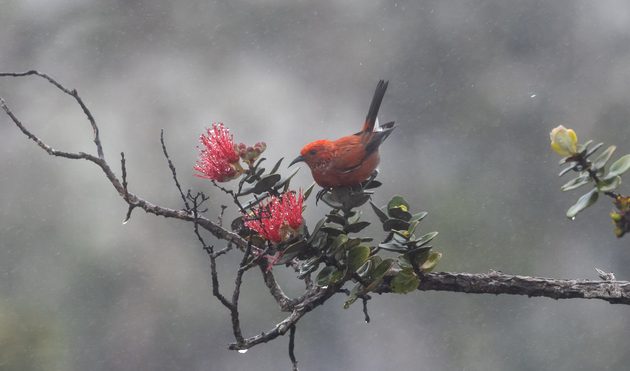
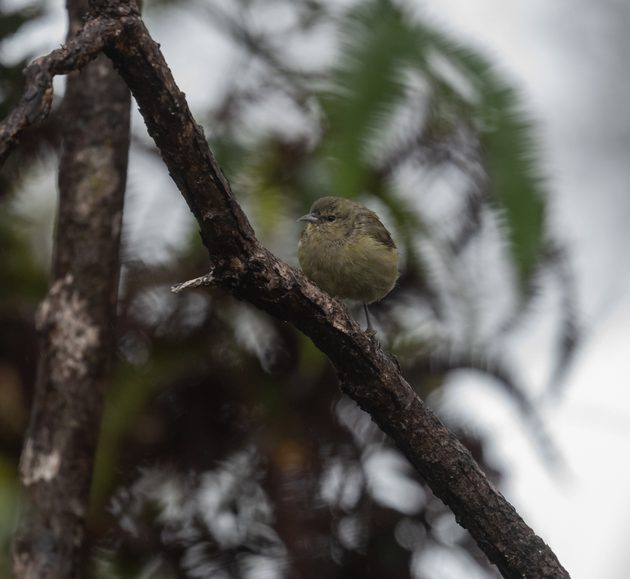
From there, we visited the Kaulana Manu Nature Trail, which is a great stop. There’s a large parking lot with several bathrooms and a short nature trail into pristine kipuka. The drizzle was getting heavier, but our morale was still up from the two lifers, so it didn’t get us down. This nature trail is pretty short but goes through a great chunk of habitat and then up to a platform. From there, we heard a chorus of bird song and checking Merlin Bird ID App we were able to pick out I’iwi and Omao calling from opposite sides of the trail. I stayed at the platform while Erik chased the Omao calls into the forest. After a while with no visible birds, I saw something fly into a tree near the parking lot; it was the I’iwi! I called Erik to make sure he saw it; he did, and then I raced down after the Omao. A few more steps down the trail and something flushed out of the bushes. It was our sneaky songster, who then landed on a branch not far from us. We got back to the car drenched, but jazzed about our sightings.
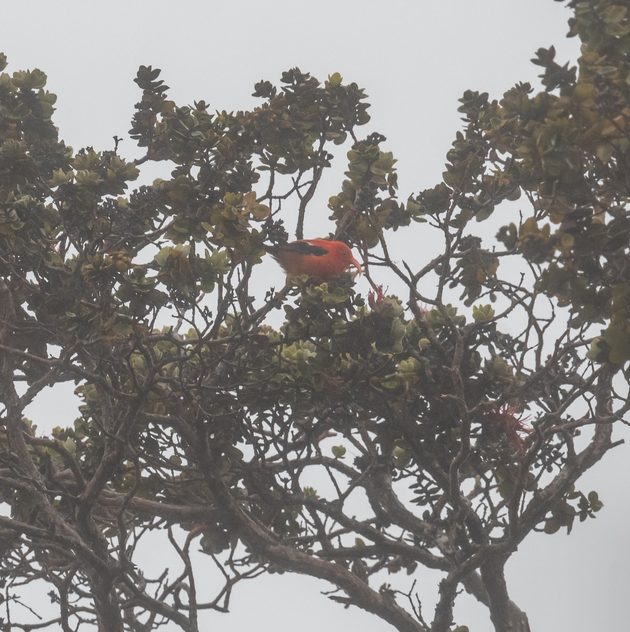
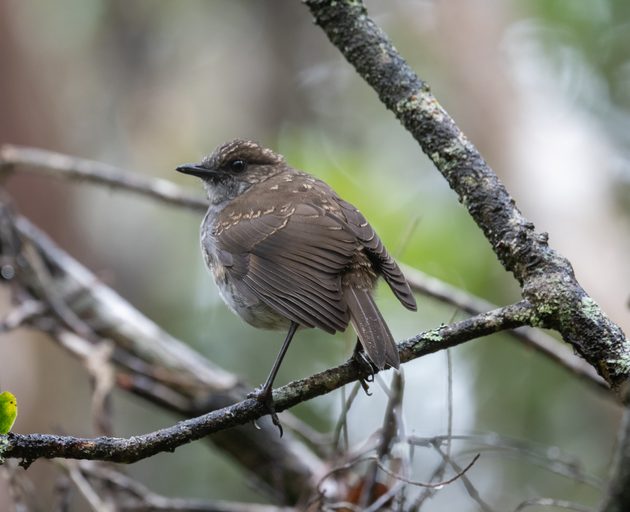
The hurricane continued to affect access to nature sites during our visit. Still, fortunately, Hurricane Nolo changed direction and caused no significant damage to Hawaii, though there was minor flooding, some landslides, and toppled trees.
The last bird we could conceivably get was a Palila, a finch-billed honeycreeper most commonly found at high elevations on the slopes of Mauna Kea. They are most recently sighted on the Palila Discovery Trail within the Ka’ohe Game Management Area. Be warned: if you plan to visit this site, make sure you are a confident driver with 4-wheel drive; these roads are not regularly maintained and have deep ruts carved by rainfall.
A few miles up the volcano’s slope, we found the trailhead. The fog was heavy, with only 20 feet of visibility. As we got out of the car, I heard the iconic “pa-lee-la” call from across the road. We raced around the car park and were teased by the persistent “pa-lee-la” coming from bushes on either side of the road. The fog came and went, and the calls kept chiming. More than an hour later, we decided to cut our losses and chalk it up to an unsatisfactory “heard-only.”
We left Hawaii the next day with a handful of lifers and a few more SCUBA dives for our logbook. We still have a few more birds to see on this island, so we’ll be back!



Leave a Comment