

By Aimevhé
Aimevhé is a nature photographer and paraglider pilot based in Vaison-la-Romaine, Provence. He has spent years watching the vultures of the Baronnies, first from a harness, then from the cliffs with a long lens. His wildlife and landscape work is at aimevhe.fr.
The first Griffon Vultures I ever saw up close didn’t care about me at all. I was hanging under my wing above the Bergiès mountain, scratching around in a weak thermal, my vario giving the slow, hopeful beeps it makes when you’re going up, but only just. Then a small group of big brown birds slid in under my wing and joined the climb.
Nobody flapped. They didn’t need to. Where I was shifting my weight in the harness and working the brakes to stay in the core, they made corrections I could barely see: a wingtip twisted, the long primaries spread like fingers, the tail tilted a few degrees. They turned tighter than I could and climbed faster. Then they left, one after the other, and a minute later my vario went quiet. They had felt the thermal dying before my instrument did.
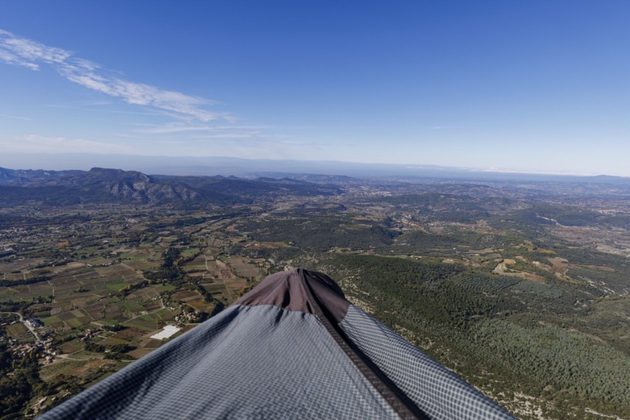
I’m going to try to fly with vultures with my paraglider.
Since then I’ve spent a lot more time on the ground, on the cliffs of the Rocher du Caire above Rémuzat, with a long lens instead of a wing. But almost everything I know about where to point that lens, I learned in the air.
Four vultures, four ways of flying
The Baronnies Provençales, in the southern French Prealps east of Nyons, are one of the few places in Europe where all four of the continent’s vulture species use the same valley. Rewilding Europe points out that it’s the first time in over a century this has been possible here. “The same valley” is the honest way to put it. You won’t tick all four from one viewpoint on one morning, and anyone who promises you that is selling something.
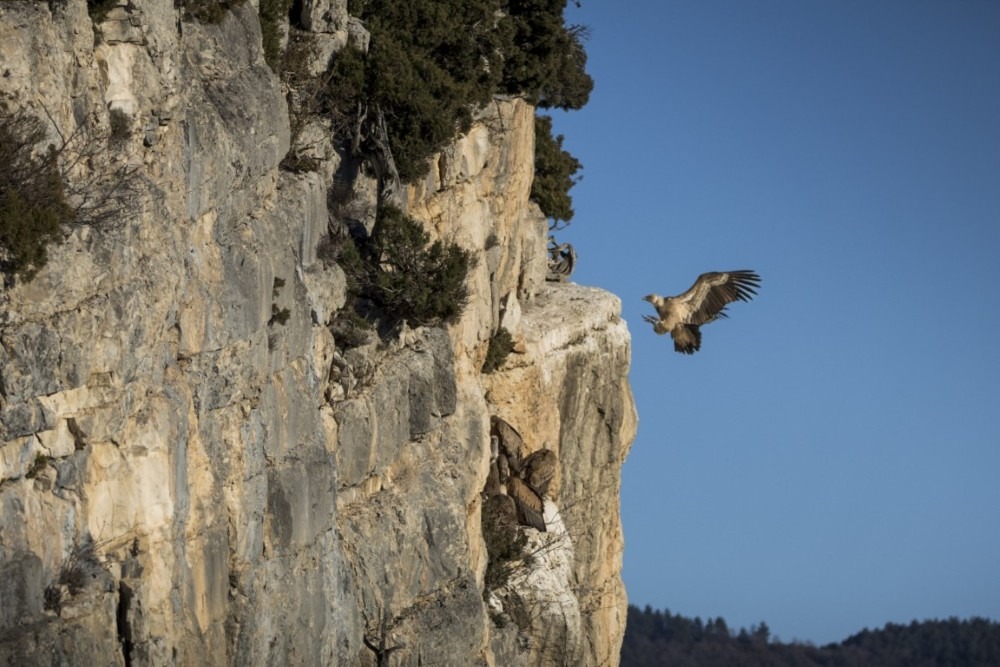
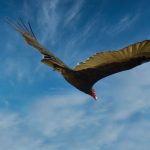
The Griffon is the one you will see. Hundreds of them live on the cliffs around Rémuzat all year. In the air they’re broad, pale brown planks with a short dark tail, wings held in a shallow V and the primaries splayed wide. They’re sociable, and they hug the terrain. If there’s a strip of lift a few metres from a rock face, a Griffon will find it, often closer to the rock than looks sensible.
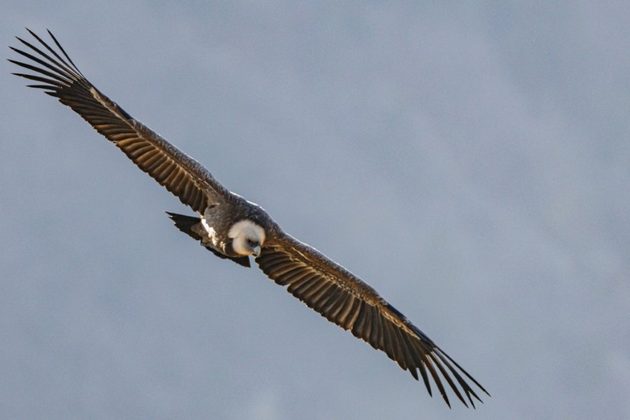
Griffons
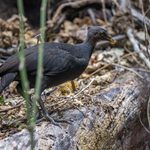
The Cinereous Vulture is bigger and darker, and flies as if it knows it. The wings are held flat, a little drooped at the tips, and the whole bird looks square. There are far fewer of them. I usually pick one out above a group of Griffons, or further off over the grazing land, rather than skimming the cliff. If a “Griffon” looks too dark and too square, look again.
The Egyptian Vulture is the odd one out: small, white with black flight feathers, a wedge-shaped tail, and here only from about March to September before it heads back to Africa. It’s quick, and it changes direction a lot, which makes it hard to follow with binoculars and harder with a 600 mm lens.
And the Bearded Vulture, the Lammergeier, is less a bird you find than a bird that finds you. Long, narrow wings, a long diamond tail, usually alone, often low along a slope, and round the next spur before your binoculars are up. They’re still rare here, from a reintroduction barely ten years old, so take one as a gift rather than a target.
I don’t have a lot of pictures of it, but it looks like this:
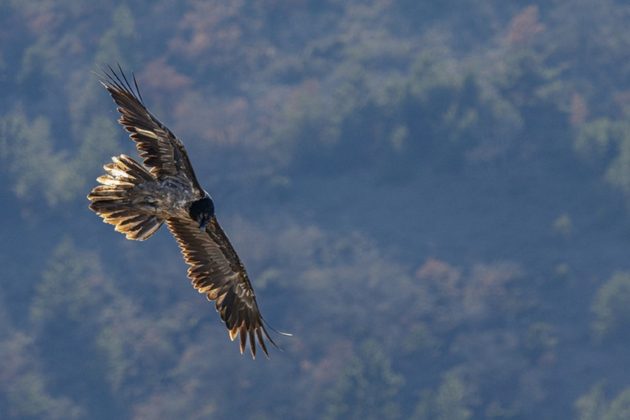
Bearded Vulture
Reading the air like a vulture
This is the part no field guide told me. Vultures are heavy gliders, and they spend their day doing exactly what a paraglider pilot does: waiting for the air to start working, then using it.
Take the mornings. A Griffon sitting on its ledge at eight isn’t lazy; it’s grounded. Until the sun has warmed the slopes enough to set off thermals, there’s nothing to fly on, and flapping seven or eight kilos of bird around costs too much energy. In winter, not much happens before 9 or 10 a.m. On take-off, we wait for exactly the same thing. So skip the dawn start. It’s a waste of a good night’s sleep.
Here’s the thing most people get wrong, pilots included, until they learn it the hard way: thermals don’t come from heat; they come from contrast. A thermal is a bubble of air warmer than the air around it. You get one where a sunny scree slope meets a shaded wood, or a dry field sits next to a damp meadow. A cold, bright March day can give superb thermals. A heatwave afternoon often gives the opposite. Everything is hot, nothing stands out, and the air feels flat. When a thermal does break loose on a day like that, it can go so high that the birds vanish into it. Good for the vulture, bad for the birder.
Once the thermals are working, you get the classic spiral. Birds circle to stay inside the rising bubble, gain height, peel off at the top and glide for kilometres to the next one, checking the high pastures for carcasses on the way.
Then there’s the mistral, the cold north wind that funnels down the Rhône valley. Visitors tend to assume it ruins the day. A moderate mistral is the best day you can get. Wind hitting a ridge is pushed upwards, and that band of rising air just in front of the cliff is what English-speaking pilots call ridge lift. (French pilots, unhelpfully, call it “soaring”.) The Griffons love it. They hang in it almost without moving, slide along the face, and sometimes pass a few metres from the edge where you’re standing. If it blows too hard, everyone stays on the ground, birds and pilots alike.
In the evening, the thermals fade, and the birds drift back to the cliffs to roost.
One practical rule comes straight out of this. Look at the terrain the way the wind sees it. Wherever the air speeds up, over a spur, a bump in the ridge or a sharp edge, the birds will come past again and again. Stand slightly upwind of those spots, and you’ll get them side-on at eye level, not as dark crosses overhead.
A comeback, not a given
None of this was here forty years ago. Vultures had vanished from the Baronnies decades earlier. Their return started with a small association, Vautours en Baronnies, founded in Rémuzat in 1992. Before releasing a single bird, they worked on the food supply: from 1993 they collected dead sheep and goats from farmers within about 20 km of the village.
The first Griffons were released in 1996. Today, well over 200 pairs nest in the Baronnies. Cinereous Vultures followed. Since 2016, about a dozen Bearded Vultures have been released here under the LIFE GypConnect programme, with more young birds put out near Villeperdrix in 2026.
The arrangement with the farmers is the clever part. Instead of paying a rendering truck to take away a dead ewe, a farmer can leave it at a designated feeding site. The farmer saves money, the vultures eat, and the hillsides get cleaned for free. People sometimes ask me whether the birds are fed for the cameras. They aren’t. It’s simply a deal that suits everyone, which is rarer than it should be.
It isn’t a finished story, either. Vultures are still poisoned in the Drôme, power lines still kill them, and a colony that took thirty years to build can lose a lot in one bad season.
Field notes for visiting birders
Rémuzat is about 40 minutes from Nyons, up the Eygues valley. A waymarked path climbs from the village to the viewpoints on the Rocher du Caire, and there’s a higher viewpoint you can drive closer to. The ground is stony and exposed, so wear proper shoes and carry water. In the village, the Maison des Vautours and the guided outings run by Vautours en Baronnies are the best way to learn which ledge is which, and which corners are off limits.
Winter, from December to February, brings courtship flights close to the cliffs. Spring means busy nests, and the Egyptian Vultures arrive in March. Late summer and autumn bring juveniles and big gatherings in the thermals, though they tend to be high and hard to photograph. Whatever the season, pick a bright day with a bit of north wind and turn up mid-morning.
Bring binoculars before anything else. If you want photos, a 300 to 400 mm lens is usually enough for Griffons along the ridge.
And stay on the paths. Some sectors are closed during the breeding season for good reason: disturbance at the nest can kill a chick. Stand still, keep your voice down, and if a bird changes what it’s doing because of you, you’re too close. The Griffons will come to you if you let them. They have the wind. You only have your feet.
I still fly in the Baronnies. Every so often a Griffon slides in beside me, looks me over with that pale, unimpressed eye, and climbs away. I’ve stopped taking it personally. They were here first, and they read the air better than I ever will. It’s the only sport I know where losing to the locals is the whole point.





Leave a Comment