

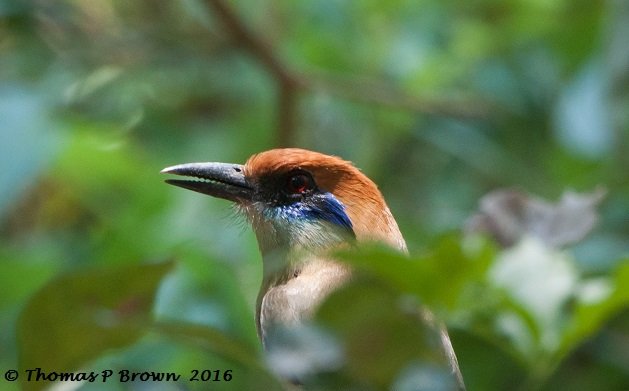
Every time I travel into a new area, I try to do my due diligence and have a pretty good idea of what bird species I might expect to find. A few weeks ago, when we traveled to Guadalajara, Mexico, I researched the many different species, especially the hummingbirds. Somehow is all my studies, the Motmots were never added to my “possible” list.
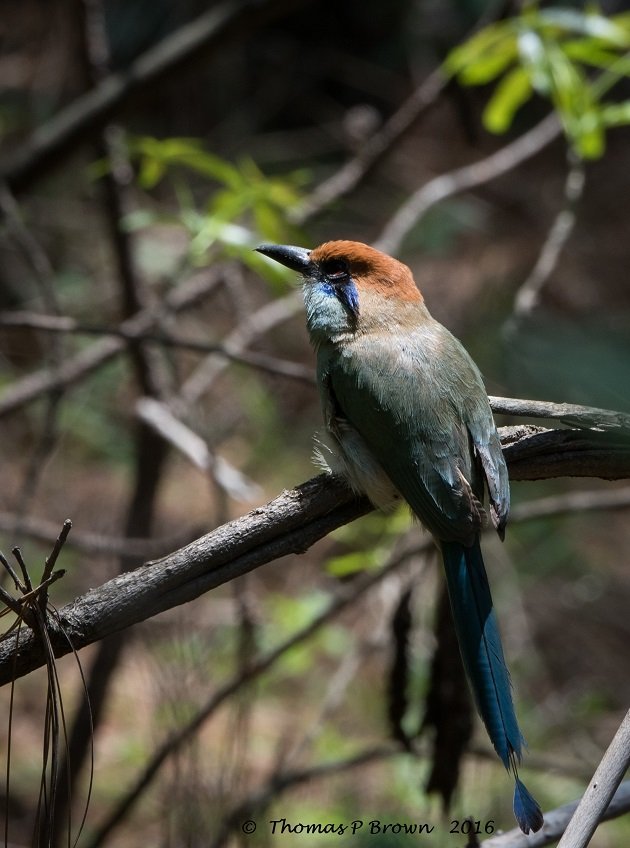
On our first visit, the only opportunity to do any birding was to spend a few hours in Parque De Coloma. A 250 acre park that is not only very well developed, but exceedingly well used by the locals. In mid June, the sun was out, and it was a beautiful day. Several “new-to-me” species made an appearance, but none had me as excited as the Russet-crowned Motmot Momotus mexicanus.
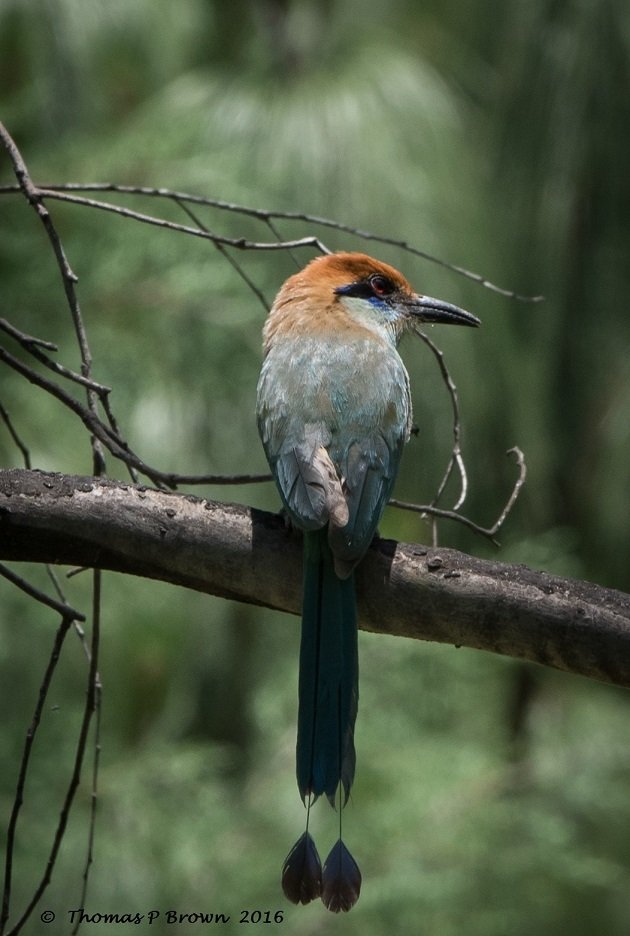
This beautiful bird, sporting such a unique tail seemed quite happy to see me. It never got to excited, and in fact posed nicely, turned and gave me both profiles. As I sat the firing off frame after frame, that outstanding tail that I was enjoying so much started wagging back and forth quickly. What had I done, what behavior had caused this? Less than a minute later, a very friendly black Labrador dog came ambling by. The Motmot never flew away, and as soon as the dog was out of sight, the tail stopped wagging. Nerves, a sign of pending danger, perhaps a warning to other, unseen birds, who knows?
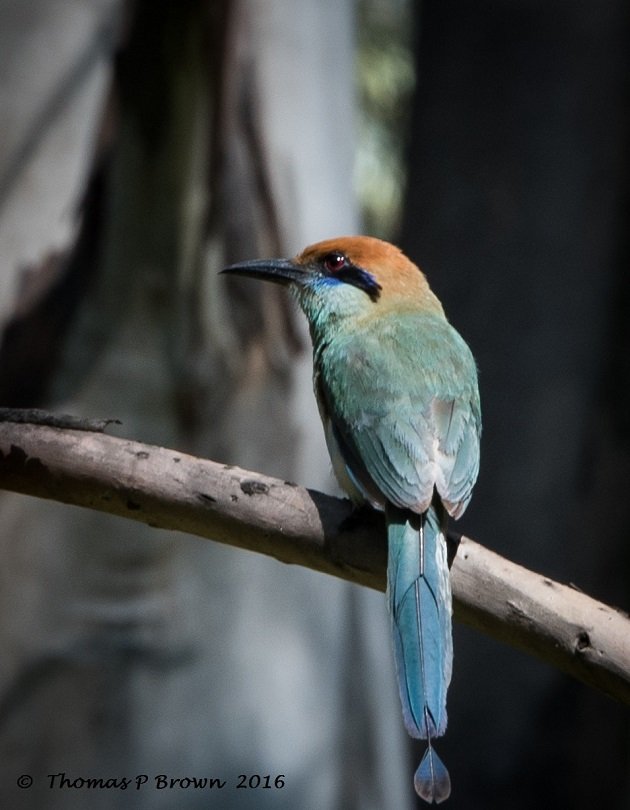
In doing some research on the Motmot family, I found several references to the fact that the long decorative tail is actually quite fragile. I found this to be true, as when I photographed the bird shown below, it had one complete tail feather, and the other, broken off just above the half-way point.
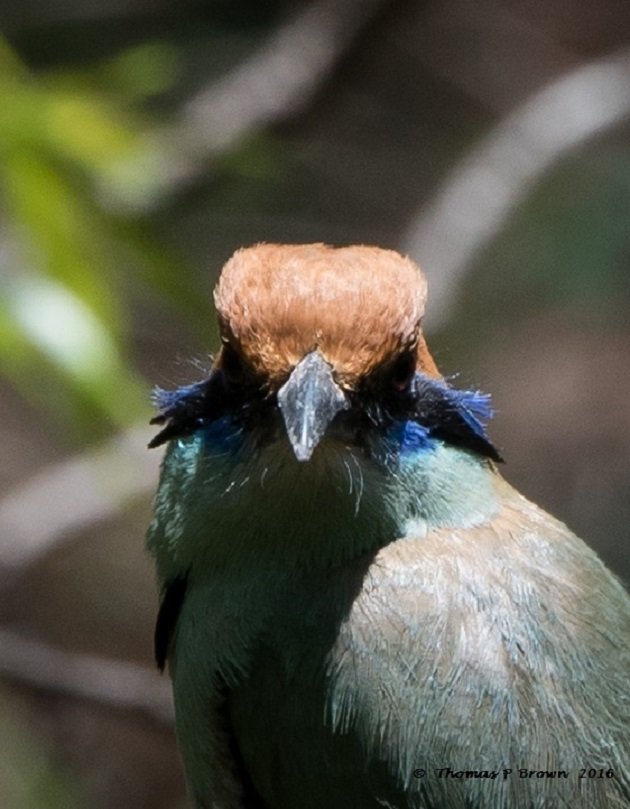
Usually found in old growth, dry tropical forest areas, as well as park like settings, these relatives of the kingfishers and bee-eaters have a moderately heavy bill, that is serrated, as can be seen in the cover photo. Their food consists of insects, small reptiles, and fruit. They lay 3-4 eggs, inside a nest that is located in the back of a tunnel, they dig in a bank. These tunnels have been found in some cases, up to 14 feet deep.
The Russet-crowned Motmot, one of nine different Motmot species worldwide, is the only one that is located in central and western Mexico.








Motmots remind me of bee-eaters. I can’t wait to eventually see one.
Thanks Duncan…..And I now want to see a Bee-eater!
Have a great weekend
Tom
It is like a Drongo and a Bee-eater got together and came up with a Motmot! 🙂
Hi, I came across your page sfter scrolling around to find out more about this beautiful bird. I live in a remote area north of Guadalajara, Jalisco. This morning, as I was driving up a dirt road, I saw something move next to my vehicle on the side of the road. I stopped the car to see and noticed it was a very beautiful bird with a damaged wing. I grabbed a cloth grocery bag, grabbed the bird and took it home. It is now caged as it is injured. After doing some research, I’ve found out it is a mexican russett-crowned motmot. I have applied a little bit of diomataceous earth powder on its wing to avoid critters and plan to release it into the wild as soon as its wing is cured. I notice its long tail is also missing. The bird may have been attacked by a larger bird or several larger birds since it seems to have a pointed wound that looks like it may have been caused by something more like a beak rather than an animal bite. Its large wing feather is loose, seems to be dislocated.