

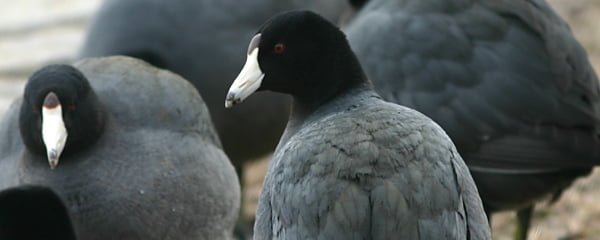
For the uninitiated, the word “coot” calls to mind nothing more than doddering old codgers and curmudgeons. Nature lovers, on the other hand, are privy to an entirely new complement of coots, a collection of charming charcoal wading birds found throughout most of the world.
Coots are mid-sized waders in the genus Fulica. Technically rails, coots are far more confiding and boldly colored than most of their kin in the family Rallidae. In fact, coots tend to live out loud under our very noses, safe from the scrutiny of an uninformed public that usually mistakes them for ducks in local parks. They resemble stealth gallinules in ninja plumage of black shading down to hues of soot and plumbeous. However, with their pugnacious, territorial ways and bold bills and frontal shields, they’re not sneaking up on anybody!
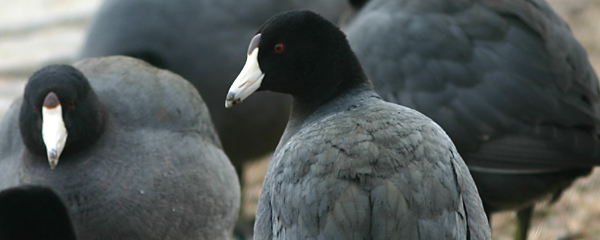
American Coots by Mike Bergin
Coots flaunt remarkable fissipalmate feet, which means their toes are lobed. This adaptation, shared with other waterbirds like grebes and phalaropes, is useful both to propel the swimming bird and to facilitate passage over matted floating vegetation. Fissipalmation is also instrumental to coots’ noted hardiness, helping the birds hold up in high temperatures by dissipating excess body heat.
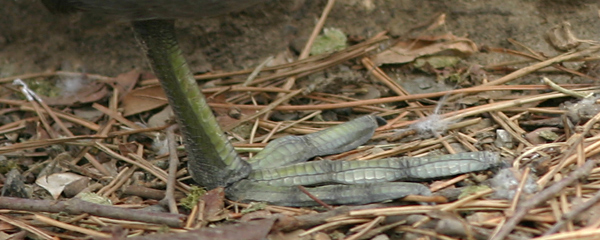
This is what you see next to ‘fissipalmate’ in the dictionary!
There are 11 known living species of coot, many of which reside in South America, and a few extinct species as well:
- The American Coot (F. americana) is a common fixture of waterways all across North America. While it doesn’t usually overlap with other coots, it is distinguishable by its carnelian frontal shield and white bill tipped with a dusky ring. Fulica americana is represented at the western and eastern fringes of its territory by close congeners, the Hawaiian Coot (F. alai) and Caribbean Coot (F.caribaea) respectively.
- The only other coot to appear in large numbers in the northern hemisphere is the Eurasian or Black Coot (F.atra) of Europe and Asia. This common wader presents an unblemished alabaster bill and frontal shield.
- The Andean or Slate-colored Coot (F. ardesiaca) claims the western reaches of South America from top to bottom. ‘Slate-colored’ is hardly diagnostic when talking about coots, so recognize this species by its white bill and canary yellow frontal shield.
- The White-winged Coot (F. leucoptera) overlaps with the Andean Coot to the south but extends east throughout Brazil and the east coast of South America. F. leucoptera shows a broad, rounded gold tone shield and tinged bill.
- The Red-gartered Coot (F. armillata) can be found throughout F. leucoptera’s range but the two are unlikely to be mistaken. This bird has a yellow bill like most of the South American coots with a shield that looks like an exotic, pointed flower petal draped over its nose, mostly white with a ruby base that matches the bird’s eye. The red line connecting the shield to bill is not the garter but the saddle; this bird’s name comes from the reddish coloration of parts of its leg, usually greenish yellow in coots.
- The Red-fronted Coot (F. rufifrons) shares a lot of territory with the previous South American birds. This stocky bird wields a saffron dagger for a bill, an elongated maroon shield, and flaring white undertail coverts.
- The Giant Coot (F. gigantea) is, as the name advertised, the largest of the coots. This scarce bird subverts the usual design paradigm of southwestern South America by presenting a crimson bill, yellow frontal shield, and reddish legs. This coot of the high cordilleran zone is known for building enormous, conspicuous nest platforms in open water.
- The Horned Coot (F. cornuta) also covers the western portions of South America but is near threatened due to both habitat loss and human and animal predation. Another high altitude, platform-nesting coot, this bird has the expected yellow bill, but is famous for the rather unsightly black caruncle in place of a shield. Depending on the bird, this fleshy excrescence can look like a squid, leech, or miniature antler.
- Speaking of unsightly, the Red-knobbed or Crested Coot (F. cristata) is named for a bifurcated bulb resembling a painful blood blister above its white frontal shield. This mark is only evident during breeding season but the baby blue bill is adequate to distinguish the Red-knobbed from Eurasian when the two overlap. F. cristata can be found throughout much of Africa as well as southwestern portions of Europe.
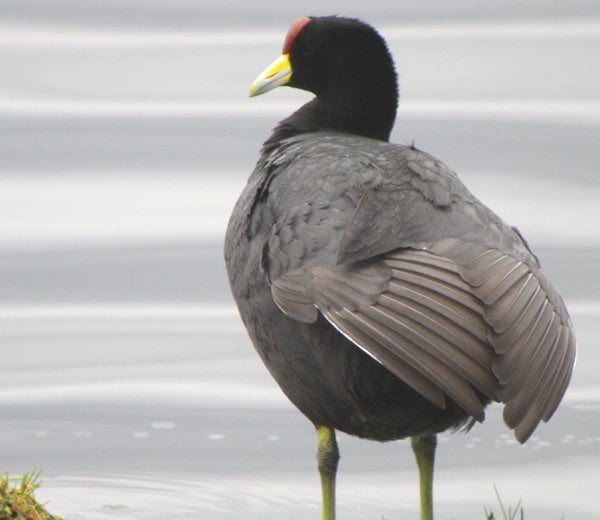
Andean Coot by Corey Finger
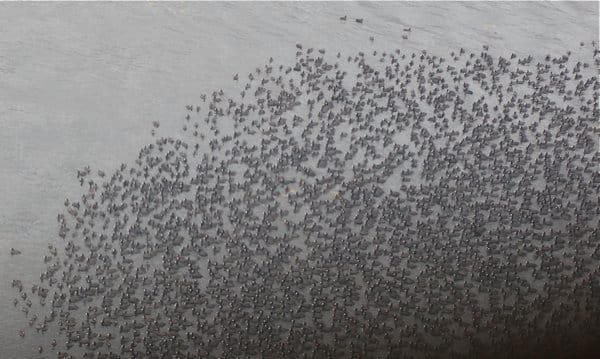
A whole lot of American Coots on the Upper Mississippi… what Birdchick calls a Cootpocalypse!

Eurasian Coot by Corey Finger
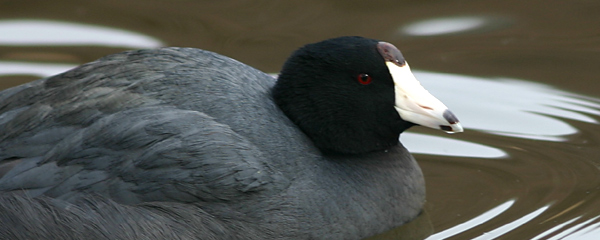
Who are you calling an old coot?




Coots are just weird lookin’ birds. I get used to seeing them and then all of a sudden I’ll take a good look and think, “Whhhhhhhaaaaaaattttt?” They are odd ducks! 🙂
This is really good, but you forgot to mention that they’re demonic. Which is extremely important to be aware of. I can’t even tell you how many innocent Brooklyn children and old ladies have been dragged under the waters of Prospect Lake by the coots and devoured to the marrow.
I can’t believe I forgot to mention that, Carrie…
Anyway, there are no innocents in Brooklyn!
The Black Coot is one of my favorite species despite being a rather unsocial fellow. One thing that surprise me is the call one would expect the m to sound like a duck but instead it more like a “beep”.
We have coots at Lake Murray in San Diego that have characteristics of both American Coots and Eurasian coots. These birds have the red mark on the end of the beak like Fulica americana, but a white forehead (lacking the frontal shield) like Fulica atra. What are they?
Cliff
http://www.beakycoot.com
Cliff, the coot you describe sounds like a Caribbean Coot, but I can’t imagine you have them in San Diego!
Yes, Caribbean coot is most likely, the following link applies:
http://www.geocities.com/secaribbirds/idamericancaribbeancoot.html
The pictures are not very good, so I don’t carry this link on my website.
I am also thinking of the Hawaiian coot:
http://www.pbase.com/jourdaj/hawaiian_coot
My recent pictures from Lake Murray:
http://www.beakycoot.com/LM-1.JPG
http://www.beakycoot.com/LM-2.JPG
Coots like this (and variations) are common at the lake.
I’ll have more information and pictures in the Coot News for June:
http://www.beakycoot.com
Cliff
By the way, the following picture shows good detail in Missy’s right foot. It was bothering her a bit, but she recovered.
http://www.beakycoot.com/foot7.jpg
Cliff
If you go swimming in London’s Hampstead ladies’ bathing pond during summertime, coots and their spectacularly ugly children sit on the life belts that are dotted around the deep end. When you go past, you can see their weird toes hanging over the edge in extreme closeup. It’s not for everybody, but I call it fun.
Do Coots mate for life?
Research indicates that coots will stay mated so long as they can keep their territory for nesting. Migration is problematic if the pair becomes separated. Since I am on the winter end of migration, my observations are limited. It seems that winter philopatry in coots only comes with first-year birds, and I will be watching for the return of six individuals from last winter. One pair, “Freddie and Mollie”, is especially important since Freddie was a returnee from 2006/2007 who again returned in October, 2007. In November, 2007 he met Mollie, a small female whom I don’t recall seeing before. They bonded instantly, and maintained a territory south of my dock until they left in March. Stupid Marvin will of course be back for his fifth year, and has never kept a mate in winter.
Cliff
Same for the coot, if you have a Cheezit cracker in you pocket and give the coot a few crumbs. If you hand feed them every day so that they can clearly see your face, coots will form lifelong bonds with people. It is always gratifying to have old friends come running up to me in the fall when I haven’t seen them for six months.
Cliff
I was kind of surprised to see what I thought was a dark duck in the middle of the road this morning. I picked him up, and on my lunch break got him to Wildlife Rescue’s vet. It was then I learned the duck was a coot. Thanks to your site, I now know more about the lil fella. He has a busted wing and left foot, but seemed pretty alert when I left him.And those are some feet on him!
Thanks for the info. Hope the bird’s wing can be fixed. A coot can live with a foot missing, but most US rescua and rehab agencies won’t keep a bird that can’t be released. It’s just expensive and time consuming to care for a crippled bird, especially one like a coot that lives for twenty years.
I really enjoyed this info about coots. I’ve seen them swimming in many ponds. I watched a nest at one time and thought I saw immatures later, but they were greyish white — don’t know the age. When do they lose their red coloring? When I learned about their unusual feet, I was able to get closeups, but I had read they were webbed feet. Thanks for this expertise!
Coots can’t breed here at the marina, and I don’t get to the lakes enough to know what the molt schedule is for juveniles. They must get done in time for fall migration, though. The following is a picture of a juvenile from Chollas lake:
http://www.beakycoot.com/JUVE46_1.JPG
I will upload new pictures and stories tonight for the January issue of Coot News at the following URL:
http://www.beakycoot.com/news.html
I am a school teacher in the Florida Everglades. At this time I am learning how to create a podcast. Since I had really neat pictures of a coot nest, mother on a nest, the babies minutes after hatching, and babies jumping off a dock into a lake;I thought why not use these. Well a dilemma has now arose. My coot pictures look like red-fronted coots. Is it possible for them to be here in Palm Beach County? Thanks for any help you can offer. Sheree
@Sheree: My guess is that you have pics of Common Moorhens, a similar species. Pics can be found here.
Cory, I have checked out your pictures, and spoke with other teachers and we believe the pictures are of a coot The bird in question is larger than a common Moorhen. Also, the juveniles look like small versions of the adults. I would be happy to share my photos, but do not know how to with out attachment. My computer skills are poor. If you would like to see my photos, please send some directions. Thanks Sheree
I’ve had the pleasure of living on San francisco bay for 11 years. The coots have always been my favorite bird. We used to have one here year round. You could feed him by hand. I would here his distintive voice, look out of my boat and he would be there craning his neck in impossible attempt to see if you were home. I’d reach down and “hand” him a chocolate chip cookie[his favorite] and he would steam away. This year instead of the 50 or so I only have one pair but what a duo. They spend most of the day gazing to each others eyes. The male [I think] swims towards me clucking when I get home from work seeking a handout. I have even seen him face down a gull,the local badboys.I look forward to their arrival every fall and miss them all summer.You have to live around these kids to understand how stunning they are.
We have had fewer winter coots in San Diego this year. Five of my coots did not return on migration. They are compelling little animals that will study your face, and if you are nice to them will remember you and form lifelong bonds.
A male coot, when first seeing you may make the “come here” click call. More info is available on my website.
This link goes to a movie I recently made. It shows Mr. Beaky at his morning bath and his lovely bride, Monday, at breakfast.
http://www.beakycoot.com/bath.wmv
Cliff
I have been watching a coot devour a bolus of something that was as big as his head. I live on Lake Ontario near Rochester, NY, and there has been a lone coot out there for a few days now. He doesn’t look like any other duck, that’s for sure.
I have wondered for years what that crazy looking bird was and started carrying around my camera and low and not behold, I never saw one again. I finally asked a friend and he said it was a strange duck too. coot. i mean cool.
We have a friendly coot who hears my voice and then quickly comes over for a snack. What is the best thing for me to give him? I am hurting him by giving him food/bread?
Lauren: bread isn’t really good food for coots though as far as I know it won’t do them any harm provided it’s a) not stale and dry, as dry bread absorbs water from the gut and can swell up causing problems, or b) mouldy. Unless the wetland they’re living on is completely sterile coots will normally find enough food for themselves…
Since Coot is a type of “Water Diving Bird”, the question is about food. I know they like grass and weeds. What I would like to know is if they also eat fish? We have many different arguments about Coots and fish eating. Can someone solve this argument for us please…
Thanks Michael
Michael: Coots are omnivorous and will pretty much anything (like us really) and small fish are taken as food items, yes.
Hi,
I am currently raising a rescued coot-who we promptly named Bert for his ugliness! I was wondering if anyone had any tips? At the moment we are trying to find out whether Bert is a girl or boy(we hope he is a boy ,otherwise he will have to be called Bertlene)! Now though Bert is quite cute and loves cuddles! After looking at some images I can’t believe he is going to have red eyes, weird or what? I also wanted to add that Coots love to eat grapes-yum yum. Bert is extremely friendly and runs over as soon as he see’s you. He loves a rub under his chin and back. He has the largest green feet ever! We might have to rename him Bigfoot….
The local newspaper crossword asks Coot’s Home, I take this as meaning where do they nest. Can anyone answer please?
How many letters, Richard?
I live in Mission Hills Counrty Club in Rancho Mirage, Ca. where they allow people to shoot the coots. The other night there were 3 shotgun blasts out on the lake with 2 men racking in about 50 dead coots. I made a BIG deal about the killings which didn’t seem too make any difference. In the morning one survived, made it to shore until it was picked up and killed by a gardner. This was horriffic. What can I do to STOP this?
Chris
Call your local US Fish and Wildlife Service Office. Find the special agent in charge of your area. Call 310-328-1516.
Do not talk with California Department of Fish & Game or any other agency until you have been briefed by the U S Fish and Wildlife Service Special Agent.
Cliff
Hi Cliff;
Thanks for your info.
I’ve called the US Fish and Wildlife but had to leave a message. Hopefully someone will call me back.
I’ve talked to the police. No help. I did talk to the Fish and Game prior to your e-mail. No help. I talked to the management of Mission Hills Country Club who state they have a license to do this.
I just can’t believe some people. My neighbors could care less, some of them even cheering. There will be a HOA meeting in Feb. I’ll bring it up but I sure I’ll be out voted. So sad.! 🙁
Any ideas?
We had problems like this last year, but made the mistake of not contacting the US Fish and Wildlife Service first. You can read about the lessons we learned when protected birds were being exterminated here:
http://www.beakycoot.com/opinion.html
Scroll down to the bottom half of that page.
The US government doesn’t have the corruption and conflict of interest you may find in state and local governments. Also, the US Fish and Wildlife Service can prosecute cases under Title 16 US Code with penalties up to $5000 per bird, nest, or egg I believe.
If the Mission Hills Country Club has a depredation permit:
http://www.fws.gov/forms/3-200-13.pdf
it was issued by the local US Fish and Wildlife Service special agent, and you should be able to get a copy of it to see if they are in compliance.
Cliff
Thank you Cliff for all your help.
I did get a call back from the Fish and Wildlife, a Mrs. Grasper who has looked into Mission Hills Country Club. She told me that they did have a depredation permit.
I guess there’s nothing I can do, except not to be home when this is going on.
I did read beakycoot. Thank you for sharing.
Regards, Chris
Thanks for giving it a try, sounds like you did your best. Still, it’s hard for me to imagine a property manager who never breaks the law, so be sure to keep an eye on them.
Coots are charming little animals with the unusual tendency to “flock up” with other species, so they make faithful companions. It’s sad to see them killed for nothing.
It’s unfortunate that they all leave on migration in March, and most don’t make it back, but it is always a thrill to see a familiar face come scuttling up to me in September!
Cliff
Cliff, I’ve been meaning to thank you for responding to Chris’ comment. Thanks!
Thanks for allowing me to post my response. Most people have at best a naive concept of how government and nonprofit agencies work in the case of wildlife. The quickest way to work around the corruption, conflict of interest, and downright graft, is with your local US Fish and Wildlife Service (USFWS) special agent.
I’m not saying that the USFWS is a panacea for preventing extinction of wild birds. It still doesn’t make sense to issue depredation permits to exterminate wildlife surviving in the urban environment when the natural habitat is gone.
These are just the facts, and they have been hard to uncover over the past seven years. If you want my opinion, that would take a bit longer. . .
Cliff
I agree with everyone that coots are fascinating birds… in fact, so fascinating that I just completed my dissertation studying them. Some fun facts about coots: (1) The chicks are world champions in terms of colorful juveniles. They have bright red beaks, bright red bald heads and red and orange plumage until they are about 2 weeks old. (2) They are conspecific brood parasites, or “egg dumpers”, who lay eggs in other coot nests in addition to their own. (3) In response, coots that receive other coot eggs will recognize and reject ‘parasitic’ eggs and chicks some of the time. (4) Coots lay more eggs than they can raise, so typically half of the coot chicks from a given nest will perish before independence. The parents use a combination of aggression towards older chicks and favoritism toward youngest of the surviving chicks, which then catch up to their older siblings in size before fledging. And there are so many more fascinating things about them… they are indeed a great study animal for ecology, evolution and behavior.
I have just spotted a coot here in laughlin nevada at the southern california edison plant. Is this an odd spot for a coot?
Tammy, I’m not surprised to spot coots anywhere in any weather. They’ve been common everywhere I’ve been in the contiguous United States.
Mike,
Thanks for responding….I have never seen one and just thought it was so odd and odd looking. Is it normal for them to be alone? And really not too close to any body of water.
Coots need about fifty yards of open water to take off and land. I would guess that your coot had been injured or weakened by starvation and separated from the other migrating coots.
Cliff
It not appear to be injured but weakened by starvation possibly, it stayed in the same place for about 3 hours outside my office window…when someone came by to see what kind of bird it was (this is before we knew)he is back now outside the office nestled under a shrub and sitting or laying is it possible it is a female and its getting ready to lay some eggs? And if it is weakend what should we do? We are thinking we should call Nevad wild life.
If the bird is sitting, it is too weak to stand, and probably ready to die. The bird needs to get warm and get some food and water. I use Cheez-It crackers and a coffee cup with fresh water for a start.
I don’t know about your wild bird rescue and rehab facilities in Nevada. I suspect that there is nothing you can do within the law to keep this bird alive for long. Most rescue agencies here refuse to come out and pick up animals, and if you handle this bird without the federal permit, you will be in violation of US Code Title 16, chapter 7. Plus whatever your state fish & game department may threaten…
I usually tell people to do whatever you can where you are to save a life, and let your conscience be your guide. In my experience these laws are almost unenforceable.
Check my website http://www.beakycoot.com for more details.
Cliff
will any cracker do? since I am at work we do have some crackers but not cheeze its…
Whatever you have will do to see if the bird can eat. Cheez-its are good because they have oil (fat) in them and you can sail them like a Frisbee. Rice pudding is a favorite since it has fat, sugar, and carbohydrates, and the birds love it.
The only other thing would be to take the bird to a freshwater pond, where it may have a chance to survive. Of course, you would probably be breaking all sorts of laws by releasing or abandoning a live animal…
Cliff
I will see what I can take out there…taking it to a pond is not an option unfortuneatley, so when I go out there the bird will not be aggressive right?
ok took the water out and some crackers i tossed the crackers towards the bird and she got right up and went the other way of course, I came in and watched her thru the window she was waiting to make sure I was gone… lol
That’s probably all you can do. Usually if a bird is injured or sick it will run away from the rest of the flock and be difficult to catch. It’s really sad.
Coots can make faithful companions because of their tendency to flock together with other species. However, if you grab a coot and hold onto it, the bird will be terrified of you. But if you can get down on your knees and hand feed a coot so the bird can see your face clearly, the bird may form a lifelong bond with you and act like a domestic pet.
Cliff
yea we will see how she is tomorrow she still isnt eating the crackers its like she is hiding she is in the corner of the wall its pretty sheltered from the wind and the rain. Thanks for all the input this has been an interesting day learning about this odd bird! The more I read about it they are pretty cool. I will check back and give a report tomorrow.
Well no sign of my bird this morning….She didnt eat any of the crackers and looks like none of the water either. Hopefully she is ok…there are alot of coyotes here I dont want to think the worst.
Hopefully the coot was able to get up and flying. Coots migrate at night, so she was probably gone soon after you left. Thanks for passing along the interesting story.
Cliff
yes thank you for all the info I shared my new found information with my family.
I’m attempting to identify a coot found on the island of Nevis in the Leeward Islands of the Caribbean. Its coat is an indigo to black and its bill is bright red tipped in white, legs almost an irridescent green, a white patch on either side of its tail feathers. Can you help with its name? I’m hoping to paint it and enter the painting in Birds in Art.
I think this is a Common Moorhen. A coot would have a white beak and forehead.
Cliff
How long do baby coots stay in the nest for? I have been watching a pair of coots sitting on their nest for a couple of weeks, but yesterday I walked a different way with the dog and today when I went past the nest the coots were gone! Could the babies have hatched and swam off in the space of 48 hours? I can’t see any eggs in the nest.
I am concerned that someone has purposefully scared them away as the nest is in the middle of a dock where a big swimming competition is taking place tomorrow…
http://elibrary.unm.edu/sora/Auk/v071n04/p0366-p0412.pdf
The above link from SORA describes the reproductive cycle in American Coots. Page 389 covers the care and development of the young coot. When the young coot is six hours old, it is quite buoyant and will climb in and out of the nest.
When the nests are disturbed, every young goes over the side into the water to swim to cover. Any of the young that are less than 15 to 20 minutes old are not yet buoyant and generally drown.
Gordon Gullion’s work in the 1950s is the most detailed and accurate research available on American Coot behavior. Unfortunately much of the academic papers written are hindered by prejudice and conflict of interest. The authors who submit papers to these journals pay to have them published, and get to pick who reviews them.
http://elibrary.unm.edu/sora/
It’s really sad that people these days don’t seem to have the time to spend a few hours every day in the company of wild birds. The birds will eventually learn to accept you, and you will learn to recognize them as individuals. Now that we are well into this planet’s sixth extinction event, there should be an even greater need for competent field biologists. I call the Port of San Diego information number, and ask to talk to their biologist, and they say that they don’t have one. The Port manages hundreds of acres of public parks and wetlands.
Oh well…
Cliff
I live in Cape Town South Africa. I walk every day and feed the ducks in the pond.(2 years now)As we have fairly good weather they do not migrate. Amongst then is a pair of Coots who have already raised a clutch of 4 eggs. They are extremely good and protective parents and raised them until they flew the coop. Unfortunately 1 of them got a huge fishing lure with fishing line stuck in the foot, he or her were so tired from trying to get loose that we were able to catch him and remove it. After 2 weeks he was still hopping around so we caught him again only to disover another piece of fish hook stuck in the joint. We took it out and took it to the vet who gave him an antibiotic injection. I have put him back where we found him and hopefully he will survive even if he hops on 1 foot. I have to try and give him a bit of antiobiotic in a piece of bread for 4 days. Fortunately he does feed when I feed the ducks. Hold thumbs.
Lesley, thanks for caring! Charlie
Lesley, you are fortunate to live in a country where you can take a wild bird to a veterinarian without breaking the law or getting the bird killed for your efforts.
Coots are unusual in their egalitarian tendency to flock with other species, and quickly form bonds with humans. I assume that you have Eurasian coots over there, and it would be interesting to know if they behave the same as our coots.
I just put up the Coot News for September, and you can read about the horrors we have over here at beakycoot.com.
Cliff
A woman brought me a small Coot that she had found about a week ago. I have been trying to feed it since. I discovered that it much prefers living things like mealworms and crickets. How much feed does this little bird need and what else will it eat?
I am not aware of anyone who has successfully raised a baby coot. I suppose the basic guidelines common to all newly hatched chicks as found at pigeons.biz or starlingtalk.com would apply. You want to feed as much protein as possible (insects or dog food) and avoid choking the bird with food items that are too large to swallow. Use commercially raised feeder insects available from pet shops, and cut off the heads of live worms before feeding until the bird learns to do this. Superworms do bite and are dangerous to juvenile birds.
Generally, coots will eat most anything that you would. beakycoot.com/food.html describes some of my experiences. Every coot is an individual with individual tastes.
If you live somewhere in the northern part of the Americas, you may need to keep the bird indoors over the winter. We had our first coot of the winter migration arrive yesterday here in San Diego. Any coot that can’t fly before the first freeze of the winter won’t survive.
The most interesting thing about coots is their tendency to form lifelong bonds with humans. For the coot, this is about twenty years. So, keep this in mind.
Always avoid licensed wildlife rehab and rescue agencies unless you have worked for one as a volunteer, or know a volunteer who has. Where the law requires these to be nonprofit corporations, they must take in more money than they spend to stay in business. Handling live animals is an expense and a nuisance for them. State laws are written to give them an exclusive license to make money, and cut their expenses by requiring them to release or kill animals.
Cliff
HI Ciff!
I found a juvy coot at a pond at work and am trying to take care of it.
It is too weak to stand.
We gave him water and some grape tonight.
Any help would be appreciated!
I’ll pick up some chez-its tomorrow. 🙂
Thanks!
Good luck with your coot. As I wrote before, any sort of high protein foods like insects or meat will help with growth, but avoid objects too large that may cause choking.
I am not aware of anyone who successfully raised a coot from a chick, but I see no reason why it would be difficult. Keep us informed of your progress.
Cliff
Thanks for the reply!
Good news!
He is eating watermelon and starter wild chick food!
We are giving him antibiotics in his water too as he seems sick and weak.
Last night he started to drink water out of a dropper so we knew he wouldnt get dehydrated. We have raised pigeons from chicks succesfully and that is a challenge let me tell you!
He doesnt like cheezits but man he sure tore through the watermelon!
🙂
So far so good.
He is a juvenile btw.
Kinda onery!
Devin I just released a Coot that I had for a month and he did juds fine. After a little study I discovered that they will eat just about anything that you will. So the trick is to find something that he likes. The Coot that I had would eat chicken feed at least enough to survive but what he really liked was something alive. I started buying crickets and small mealworms from a pet store and he became a happy Coot. You may want to find a less expensive place to buy crickets and mealworms because my Coot could eat a lot at a time. He would eat as many as 10 crickets or a tablespoon of mealworms at a time. He also preferred to be fed by hand as opposed to just putting food in a bowl.
I was told not to feed him too much because he might become too fat and then have difficulty being released back into the wild. How much too much food is I don’t know. I was also told to release him in a safe place (where he was safe from predators) before he could fly because he’ll imprint on you as mama and he might come back.
One of the hardest (and most painful) things to understand about the academic world of ornithology is the amount of prejudice and misinformation you read about birds. Anything you folks figure out yourselves from actually working with live birds will put you on the right track. A friend just sent me a copy of Irene Pepperberg’s book “Alex and Me.” Her book is a layman’s story of her 31 year study of language in a parrot. Even with her Ph.D from Harvard, she had little credibility, and had great difficulty in getting funding for her research. This qoute is from that book:
“Exactly how scientists came to espouse ideas about
animal minds that were so at odds with what nonscientists
would call common sense is fascinating and instructive. It
bears exploring, because it tells us a lot about ourselves as
a species.”
That said, every coot is an individual, and each likes different things. Beaky the Coot likes watermelon (cut in small slices) and lettuce. He also craves whole kernel wet corn from the can, and rice pudding. Every coot is different, and tastes may change over a few months of time.
Nine out of ten wild adult coots will form lifelong bonds with people who are nice to them. This is like an adult form of “imprinting” except the bird remains perfectly wild. The birds still need some kind of a pond for safe roosting, and will continue to migrate (and return) if they can. In any case, you will have a buddy for life if you are nice to a coot (for the life of the coot, anyway).
Cliff
we have coots here in Maryland, today I got some pics at Loch raven Reservoir, I have been learning the the Identity of the differnt water birds, this is a new one to me (I thought it was a loon at first), it was swimming in with Canadian geese, red head ducks, hooded Mergansers, buffle heads, mallards,and a few mute swans.
very nice web site here, and the people are all genuine
If you are looking for your coots (black with white beaks)- they are all here in Lago Vista, Texas on Lake Travis (near Austin). We have about 100 of these critters swimming around (March 2011). How long will they stay in this warm weather?
Depends on how long they have been there. They start heading north in late March, and travel at night. They stop to feed and rest during the day.
One interesting thing about spring migration, if you go to feed them every morning, the birds may seem a bit odd one day. You still have about the same number of generic coots, but eventually you realize that they are, if fact, all different coots. They start to move in the spring, and may swap feeding spots with other flocks for a few days. Then by the middle of April they are all gone.
Cliff
They’ve been here for a couple weeks – guess they like Lake Travis/Texas. They are black with white beaks. I presume they are coots.
We are building a home on 4 rural acres in the MO Ozarks. The land has about a 1/2 acre pond on it as well. We have a lone coot that has taken up residence there. He/she lives in the underbrush of a fallen tree on the edge of the pond. When we take the canoe around to fish to just check things out, he/she will come out and follow us a bit…..very curiously watching our every move. I happen to think it is very cool to have a “pet coot” on our pond, but the more I read, the more I see it is not normal for there to be only a single coot. He/she does not seem to be injured or sickly in any way. She will fly short distances (from one end of the pond to the other) – but will return to her spot in the downed tree. Is there a chance he/she will stick around….or is it just by chance the bird is there and most likely will move on?
During migration, coots will fly some distance at night, but may stop for food and water, and rest for a few days. Offer the coot a Cheez-it cracker, and get down as close to the bird as possible. In a few days the coot should learn to recognize you and take food from your hand. If the bird is not injured, it should continue on home in a few days.
more at http://www.beakycoot.com
Cliff
These Coots are a Hoot and the feet look powerful and seeing how other birds give them wide berth, suspect they react the same. Believe this is an American Coot, but, if not, let me know so I can relabel the photo.
Thanks for creating and more importantly, maintaining it.
This crazy old coot can be viewed at one of two sites:
http://www.rickhornstudio.com/photos/birds/
http://www.flickr.com/photos/rhorn2/5623052721/in/photostream
Thanks for listening.
rick
Rick, that’s definitely an American Coot. I love how your photo captures those crazy fissipalmate coot feet.
Hi, I have a pair of coots that I assume are a male/female couple. They have 4 chicks. They tend to co-parent; the mother takes 2 and the father takes 2. What I’ve noticed is that, what I assume is the mother, keeps her chicks on a short leash while the father let’s his wander all over the place. One day he was not watching his chicks at all while he was grazing and they wandered off far away. When he finally decided to check on them, he noticed that they were gone and he peeped loudly and took off faster than normal. It appeared that he was looking for them and he seemed panicked. I bet he was thinking that his mate was going to kill him for losing their chicks. Is this normal Coot parenting?
This is a great site, thanks. I was fishing with the grandaughter & son yesterday and found a baby coot swimming. He is very young so we decided to take him home and try to raise him. We have raised and released successfully many muscoveys. This little guy has a powerful personality, and loves to ride in my T shirt pocket (when not eating, his other favorite thing. Last night I got up at 3 AM to feed him and he was cold so I stayed up in the chair with him on my belly. We both finally went to sleep. Here in okeechobee Fl. The coots seem to stay all year, while that may not be so, it seems so. They are curious, and come up from the canal to eat cracked corn with the muskovies. Their “song” is unique to say the least. You may have guessed my wife and I love the wildlife here. Doc
48 hours ago we found a coot on our street late at night. He/she was not moving and appeared to be tired/sick. We took him in got him dry and warm. In the morning he seemed to be little more responsive. By now he’s been drinking some water and finaly standing up but he will still not take any food. I came accros http://www.beakycoot.com which was very informative. I tried grapes, rice pudding and oats with no luck. Tomorrow I will buy some cheeze it crackers. We’d like to nurse him back to health and release at nearby pond. Any suggestions on food I should try?
Here in the North East we hunt them and eat them ,In the mail today I got my Govt. survey for the year 2011- 2012 for Snipe,rail,gallinule and coots. I use them in Gumbo and I also marinate the breast overnight and grill them.
hi,
mi name is vicky i recently rescued an injured coot, it has a bad leg. i decided to bring him or her home to feed it and take care of it, ive been thinking about keeping it but i dont know if i can, so is it possible to have a coot as a pet?
Coots make faithful companion animals and will quickly make lifelong bonds with humans. You can’t keep a coot in the US without state and federal permits. You can’t get a permit. If you take the coot to a licensed rescue/rehab agency they may take your donation and “euthanize” the little bird. In many states the enforcement of these laws is haphazard at best, so the main threat is that they will kill the bird. The best thing would be if you could rehab the bird to be released next spring, depending upon what the weather is like there. If the bird is not releasable, state law or the rehab agency policy may be to kill the bird. Coots live twenty years so keeping a crippled bird costs money that cuts into the profits of a “nonprofit” agency. It’s all about the money.
Cliff
I am a licensed wildlife rehabilitator in Iowa. Its never about the money with me. If I can help I will. There are a lot of businesses that help if money is needed or it comes from my hard earned money. Vicky if you are in iowa, get a hold of me!!!! Its always about the animals otherwise we wouldn’t do it! This is all volunteering for me.
It’s all about the money. In California it would cost hundreds of thousands of dollars and years of litigation, and probably an act of the state legislature to be able to apply for a rehab permit. It’s a textbook example of graft in government.
Cliff
Can anyone tell me why do Coots only migrate and fly only at night time? I dont think anyone , other that a pilot, has ever seen ooots migrate. Thanks Ken
Coots, being thoughtful creatures, decided to travel at night and avoid the daytime flying predators and commercial airline traffic. Then they can stop and spend the days at established sites where they can find food and water, and rest. Any time you ask “why?” you are getting onto a slippery slope of fact unless you can train the birds to talk. I am not aware of any research on American coots migration, but be sure to check on SORA http://elibrary.unm.edu/sora/. I do know that coots use dead reckoning for navigation since I moved my boat last year and found many coots that arrived on the wrong side of the dock. They knew where the boat is, and what direction and distance it was, but could not “hop” up over the dock in between. It took months to teach them to to around.
I went to the Mile Square Regional Park in Fountain Valley, CA yesterday, Dec. 26th, and saw many American coots walking around the grass and eating. I don’t know how many there were, but I’ve never seen so many of them before. Would they compete with mallard ducks and other common ducks found in park ponds for resources?
From a few bird counts and estimates I made last week, there are probably 200 coots around south San Diego Bay. I have not seen so many since 2006. Both coots and ducks are omnivorous so they might compete for food, but in a practical sense the feeble coots don’t have any chance in a confrontation with a duck. A powerful mallard can consume an unlimited amount of anything immediately, but coots can only eat tiny bits of food at a time. Consequently, the busy coots must forage constantly; mostly eating grass from the lawn and other vegetation. Finding an occasional insect is like winning the lottery for a coot.
I have never seen one of these birds until tonight when all of a sudden this duck looking thing was wading through the snow towards my front porch so I went and picked it up thinking a neighbor lost their duck and the next thing I know it reached up and bit my lip! It was 9:45pm so it was dark out and I couldn’t see it clearly. I brought it in the house put it in a big box with a towel and water then I started looking up certain characteristics of the bird on the web and found out it was an American Coot. So now for the hunt of finding a bird rehabilitation center near by…
Don’t try to get help from a licensed wildlife rehab agency, unless you have personal knowledge that the bird won’t be killed if they think it is not immediately releasable. In many states only nonprofit corporations can get a permit, and they need to make money to stay in business. Handling live animals is a nuisance and expense to their operations. In California it’s illegal for a licensed agency to keep a bird that they consider unreleasable. It’s a perfect case of graft in government written right into the law.
Cliff
I live in Arizona and I am not sure if we have Canadian Coots are American Coots. We started off with just a few, but now they have just taken over our little lake. They leave during the summer, but return in the fall. They come back each year at least five times greater than the previous year. After about 4 years, they have become unbearable. They poop all over the place and seem to just take over.
How do we get rid of them humanely? Who can we contact to help us with this problem?
Now that the current extinction event is well in progress, any sort of “natural habitat” is gone in most places. In my view, it seems illogical to be deliberately exterminating the few wildlife species that still survive in the urban habitat. In any case, you should always contact your local US Fish and Wildlife Service agent first. You can apply for a depredation permit: http://www.fws.gov/forms/3-200-13.pdf if your agent considers it necessary. Birds are usually killed by shotgun, but your agent may have other schemes to disperse them.
Was driving near Jamaica Pond in Boston when I saw two black birds in the road. I stopped my car, got out and stopped traffic, one bird scooted to the pond side, the other was too stunned so I picked it up and put it over the guardrail. A passing walker told me it was a coot and insisted that I drive it to a nearby animal hospital. I did but they said they would euthanize it. My son and I determined that we should bring it back to the pond, as it seemed pretty active by that time. We released it pond side and it took off to rejoin its flock. Sadly when we passed the same spot later in the day there were three dead coots on the road. .. Maybe two were ours? Never saw a coot before but I was very charmed by the one I met today.
Coots are very social birds that can quickly form lifelong bonds with human companions.
In many states only a nonprofit corporation can hold a wildlife rescue/rehab permit. It is clear that there is a huge conflict of interest between the way that they make money, and what people think they do. Handling live animals is a nuisance and expense that they want to minimize, even though volunteers work for free. In some states (like California) the law requires that animals be either killed or released as quickly as possible. Most people have no idea how the legal system works for wildlife.
We have coots killed by cars on Marina Parkway in Chula Vista. Usually the coots are killed for crossing the four lane street to find food in the grass, after one side of the street has been “fished out” but this month we also had a rabbit killed. Today the second coot of this month was killed when a puddle of irrigation water from the lawn collected in the street, attracting thirsty birds during our recent warm and dry weather. Only two more months to go, and they can fly back home.
It’s just one thing after another. More at: http://www.beakycoot.com
Cliff
I just was sitting here this morning watching the coots watch the eagles watch the coots. I have a cover of 250+ coots out here on the bay this morning. (Flathead Lake, Polson, Montana.) Two juvenile bald eagles are sitting on the point, watching the coots, and giving them grief every now and again. It is interesting to watch.
A couple of days ago there were four of the juvenile balds out on a little piece of ice at the edge of the lake and a couple of magpies hanging around. The eagles were making a lot of noise, I walked out there after they left, and sure enough, coot feathers on the ice.
It seems there is an almost white coot in the cover, has anyone ever seen that before?
We are staying next to a pond in Palm Harbor, Florida, with several birds that are called ‘coots’. They are smaller than mallards and have a very un-coot red bill. What are they?
@Dinah: You are seeing Common Gallinules, which used to be called Common Moorhens. A picture of one (with a Purple Gallinule) is here: http://10000birds.com/do-common-gallinules-get-jealous-of-purple-gallinules.htm
I live in Myrtle Beach, SC. We have many many coots living with mallard ducks and geese on the ponds here. I finally figured out what they are. When I feed the ducks, what should I bring the coots? Bread? I really think the coots are pretty.. so crisp and black with their white beaks. Do people eat coots like they eat duck?? Don’t tell me it tastes like chicken. I just want to know more about these cool little birds. I am an animal advocate.. I just love them.
hi guys i have found a coot egg and i dont know what to feed it would any one know what they eat? i hope someone can reply
If the egg doesn’t hatch, you have no problem. Starling Talk at http://www.starlingtalk.com/babycare.htm gives some useful information about caring for baby birds. In the case of a coot, you would want to put the chick in a shallow dish of water, since they swim as soon as they are dry from hatching. Get some mealworms or superworms from a pet store to feed the chick. Cut the heads off the worms so that they don’t bite. Any sort of high protein food cut into tiny pieces is needed. Never seek help from a licensed rehab agency unless you have some reason to believe that they won’t simply take your money and kill the bird.
I met my first coot yesterday evening. I was about to let me dogs out in the back yard and I saw a small creature trying to get through the slats in the back gate. Puzzled, I walked up to it; I knew it was not a rabbit or a ground squirrel. Surprised, I discovered it was a young bird. I reasoned that it was not a duck; pointed beak. I decided it was a young goose, since I had not known of any other bird in our vicinity. My Biologist son quickly told me from over 1,000 miles away by phone that the little creature is a juvenile Coot! After several phone calls I spoke with someone who was involved with bird rescue and they would transport it to a bird rescue hospital this afternoon in another suburb. The little creature was cute and lively but was unable to walk well. I was told that sometimes the young Coots fly and hit something and fall to the ground, which obviously happened since we are close to the Great Lakes. It was a fun and happy experience, meeting my first Coot!!
I live in Rancho Carlsbad in Carlsbad, CA. We have a manmade lake and two natural streams and attract a lot of migratory birds as we are pretty close to the back bay. At the end of last Spring, our fairly large (maybe 30-50) coot population migrated, leaving behind one lone coot. We figured he may have been too old or sick to fly. He/she? (how do you tell) ended up joining out local mallard ducks who seemed reasonably tolerant of him – he obviously did not want to be alone too much. But during the last month, he spent more and more time on his own – we felt for sure he would die. Then suddenly a few days ago, there are now two coots – I have no idea if the newly arrived coot is male or female and if these two are a mated pair or just friends pleased to see a friendly face. So – long explanation, but here’s my question. How did the “new coot” manage to find “our coot”? I could understand if the whole flock returned, but it was just this one single bird and the two found each other. I can only hope that they are a pair and we will see chicks now. We have a lot of ducky chicks – although less this year due to a bobcat patrolling our dry stream beds.
So very glad to find this website and looking forward to any info. Will definitely try and make friends with them.
live in Vauxhall Alberta Canada about 4 hours north of the U S border.
November 12th snow on the ground but sunny, there was knocking at my basement window went to investigate seen this bird and took some pics
found out via internet it was a coot.
went outside again at dark but it was gone hopefully will find it’s way home. Never seen one before cute bird until you look at his feet.
Although you see many people /thinking unknowingly about feeding bear to birds. Don’t EVER give bread to any wildfowl.
It is dangerous to their digestive sustem.
If it moldy bread also it could kill them.
This is ludicrous. Property managers simply don’t want people hanging around feeding the birds. If they said it would be bad to feed the birds broccoli, it would have no effect. Bread has been a human staple for thousands of years and everyone is likely to have some handy. KC Lint was curator of birds at the San Diego Zoo for more than twenty years, and he wrote a book “Feeding Cage Birds” that includes bread in the diet of many species of birds. As an example for American Coot he lists the following diet: 113 gram milo, wheat, cracked corn; Meat 28 gram minced, egg 57 gram grated; bread 28 gram (one slice) greens 42.5 grams; oyster shell free choice. For “daily diet for all raills” he includes 2 gram of bread (cubed). In the midst of this extinction event there is no such thing as a natural diet. Wild birds eat what they can or they don’t eat.
Haha I found you! The writer and famous old friend of the legendary [to me] Beaky the Coot. Sorry if this is weird, I just wanted to find a way to let you know how much I admire your website and all the information it has provided me. I tend to several parks where I try to befriend and feed as many birds as I can. I usually focus on dumped domestic waterfowl, but after finding your website, I’ve befriended several Coots as well. One of them, Tiny the Coot has something wrong with his eyes, but he seems to see okay and is very smart and friendly. I’m getting off track here, but I just wanted to say thank you. I also think your opinions concerning allowing animals to live in peace in whatever piece of urban habitat they are somehow able to live in is spot on. I just really wanted to let you know, there are like-minded people out there, and you and your website are an inspiration to us. Thank you, Cliff.
Chris
Their migratory permit is only for a few hundred, not many, birds to be eliminated. They routinely go way over that number…and members at the Club have seen wounded and live birds stuffed into garbage bags.
This is such an unfair situation all around as there were NO water traps/treatments at the Club in the original design. HOA members requested them…which, in turn, diverted birds en route to Salton Sea for their centuries old migratory pattern.
So, they put water traps in–attracted the birds–now killing way more than the license allows to correct for them putting in the water traps. Insane.
We met our first coot today. At first we did not know that it was a coot, but we were certainly intrigued by it nonetheless (especially its impressive nest). We observed it for a long time, primarily debating whether it was wise of it to build its nest in such an exposed location (it was on a lake in the middle of a park in London) as opposed to closer to vegetation where it would be more sheltered. We wondered what its reasons could be. Especially considering it had a wife and babies resting in the nest. As we continued our walk around the park we came upon a sign, which is how we discovered that it was in fact a coot. So our primary question is, to summarize: why? Why would it choose to make a nest in such an exposed area, when there was an island nearby which presumably would have provided much more safety?!!?
Hello, welcome to the group and thank you for sharing your recent experience. Birds build nests in certain locations to meet a number of criteria namely a nearby reliable food source and protection from predators. Building a nest in the open water would likely restrict attacks to airborne predators and would provide an unrestricted view of any approaching threats. I hope this helps and happy bird watching!
I rescued 2 baby coots after their parents were eaten by a huge cat fish. It took me 7 hours to catch them with the help of a gardner. I took them home until they were bigger, then place them in a bassin…4 weeks later they disappeared…I guess they migrated because it’s the fall in Patris, France. I will forever miss them and the bond we had together…They would come running each day as I brought them food, oats, every day…