

When One Museum Specimen Creates a Bird Species
By Mohan
Mohan is the founder of Monto Fact Jungle (https://montofactjungle.com/), an educational website covering natural history, science and general knowledge. He enjoys exploring unusual scientific stories, museum specimens and overlooked details from the natural world, and turning them into accessible stories for curious readers.
How one unusual rail became a taxonomic mystery
There is something slightly unsettling about a bird species known from just one specimen.
Sharpe’s Rail is one of those birds.
The specimen arrived at the Rijksmuseum van Natuurlijke Historie in Leiden in 1865, obtained from the natural-history dealer G. A. Frank. Its original provenance was unknown. In 1893, Johann Büttikofer described it as a new species, Gallirallus sharpei, believing it came from South America.
That was the beginning of a taxonomic mystery that lasted for more than a century.
The bird was never seen again.
A species with a very small population
Today, it is easy to imagine a newly described bird as something discovered in a forest after a long expedition. Sharpe’s Rail was different. There was no known population behind the name—just a single museum skin.
The specimen’s uncertain origin made matters worse. Before its description, Hermann Schlegel had thought it might be a juvenile Spotted Rail from South America. That early guess helped create confusion about where the specimen had actually come from.
Later authors considered Sharpe’s Rail closely related to the Buff-banded Rail, a widespread species found across parts of the Pacific and Australasia. But the plumage of the mysterious specimen looked sufficiently different that it continued to be treated as a possible distinct species.
Because no one ever found another Sharpe’s Rail, the idea of extinction eventually entered the story.
It is a strange situation: a bird could be declared extinct even though nobody could be certain where it had originally lived.
The clue was sitting in the feathers
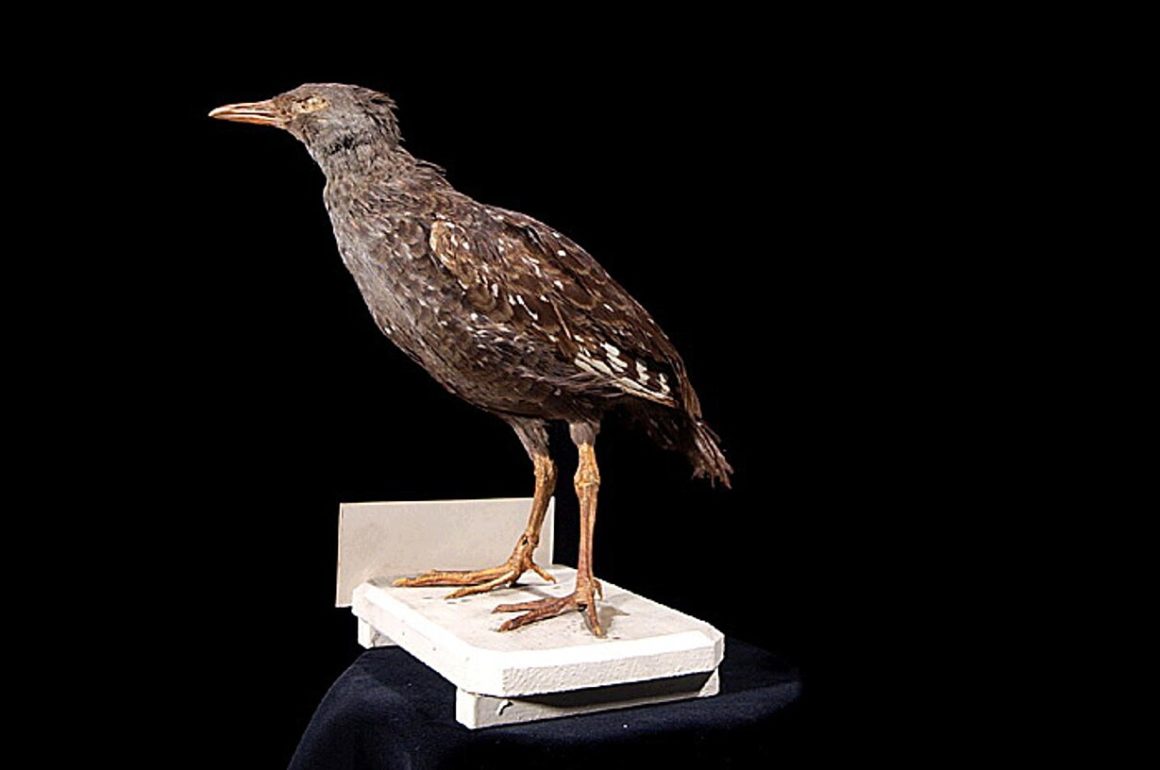
The specimen is strikingly dark. Its upperparts are brownish-black, with white spotting across parts of the body and wings. To earlier observers, the plumage looked natural rather than abnormal.
That detail turned out to be important.
In 2014, Julian Hume and Hein van Grouw revisited Sharpe’s Rail as part of their study of colour aberrations in extinct and endangered birds. They compared the specimen with a normally coloured Buff-banded Rail from the same museum collection.
Their conclusion was surprising.
The dark plumage was not good evidence that the bird belonged to a separate species. Instead, the authors identified the specimen as an example of category 3 melanism, a form of colour aberration in which the normal pattern or distribution of pigment is altered.
The specimen had not necessarily been hiding a new species.
It may simply have been an extraordinarily unusual-looking individual.
Then the DNA entered the story
Plumage alone might still have left room for debate.
Genetic evidence provided another line of evidence.
Hume and van Grouw reported that mitochondrial DNA from the specimen allowed it to be referred to Gallirallus philippensis, the Buff-banded Rail.
That changes the story completely.
The bird described in 1893 as Gallirallus sharpei was not an extinct species after all. The unique specimen represented an unusually coloured Buff-banded Rail.
A species had effectively disappeared—not because the last bird had died, but because the scientific name had turned out to describe something that was already part of another species.
The museum specimen had the last word
What I find most interesting about Sharpe’s Rail is that the specimen never changed.
The scientific interpretation did.
The same skin that once looked like evidence of an unknown South American rail later became evidence of something much more familiar: an unusual colour form of Buff-banded Rail.
That is one of the great strengths of natural-history collections. A specimen can sit quietly in a drawer for decades while scientific questions and techniques change around it.
The person who collected the bird could not have known that future researchers would examine its plumage using a much more developed understanding of colour aberrations. Nor could nineteenth-century taxonomists have anticipated the genetic tools that would eventually be applied to old museum material.
The specimen simply waited.
A useful warning for bird taxonomy
Sharpe’s Rail is a reminder that a species description based on a single unusual individual carries a special risk.
Birds vary. Plumage can vary dramatically. And when a specimen has no reliable locality information and there are no additional individuals to compare with, the evidence can be surprisingly thin.
That does not make the original description unreasonable. In 1893, Büttikofer was working with the information available to him.
What changed was the evidence.
The mystery also shows why old museum specimens should not be treated as scientific relics whose usefulness ended when they were placed in a collection. They can become more informative with time as new questions are asked and new methods become available.
Sharpe’s Rail is therefore not really a story about an extinct bird.
It is a story about a bird that was given a name, a specimen that preserved the evidence, and researchers who eventually asked whether the name still made sense.
More than a century after the bird was described, the answer was no.
The specimen remained.
The species did not.
Linked paper
Hume, J. P. & van Grouw, H. 2014. Colour aberrations in extinct and endangered birds. Bulletin of the British Ornithologists’ Club 134(3): 168–193.
Further reading
Hume, J. P. & van Grouw, H. (2014), Colour aberrations in extinct and endangered birds.
Naturalis Biodiversity Center, specimen RMNH.AVES.87485.
ITIS, Hypotaenidia philippensis — Buff-banded Rail.
Image: Sharpe’s Rail (Gallirallus sharpei), specimen RMNH.AVES.87485
Credit: Huub Veldhuijzen van Zanten / Naturalis Biodiversity Center, via Wikimedia Commons
License: CC BY-SA 3.0
Source: Wikimedia Commons







An interesting and thought-provoking read.
Thank you so much for sharing this story! One of the wonderful things about science is the way it changes with new information, and this was such a perfect illustration.