

In my first trip to the West Indies, I learned that the Bahamas boast an impressive array of wild native doves including the Caribbean Dove and White-crowned Pigeon. The various islands also support more adaptable civilized species like Mourning Dove, Common Ground-Dove, and Rock Pigeon. But one columbiform has clearly conquered the rest: in the Nassau area and perhaps beyond, the Eurasian Collared-Dove reigns supreme.
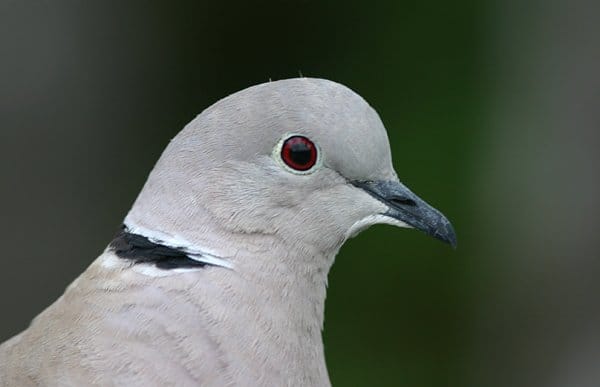
Eurasian Collared-Dove
Streptopeleia decaocto is one of the most active invasive bird species of our day. As its name implies, this collared-dove is a native of Eurasia, specifically Turkey and the Indian subcontinent. At the beginning of the 20th century, this species started to expand its range. It already had a foothold in the Balkans and Middle East but it moved further westward into the rest of Europe, jumping over to the British Isles where it is considered one of the most common British birds. Its range on that continent extends as far east as the Iberian Peninsula, west to Russia, and north to Scandinavian points above the Arctic Circle.
The Eurasian Collared-Dove may be able to handle the cold, but it thrives in warm, even tropical climes as well. A flock of the doves were released (accidentally, like so many other invasives) into the Bahamian ecosystem in the 1970s. From there, it was a short hop to Florida. Now the bird has been spotted in 22 US states and shows no sign of stopping. Not bad for a non-migratory bird!
This dove shares a distinguishing mark, a black collar around the nape that does not extend all the way around the neck, with the Ringed Turtle-Dove. However, the Eurasian dove is much larger. Streptopeleia decaocto is a silky gray with a pearlescent wash from neck to belly, slightly olive over wings and back. Its long broad tail is black near the rump but displays a telltale white fan in flight. So learn to love the vapidly attractive face of the Eurasian Collared-Dove, because chances are that, no matter where you live, you might be seeing it soon.
This post was originally published in February 2006, but we hate to keep posts this good buried in the archives!







I remember when Collared-Doves appeared in our part of the UK in the late 1960s. The colonisation of was very rapid; by the mid 1970s they were a common sight on farmland and in suburban gardens.
I am stationed in Iraq right now and these guys are everywhere! Wondering what in the world they subsist off of?? There really isn’t any food to speak of out in the desert.
I live in Tyler, Texas. Tw0 years ago in our yard there were 2 Eurasian Collared Doves. Now there are 6. What can we do to stop them from taking over the feeders from the Cardinals, Blue Jays,Chickadees and the other smaller winged wonders?
“Now the bird has been spotted in 22 US states”
That number seems too low to me.
I’ve been expecting them to take over the world for years now. When I’ve been on a boat out in the Gulf of Mexico heading to and from the Dry Tortugas I’ve seen collared-doves winging their way towards the mainland. They don’t seem at all phased by flying across all that water.
When I was 15 I had an aviary of 40 of them in 29 palms CA. I turned them out like pigeons. Then when I was over them I gave them to my neighbor. He let them free fly as well. When I went back to visit ( I lived in the MIDDLE of the desert Not in the town) I was shocked to see wild ones all over! Im guessing some were descendants from my original flock.! But beings its the desert, Im wondering if they are causing any issues with native species …?
Dove is very nice & cute bird i like it