

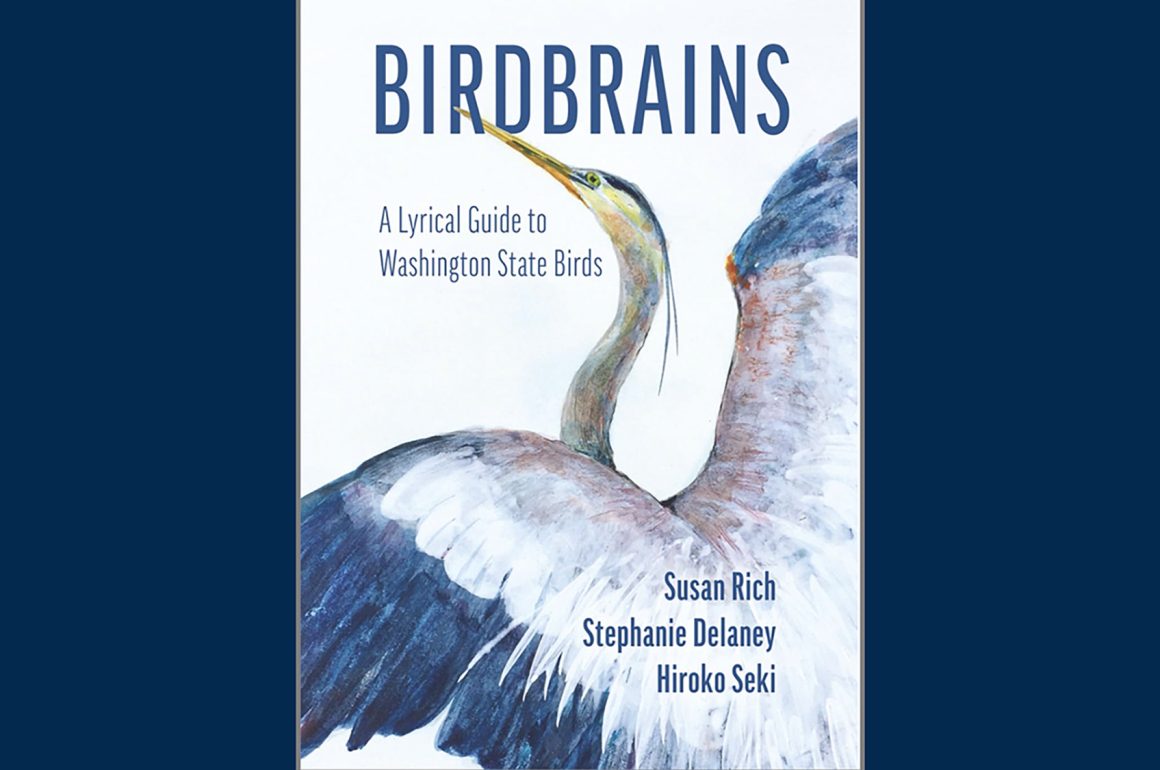
How to celebrate birds? Let us count the ways. We watch them; count them; talk about them; Discord, WhatsApp, and GroupMe their presence; plan special days and festivals around them. We write songs about birds, we photograph birds (sometimes to the point where they are barely recognizable in an attempt to capture their beauty); we draw and journal, paint, and sculpt birds. And we write many words about them–guides, handbooks, histories, mysteries, and poetry. In Birdbrains: A Lyrical Guide to Washington State Birds, editor and poet Susan Rich seeks to celebrate birds combining three of these processes–poetry, art, and written nonfiction. This is a lovely anthology, organized with thought and the enthusiasm of a creative mind first learning to know her birds. There is a strong sense of place–this is a book focused on the birds of one singular Pacific Northwest state–but the strength of the book is that this specificity becomes a gateway to the universal.
Birdbrains: A Lyrical Guide to Washington State Birds presents visual, textual, and poetic portraits of 105 birds, residents and migrants, of Washington State. For each species, we get an exquisite ink wash painting by artist Hiroko Seki; a factual “Bird Note” by Dr. Stephanie Delaney, college administrator and avid birder; and a poem offering a lyrical, sometimes spiritual, sometimes anecdotal, sometimes even opinionated image of the bird. Editor Susan Rich has solicited poetic contributions from 97 writers (98 if you include a group of five children at Seattle Children’s Hospital).
Most of these poems are appearing in print for the first time, and of the 18 poems that have been previously published all but one (an excerpt from Lyanda Haupt’s Mozart’s Starling) were published in small and university press poetry books and journals. It’s a stellar group of writers. Three are Pulitzer Prize winners (Rae Armantrout, Ted Kooser, and Diane Seuss), four are Washington State Poet Laureates (Elizabeth Austen, Claudia Castro Luna, Kathleen Flenniken, and Derek Sheffield), others are local poet laureates, winners and finalists of prestigious writing awards, beginning poets, MacArthur fellows, teachers, and–in several cases–birders! Backgrounds are also diverse, including members of Washington’s Native-American tribes. Most of the contributors have a connection with Washington State and the Pacific Northwest; place names like Puget Sound, Bainbridge Island, Olympic Peninsula, Bellingham, Tacoma and of course Seattle echo throughout the poet biographies at the back of the book.
The poems, most no more than one page in length, are wonderful reading. They offer the essence of each species–a fleeting glimpse of a flock of Bushtits (“that glitch in my vision”); the frenzy of a Pigeon Guillemot as he catches a fish to share with his mate (“He shakes and shakes/ it, and in a burst of joy, splashes his wings/ on the water…”); a Common Nighthawk catching insects at dusk (“A boomerang that you could never catch/Misnamed, voracious, cheerful in his cry”). Some of the poetry touches on the intersection of humans and birds. Risa Denenberg laments “the dwindling numbers” of the Tufted Puffins she sees from her desk, one couple now nesting in Discovery Bay. In a very different piece, one that editor Susan Rich calls “flash fiction,” Harold Taw presents the voice of the Stellar’s Jay arguing against the ‘handle’ of @stellarsjay. Couched in social media abbreviations and odd spellings, the Jay asks, “But who was German naturalist Georg Wilhem Steller 2 us? Mr. Steller did not “discovR” us in 1741. Our kind arrived alongside the indigenous peoples of the Americas as the ice shEts reCded….” It’s funny, touching, and sad, striking the mind and senses in a way that a more factual article could not.
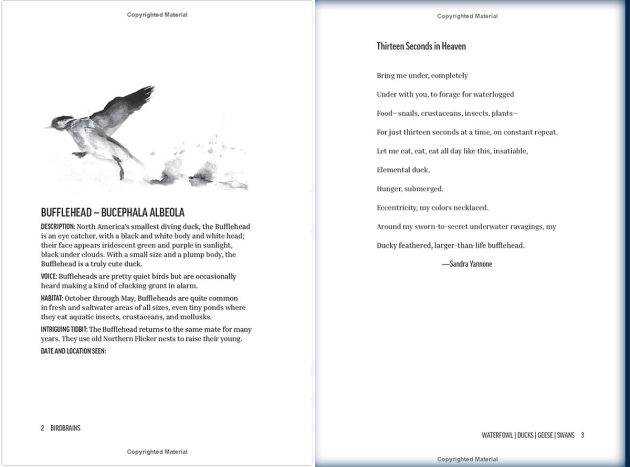
© 2025 Raven Chronicles Press, “Bufflehead,” illustration by Hiroko Seki, Notes by Stephanie Delaney, poem by Sandra Yannone.
Birds range from species seem across the United States (Bufflehead, Bald Eagle, Killdeer, Mourning Dove, American Kestrel, Belted Kingfisher, Barn Swallow, American Robin, American Goldfinch–state bird of WA, Song Sparrow) to species iconic to the Pacific Northwest: Snow Goose, Glaucous-winged Gull, Pigeon Guillemot, Vaux’s Swift, Common Raven, Stellar’s Jay, Mountain Bluebird, Varied Thrush, Wilson’s Warbler, Sagebrush Sparrow, Western Tanager and more. (Yes, Snow Goose migrates through central and Easter U.S., but there is nothing more emblematic of Washington state birds than the massive flocks of Skagit Valley in winter.) It’s a relatively small proportion of total number of birds commonly seen in Washington State–the ABA Field Guide to Birds of Washington (Paulson, 2020) lists 308 species–and the persnickety eye might comment on the omission of favorites like Mountain Chickadee, Red-breasted Sapsucker, Red Crossbill, and MacGillivray’s Warbler, but this is, I think, a very good representation of Washington’s bird families. Birds were chosen by the poets contacted by editor Susan Rich, and I’m sure there was more of an effort to achieve this diversity than she lets on in her introduction (I wonder how many writers wanted to wax lyrical about those Snow Geese flocks?).
The Bird Notes by Stephanie Delaney give brief, chatty introductions to each species, listing Common and Scientific Names, Description, Voice, Habitat, Intriguing Tidbit, and an open-ended section for Date And Location Seen. By “chatty,” I mean that the section uses whole sentences, making the descriptions easier for the beginning birder to read than the abrupt notes of a typical field guide. Descriptions include size, plumage, most notable field marks, and notes on behavior such as social grouping or typical movement. Habitat sections are oriented towards Washington State and often includes the state areas and parks where the bird is typically found. Though there is no section for distribution and status, the notes often comment on whether the species is seen year-round or in a specific season. The Intriguing Tidbit section is, of course, the best, offering fun and educational facts on feeding, nesting, and ecology not often found in field guides. Overall, I was very impressed with these Notes, they complement and enhance the artistic creations of the book.
The art by Hiroko Seki is a perfect match for the poetry. Hiroko Seki, who got her start in silk-textile and Yuzen kimono painting, is a Sumi-e artist. Sumi-e is also called ink wash painting, but it’s a very specific process, involving simplicity and spontaneity. A website about Sumi-e says it was introduced in Japan by Zen monks, and “as in Zen practice, reality is expressed by reducing it to its pure, bare form. Touch-ups, additions and decorations do not enhance a work but rather hide its true nature.” It may take a few minutes for the eye to adjust to this type of avian illustration, we are much more used to sharp color photographs or Audubon-type paintings illustrating our bird books. But I think it’s clear how appropriate this type of art, which is all about the essence of spirit, suits the poetry of this book, which is all about essence, immediate observation, and spontaneous reactions.
Editor Susan Rich’s contributions aren’t as evident as her collaborators, but we wouldn’t have this volume without her pursuit of an idea that came to her as she was looking for a new life passion. A beginning birder and resident of West Seattle, she writes that “the idea for Birdbrains: A Lyrical Guide to Washington State Birds arrived all at once, whole cloth, over a long holiday weekend and within a month had a commitment from Raven Chronicles Press. Rich is a poet and editor of prose anthologies who has received the PEN USA Award, her most recent poetry books are Blue Atlas (Red Hen Press) and Gallery of Postcards and Maps: New and Selected Poems (Salmon Poetry).
Birds are organized very loosely by taxonomic groups, “loose” being the operative word, and species belonging to the same family are sometimes mixed up with birds from other families, which makes my birder’s head spin. There are editing mishaps which I hope can be corrected in future editions. The section entitled “SHRIKE | VIREOS | CORVIDS | SWALLOWS” does not include shrikes nor swallows. The section BLACKBIRDS | FINCHES | SPARROWS includes only Vesper Sparrow. Two sections later, we find six sparrow species in a section entitled NATIVE SPARROWS | WESTERN TANAGER | LAZULI BUNTING. There is no reason that I can see to single out Vesper Sparrow, it’s a common migrant, just like Golden-crowned Sparrow, and I think this separation will be confusing to readers unfamiliar with taxonomic families. Catbird is tacked onto the end of the “Native Sparrows” section as if it’s an afterthought.
Finally, the entry on Double-crested Cormorant appears to feature a poem by C. Hunter Davis about the Pelagic Cormorant. The poem begins: “Pelagic cormorants’ / wings kited out in wind / twisted in thistle-sized rain” and continues a few lines down with “these warriors of winter / are servile to the sea” (p. 43). Now, this could be a case where the word ‘pelagic’ is meant to be an adjective not a bird name, but Davis is described in the bio section as “a poet who lives among birds, writes a column on birds, and sometimes wishes she was a bird” (p. 284), so I wonder if she would make this type of error. Perhaps the poem is about both cormorant species?
There are substantial back-of-the-book sections, something that always makes me go, “Hooray!” The sections include “Traveling,” a lyrical poem by well-known poet Rae Armantrout that speaks to the mysteries of living amongst birds; Glossary, selected definitions of terms such as ‘indicator species,’ Resources, Bird Index, Permissions and Publication Credits; Bibliographical Notes: Writers; Bibliographical Noted: Editorial Staff; Other Raven Books and Publications; and Publisher’s Acknowledgments. The Bibliographical Notes (actually Biographical Notes) are great, paragraph-long bios that give professional, creative, and sometimes life-style backgrounds of this long list of contributors. I found them very useful in writing this review! I’m happy that there is an index listing common and scientific bird names, but it should be improved so birds are listed by the second word of their common name–“Sparrow, White-crowned,” for example, rather than “White-crowned Sparrow.” People new to bird identification are not likely to remember complete names, just that the bird they’re looking for is a sparrow or a finch. The Resources section offers an excellent basic collection of books, organizations, and web sites useful for learning about and identifying birds in the field. My only note is that the Additional Field Guides and Books section should include the ABA Field Guide to Birds of Washington by Dennis Paulson (Scott & Nix, 2020), a helpful guide for beginning birders and young people.
I thoroughly enjoyed reading and reviewing Birdbrains: A Lyrical Guide to Washington State Birds, a book I probably would not have known about were it not for the efforts of Raven Chronicles Press’s publicist. A major source of my joy is the quality of the book itself. This is a book made of good paper and readable fonts in dark ink, that is designed with value for the contrast of printed matter to blank space, that allocates ‘real estate’ to illustrations, that decadently separates poems with dragonfly-printed pages and devotes whole pages to section titles. Reading a book designed so cleanly and thoughtfully is as spiritually smoothing to my eyes as the content is to my brains and heart. Thank you, editor Susan Rich, book and cover designer Tonya Namura, and publisher Raven Chronicles Press to thank.
Raven Chronicles Press is a nonprofit, independent publishing organization that started as a community-based literary magazine in 1991 and became a publisher of “work that embodies the cultural diversity of writers and artists; work that expresses family and forebears; work that connects with the soil, water, and air of place and home” in 2016. Although Birdbrains is one of their few titles in the nonfiction category (they are named ‘Raven’ for the mythological storyteller Raven, not the covid), I hope it will motivate them to publish more titles about the Pacific Northwest and nature. I also hope that this “lyrical” celebration of birds will serve as a model for future creations from poets and artists and writers. It’s an inspiring way to encourage interest in birds, nature, ecology, and conservation without beating one over the head about it. It’s also a unique way to introduce birders to poetry and art, breaking down the often superficial barriers between the creative arts and natural sciences. More poetry, more drawing, more independent presses, more celebration of birds!

© 2025, Raven Chronicles Press; snippet of back cover: editor Susan Rich, writer Stephanie Delaney, artist Hiroko Seki
Birdbrains: A Lyrical Guide to Washington State Birds
by Susan Rich (editor); Stephanie Delaney (bird notes); Hiroko Seki (artist)
Raven Chronicles, Nov. 2025
342 pages, 6 x 1.06 x 9 inches, 1.73 pounds
ISBN-10 : 1735478091; ISBN-13 : 978-1735478098
$38.99 (discounts from the usual sources, including publisher)




The three-part format sounds especially effective: Hiroko Seki’s ink-wash portraits, Stephanie Delaney’s approachable Bird Notes, and a poem for each of the 105 Washington species. The glimpses of Bushtits as a visual glitch and the joyful Pigeon Guillemot shaking its fish made me want to read those poems in full. I also appreciated the regional detail, especially the massive winter Snow Goose flocks in Skagit Valley. It is a thoughtful way to connect field-guide observation with art and the lived experience of birding.