

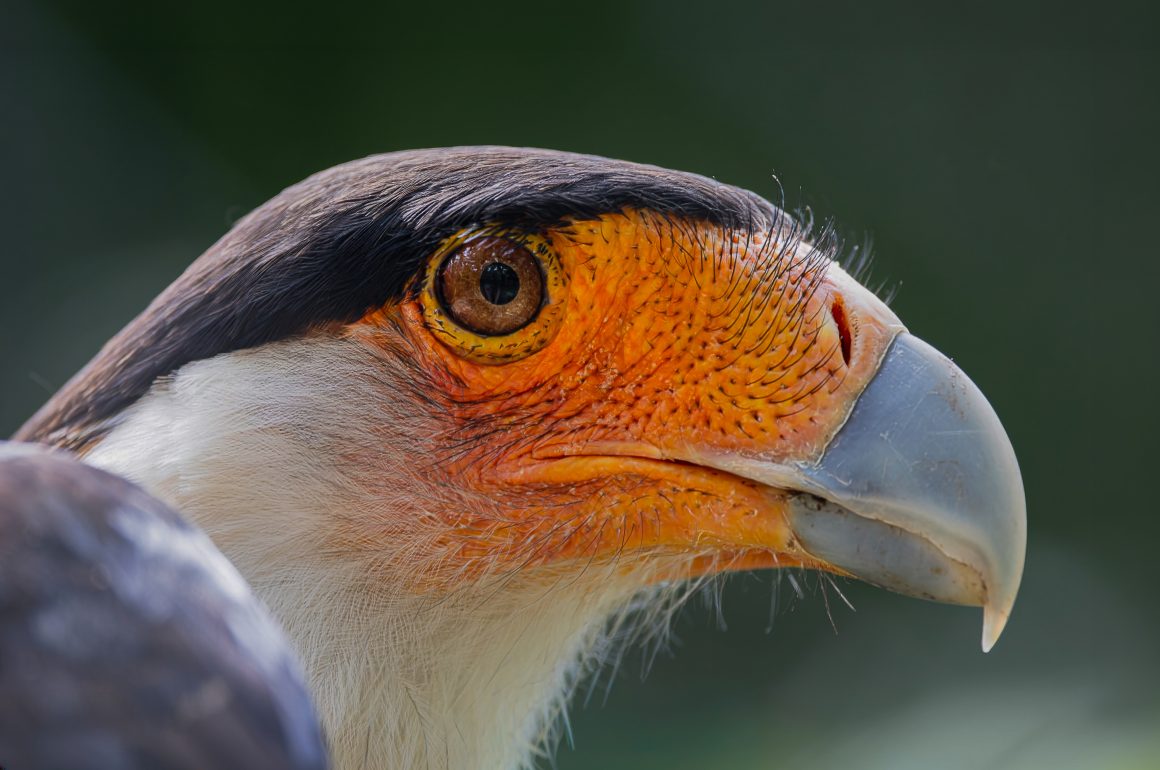
Though caracaras are members of the falcon family, their behaviour can sometimes make you wonder.
When I think of a falcon, I picture speed, sharp turns and a bird that seems built for the chase.
Yet one of the caracara scenes I see fairly often is the other way around. I hear a commotion overhead, look up, and there is a Yellow-headed Caracara being chased by birds a fraction of its size. Falcons get mobbed too, of course, so this is hardly something unique to caracaras, but there is still something amusing about seeing a member of the falcon family so firmly encouraged to move along.
The differences do not stop there. Caracaras are perfectly capable hunters, but many spend a surprising amount of time on the ground. They walk, run, scavenge and investigate whatever might provide a meal. Speed is useful, apparently, but so is checking to see what everyone else has left behind.
There are nine living species of caracara, all found in the Americas. There was another until relatively recently: the Guadalupe Caracara, found only on Guadalupe Island off Mexico, but it is now extinct.
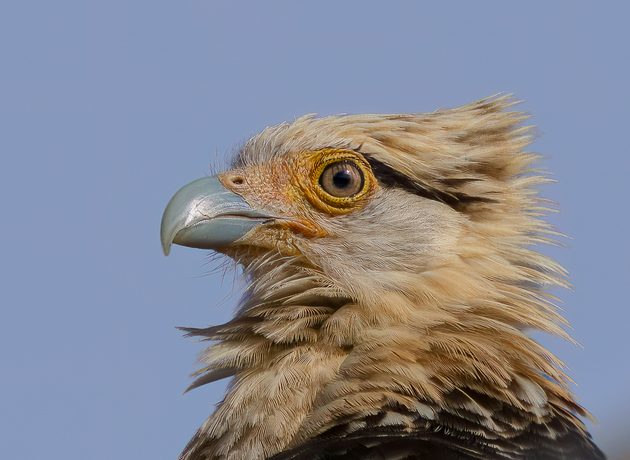
Here in Panamá we have three, the Yellow-headed Caracara , Crested Caracara, and Red-throated Caracara. So far, the Red-throated has managed to avoid me, or I it, which leaves the other two as the subjects of this article.
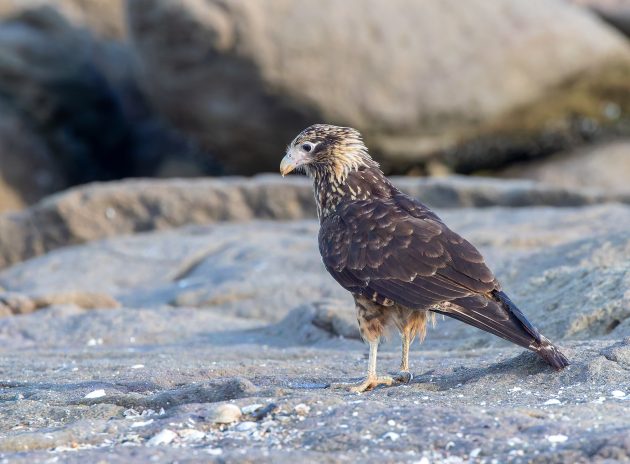
The Yellow-headed Caracara is the smaller and less imposing of the two. With its pale cream-coloured head and breast, dark wings and narrow dark stripe behind the eye, it does not have quite the fierce appearance expected of a bird of prey.
I often see them sitting quietly on a branch, fence post or other convenient lookout, apparently doing very little. Of course, that does not mean they are not paying attention.
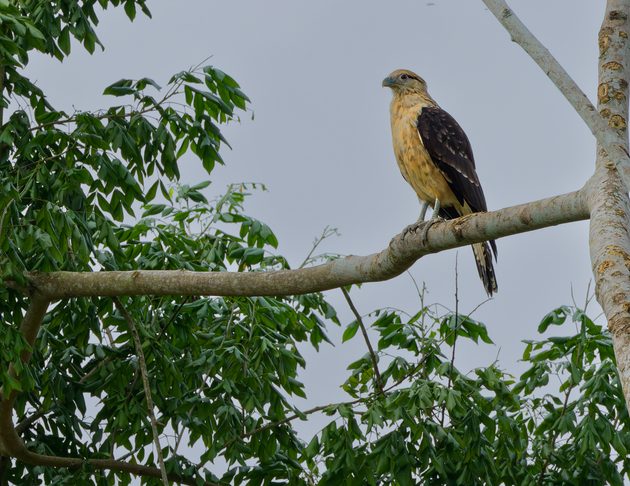
Yellow-headed Caracaras are wonderfully opportunistic when it comes to food. They eat insects and other small animals, scavenge carrion and roadkill, and spend a good deal of time foraging on or close to the ground. They are birds of open country, so pastures, roadsides and agricultural areas suit them well, they are even at home within the city limits.
They apparently also have an interesting association with cattle. A Yellow-headed Caracara may perch on an animal and pick off ticks and other invertebrates. They have even been recorded doing the same thing on tapirs, capybaras and, rather unexpectedly, iguanas.
It is certainly a different approach from chasing prey through the sky at high speed like any self respecting Falcon.
Perhaps that adaptability helps explain why I encounter them so often. They don’t need pristine forest or some distant patch of wilderness. A pasture, roadside, fence post even a high rise balcony in the city or open field can provide everything they need.
The Crested Caracara is altogether more substantial.
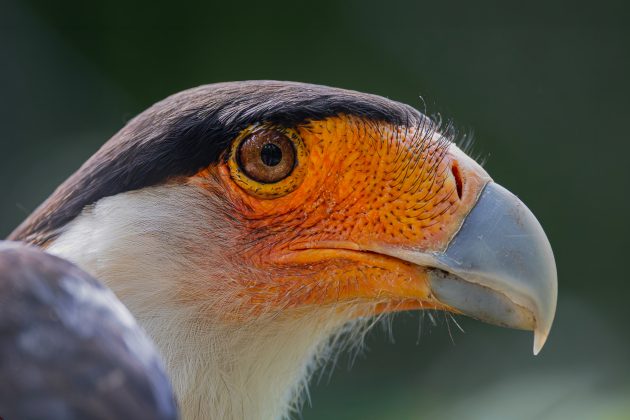
It is a striking bird: black cap, pale neck, dark body, long yellowish legs and a large hooked bill. The bare skin on the face can vary in colour, but on an adult it is often a vivid orange-red. Put everything together and this is a bird that certainly looks capable of taking care of itself.
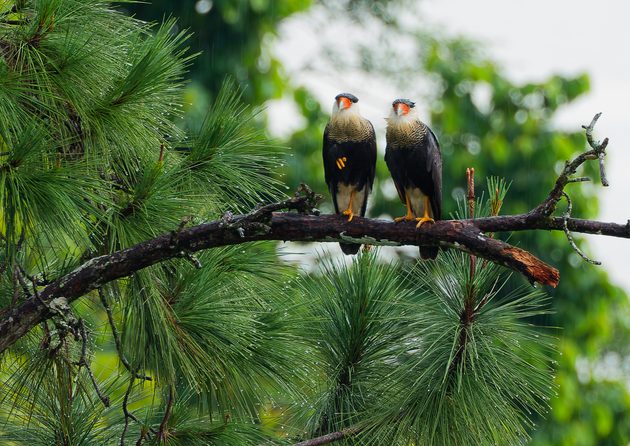
Then you see one walking.
Crested Caracaras spend a remarkable amount of time on the ground and will regularly walk or even run while searching for food. Those long legs suddenly make a lot more sense when one is striding across a pasture.
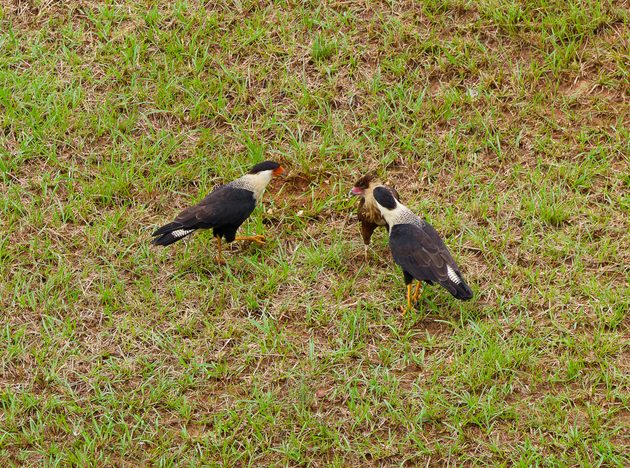
Their menu is equally practical. Carrion is an important part of it, and they often join vultures at carcasses, but they also eat insects, fish, reptiles, amphibians, birds and small mammals. They turn over debris looking for insects, dig for turtle eggs, wade into shallow water after fish and take advantage of animals disturbed by fires or farming activity.
In short, if there is a possible meal involved, a Crested Caracara seems willing to investigate.
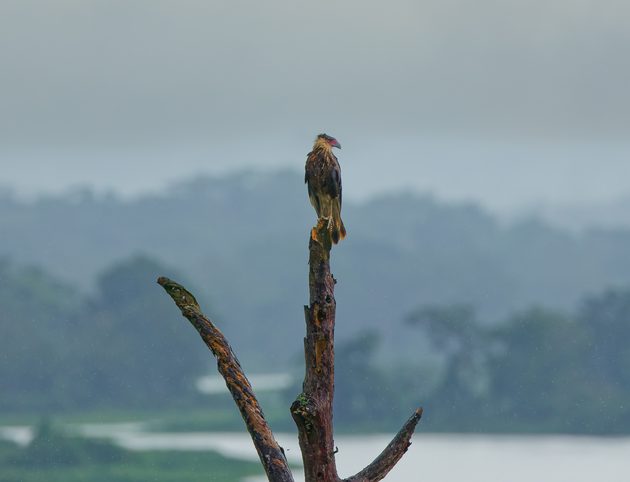
I often find them perched somewhere open, a post, a bare branch or another convenient lookout, watching what is happening around them. Despite their rather commanding appearance, they are mostly silent. When they do call, they can throw the head backwards and produce a strange rattling sound, but most of the birds I encounter seem content to sit quietly.
There is another interesting departure from the usual falcon routine. Most falcons don’t build what we would think of as a conventional nest. Crested Caracaras do, collecting sticks and other plant material to construct their own.
The more I watch caracaras, the less surprising any of this becomes. A caracara can look thoroughly imposing one minute and oddly casual the next. It may be hunting, scavenging, walking through a pasture or simply sitting on a post doing very little at all.
Whatever it is doing, it rarely seems particularly interested in behaving the way I expect a falcon to behave.





Maria Bethânia made a wonderful song about the caracara and its link to poverty through its scavenging of drought and famine victims; where birding meets social commentary: https://www.youtube.com/watch?v=7XXK9WfBJmQ
Entertaining birds, beautifully described by Fitzroy. I remember sitting on the beach on Sea Lion island in the Falklands (South Atlantic) and having a pair of striated caracaras come over to inspect me. It was a bit of a shock for a bird to come to me, rather than fly away at the sight of me. I was specially excited as striated caracaras have the most restricted range of any of the family, so are a good one to see.
Such an interesting group of birds, the caracaras. They’re undeniably some of the most calculating birds, evident by their resourcefulness and willingness to adapt, function in small groups, the list goes on!
A caracara hitching a ride on a cow to pick off ticks is such a wonderfully un-falcon-like image. It is fascinating how this family swapped high-speed pursuit for patience and opportunism — more like raptors that decided to read the room instead of the rulebook. I had no idea the Guadalupe Caracara held out until such a recent date; a sobering note to set against all that adaptability. Best of luck with the Red-throated — sounds like a fine excuse to keep wandering pastures and roadsides!