

By Matthew Kwan
Matthew Kwan is a birder, bird guide, and wildlife photographer based in Hong Kong. He has been writing a birding blog ‘As the Crow Flies’ about birding in Hong Kong and his travels since late 2014. His passion for birds started at the age of six, when he saw his first Common Kingfisher in an urban park and was hooked ever since. He is currently a member of the record committee for the Hong Kong Bird Watching Society.
For many birders, birding is all about the thrill and excitement of chasing a rarity, the buzz of finally nailing a target bird, and the adrenaline that comes with it is what keeps us birders going. Recently, I experienced something entirely different, a bird that brought a range of emotions, a bird that brought me to tears.
In March 2026, we went on a birding trip to the island of Mindanao in the Philippines. I’ve wanted to visit Mindanao ever since I learned about the many Philippine endemics. We visited the forest of T’boli for the rare Mindanao Lorikeet, hiked up Mount Kitanglad for the legendary Philippine Eagle and Apo Sunbird, and we even found two mysterious and little-known Mindanao Serin while we were there (a story for another time)!
Our last leg of the journey was the infamous PICOP. For those who are not familiar with PICOP, it is a remnant lowland rainforest near the town of Bislig, owned by the Paper Industries Corporation of the Philippines (PICOP). The company have ceased active operations since 2006, due to management disputes and changes in environmental logging restrictions, the land they previously operated in transitioned back to being controlled by the Philippine government. Although the paper company no longer operates there, the entire area has essentially become a free-for-all to illegal settlers who chop trees down to sell on the black market; many of them also hunt wild animals for food or for sport. Having read numerous trip reports about the place, I was expecting to hear chainsaws and gunshots daily, but seeing and hearing it firsthand was a whole different matter.
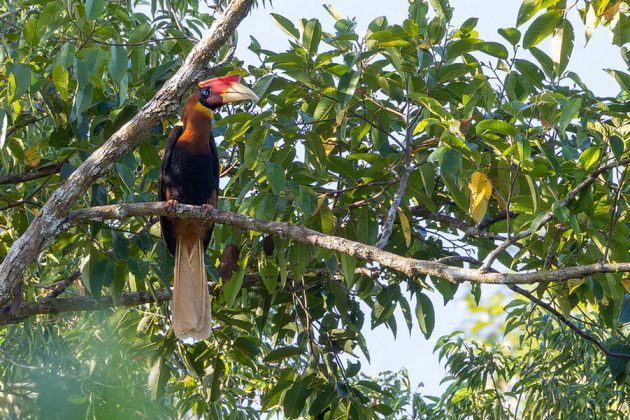
Rufous Hornbill
Wattled Broadbill
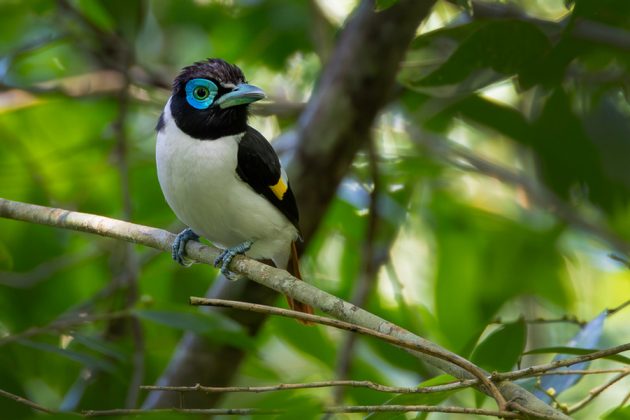
For birders visiting PICOP, the site grants you a chance to glimpse some of the most sought-after lowland species of the Philippines, such as Rufous Hornbill, Writhed Hornbill, Blue-crowned Racket-tail, Wattled Broadbill, Azure-breasted Pitta, Black-bibbed Cicadabird, Mindanao Pygmy Babbler and Short-crested Monarch, just to name a few of the goodies that await birders there. The holy grail of PICOP is no doubt the Celestial Monarch, a bird so beautiful it was named after the divine, as if it itself descended from heaven.
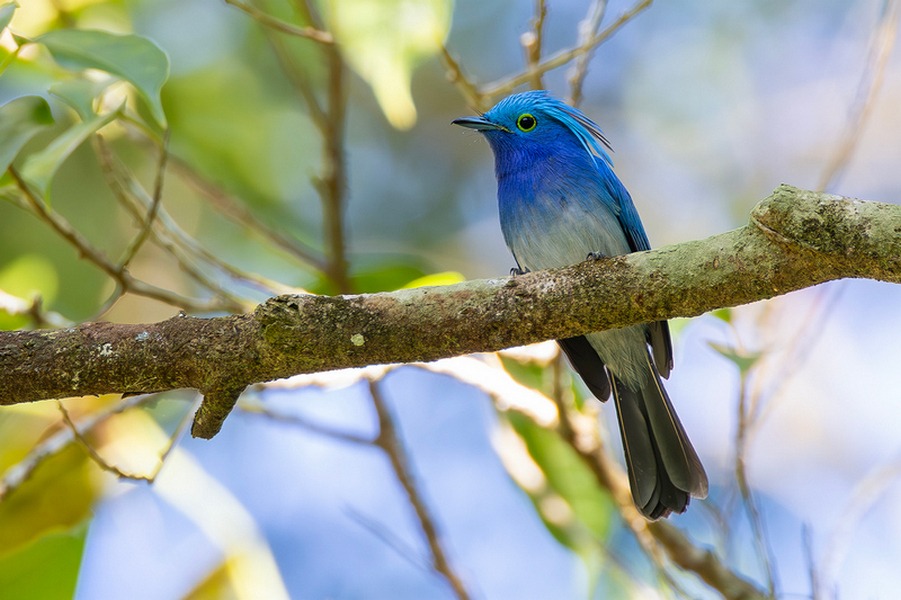
The Celestial Monarch is often described as one of the most attractive-looking monarchs in the world, with turquoise blue plumage from head to tail; the male sports a green orbital ring and a long cerulean blue crest. While it is not unique to Mindanao, this once widespread Philippine endemic has seen much reduction from its former range, with very few recent records in Luzon, east Mindanao, and Samar, which appears to be the very last stronghold of this species, with PICOP being one of the most accessible locations for visiting birders to have any real chance in finding one.
Our bird guide, Zardo
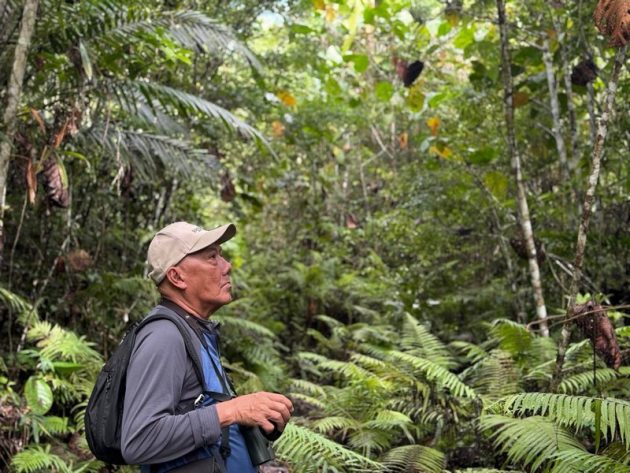
We were guided by Sir Zardo Goring, a birdguide that is just as legendary as the birds themselves, one of the pioneer birders of the area. (For those who wish to know his story, there is an excellent article written about him on the Wild Bird Club of the Philippines https://birdwatch.ph/2023/03/31/behind-the-guide-zardo-of-picop/) He knew the area like the back of his hand, and with his help, we managed to get an excellent selection of our target birds on the first two days. Seeing all the new lifers was exhilarating; I was ecstatic with all of our findings and even felt a bit proud of the progress we were making. However, one bird eluded us, and that was the Celestial Monarch. We went to all the places Zardo had seen them before and didn’t even hear a single call from the bird.
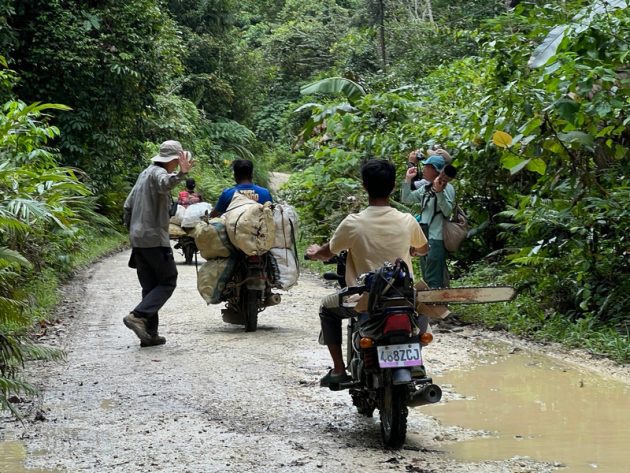
Illegal loggers
Truck full of illegal timber
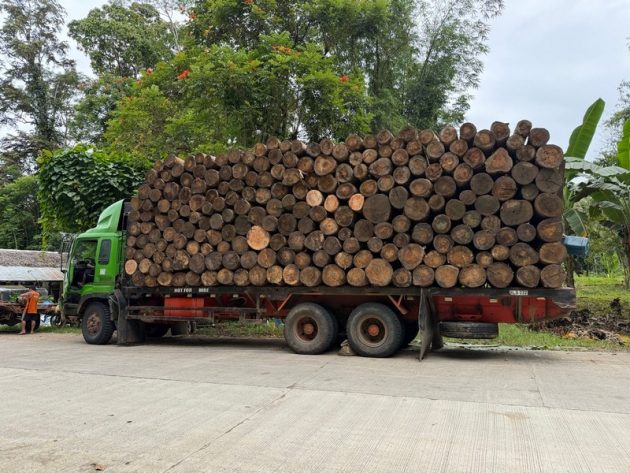
Over the first two days, we saw truckloads of illegally logged timber, illegal loggers with chainsaws, young men pulling trees from the forest using motorcycles, and hunters with guns loaded on their backs. At one point, we were watching a pair of Rufous Hornbills when suddenly a gun fired nearby, which no doubt was aimed at the hornbills. At present, the habitat in PICOP is already highly degraded; there were very few large trees left, and in some areas, we were walking through what is essentially shrubland. Each of those events chipped away at me, and I was slowly feeling the weight of it all. We had one last morning to look for the Celestial Monarch; we knew this was our last chance.
“Celestial Monarch, it is calling!” Zardo exclaimed in a low voice. It was calling from a tall tree close to us, and I managed to catch a quick glimpse of the electric blue bird. For the next few minutes, we were all clamouring to get a photo of our main target, which proved difficult in the dense vegetation. I finally caught sight of it on an open branch for a few seconds. I tried to focus my camera on the bird, but I just couldn’t! It was only then that I realized my hands were literally shaking, perhaps from the adrenaline of seeing the bird. I was so frustrated with myself for having missed the shot I could have taken. Fortunately for me, the bird did not go far. It soon returned, this time perched on an open branch, preening for a few minutes!
Celestial Monarch
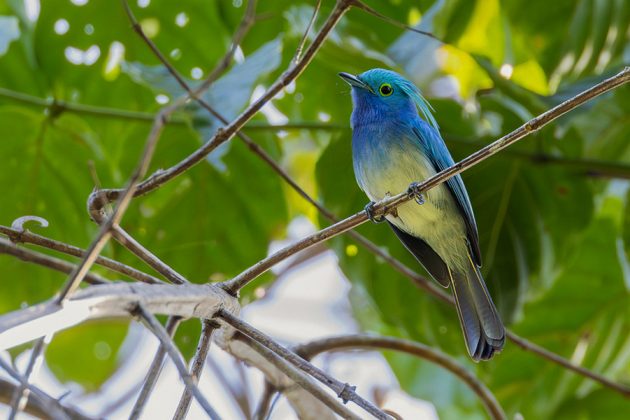
I managed to gather my composure and got the photo I wanted. The moment that happened, I broke down in tears. The tears were a mixture of joy, excitement, sadness and despair, the emotions of having seen all the constant destruction around us. I suddenly realized we could be the last generation to see the Celestial Monarch at PICOP, to think that the future generation may never get a chance to be in awe of its beauty, to think that children growing up here may never know such an incredible bird existed. Some say that at the current rate of deforestation, the forest in PICOP could disappear within the next 10 years, and having seen the destruction firsthand, I would say that is a very optimistic prediction.
A sight all too common at PICOP
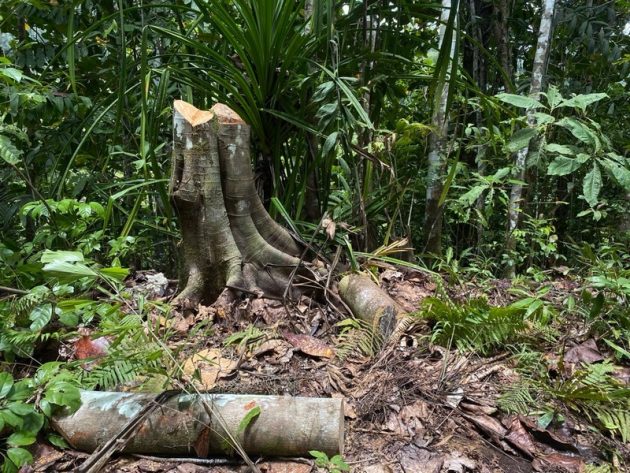
There are currently no conservation efforts or plans going into protecting the forest of PICOP. The sad reality is that settlers there live in poverty, and selling the timber provides them with quick financial gains.
The town of Bislig and the forest of PICOP are seldom visited by tourists, with the exception of visiting birders. Providing financial benefits through birding to the local community could be a way forward, letting them know that by protecting the forest and birds, they may actually make more money in the long term than just cutting down the forest entirely. We have seen this happen in many parts of the world, where local communities recognize the benefits birds can bring and start protecting the birds themselves. I see no reason why this model can’t work at PICOP. Zardo told me he is hoping to hold a birding festival at Bislig, which may draw more attention to the avian wonders of PICOP, so perhaps there is still a glimmer of hope in all the destruction.
As if knowing it was our last morning there, the Celestial Monarch gave us one last look, this time in very good lighting at close range. I was very happy to be able to get a photo that does it justice, as it truly is one of the most remarkable birds of the Philippines, and I will forever remember it as the bird that brought me to tears.




Wow, such a moving essay (thank you!), and very sadly, I am sure, an experience that can be recounted in so many places, especially given the current environment-unfriendly politics, from the US to Brazil.