

Bird names can be many things: descriptive, evocative, flattering, inaccurate, deceptive… the list goes on. A favourite name for members of the Burhinidae, for example, is thick-knee, which is misleading, as it’s not the knee that is thick, but the birds’ ankle joint. We British tend to call thick-knees by the name of stone-curlews, which is quite appropriate as they sound like curlews and like to live on stoney ground. My most recent Australian field guides call them stone-curlews, too. In Southern Africa these birds are invariably called dikkops, which translates from Africaans to English as thickhead. It sounds unflattering (you wouldn’t want to be called a dikkop, would you?) but if you look at my photograph of a Water Dikkop (below) you will see it’s really quite an appropriate name.
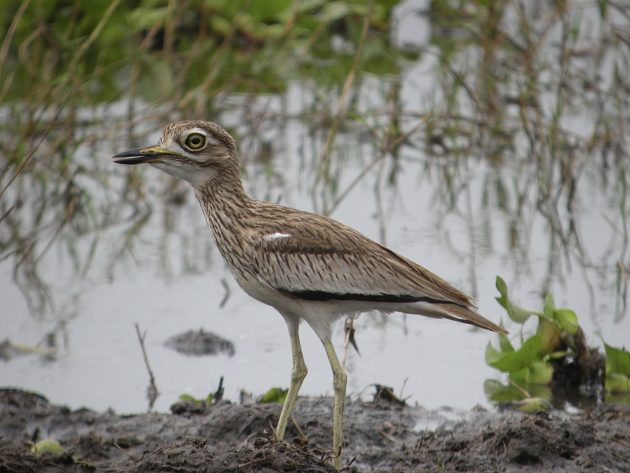
Water Thick-knee, or Water Dikkop, photographed in Uganda. This is a widespread species south of the Sahara
There are 10 members of the family Burhinidae: last week I wrote about the Stone-curlew (or Eurasian Thick-knee), which is the only one that occurs here in Britain, or indeed anywhere in Europe. It has seven similar cousins, all of which share the same yellow staring eyes, long legs and cryptic plumage. Confusingly, if you follow the names provided by the latest AviList, which I have done here, some are known as Stone-curlews, the others Thick-knees.
Anyone who has been on a safari in sub-Saharan Africa is likely to have seen two of them, the Water Thick-knee and the Spotted Thick-knee, as they are both common in suitable habitat. Of the two, the Water Thick-knee is the easiest to see, as they can often be found sitting conspicuously on river banks or on the edges of lakes, and they are never found far from water. They don’t seem to mind being looked at, as they are typically tame and approachable. This is makes a complete contrast to Stone-curlews, which are always shy and difficult to get close to. The two are similar in appearance, but their ranges don’t overlap. One of my books mentions that Water Thick-knees have an affinity with crocodiles, but it didn’t enlarge on this. I’m intrigued, as I’ve certainly seen crocs and Water Thick-knees in close proximity, but nothing which suggested any sort of relationship.
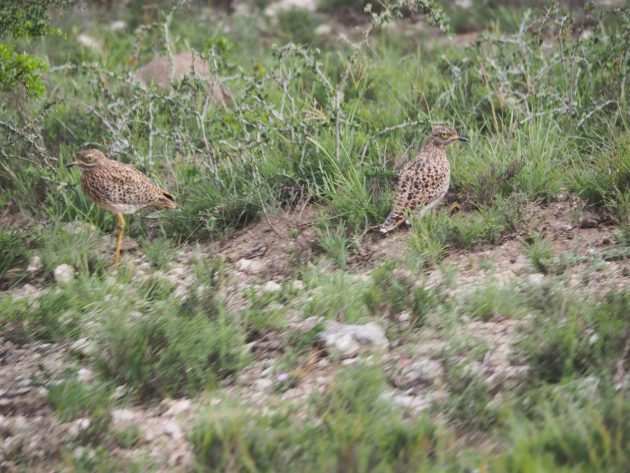
Spotted Thick-knees, or Spotted Dikkops, photographed in South Africa
You may see Spotted Thicknees on the same game drive as Water Thick-knees, but there’s no confusing the two. They may be similar in shape and general appearance, but their plumage is quite different, for the Spotted lives up to its name with its heavily spotted and streaked plumage. I’ve never seen the two together, either, for the Spotted is a bird of dry country, though it will venture into towns and sometimes nests in suburban gardens. On game drives you generally spot these birds sheltering under bushes out of the sun. Like all members of the Burhinidae they are crepuscular and most active when the sun has set, often venturing onto roads at night.
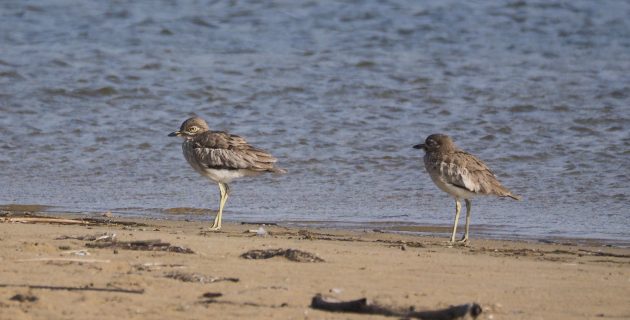
A pair of Water Thick-knees. They were photographed at Wilderness, South Africa
Both Water and Spotted Thicknees are exclusively African birds, as is the Senegal Thicknee, though this species has a more northerly distribution, as its name suggests. In appearance it looks very similar to the Stone-curlew and the Water Thick-knee; like the latter, it is often quite tame. My most memorable sightings were in Cairo, where these birds nest, somewhat incongruously, on flat rooftops, ignoring the cacophony of the busy streets below.
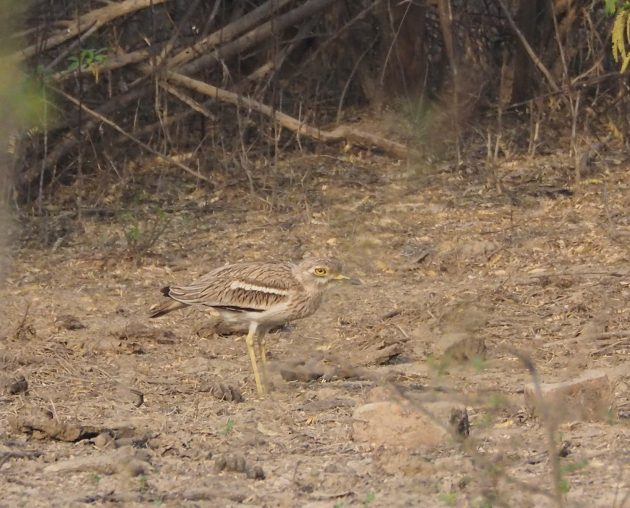
Eurasian or Indian Stone-curlew? I photographed it at Bharatpur in northern India in March 2017. My suspicion is that it is the former species, but I may well be wrong
When I first visited India the Indian Thick-knee was still regarded as a race of the Eurasian Stone-curlew, but these days it’s classed as a full species, Burhinus indicus. I should have looked at the birds I saw more closely, as they are described as being smaller and more heavily streaked than the Stone-curlew, with a proportionally bigger beak displaying less yellow. Because of the challenge of separating the two in the field, there’s uncertainty about whether Stone-curlews winter in India in any numbers – the Indian birds are non migratory. My photograph of a Burhinus species, taken at Bharapthur in northern India on 1 March, looks much like a Eurasian Stone-curlew to me, while the bird taken in Kanha National Park, also in March, does look right for indicus.
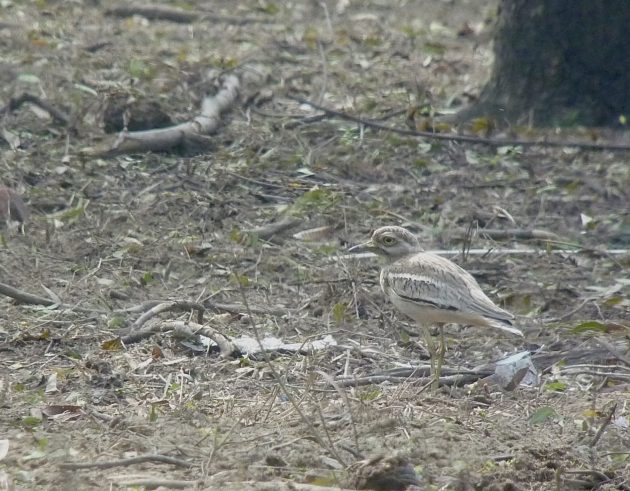
Indian Stone-curlew. Photographed in Kanha National Park in Madhya Pradesh
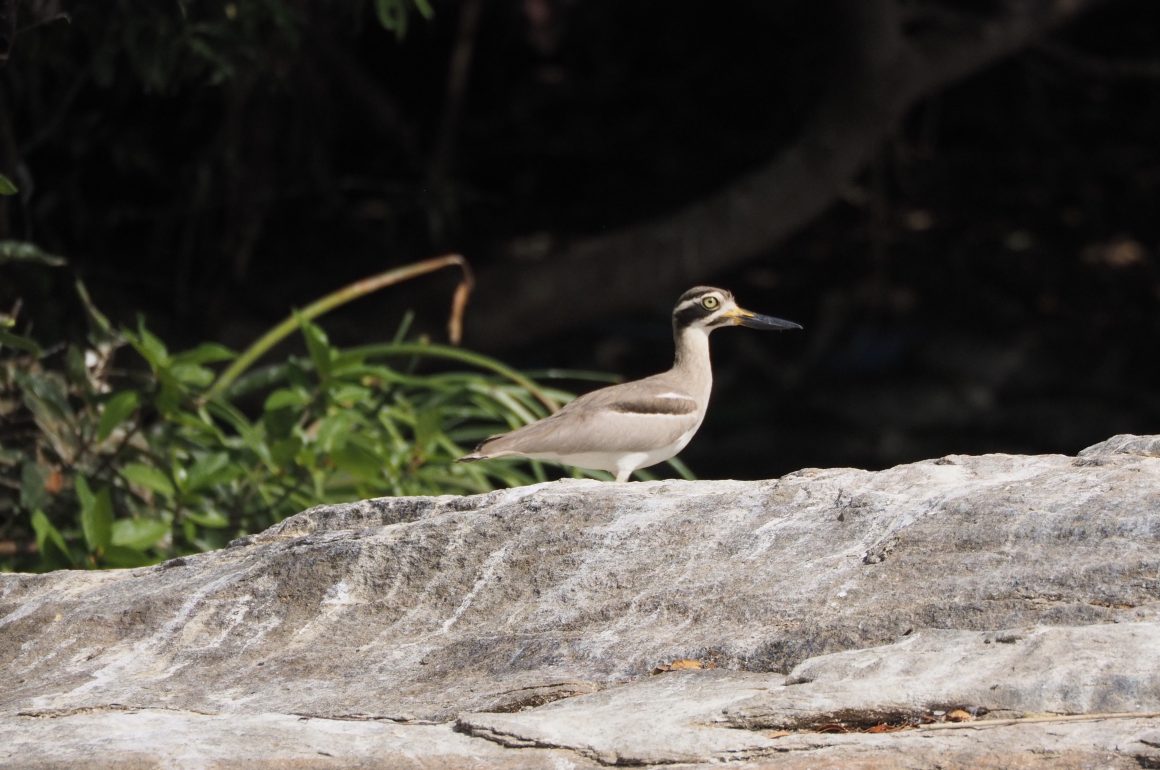
There’s no confusion at all if you are lucky enough to see a Great Stone-curlew in India, where it is a widespread bird, favouring shingle banks on rivers, coastal beaches, even intertidal mudflats. Though clearly closely related to the Burhinus birds, it’s in a different genus, Esacus, along with the similar Beach Stone-curlew which occurs on the tropical coasts of Australia, Malaysia, Indonesia and New Guinea.
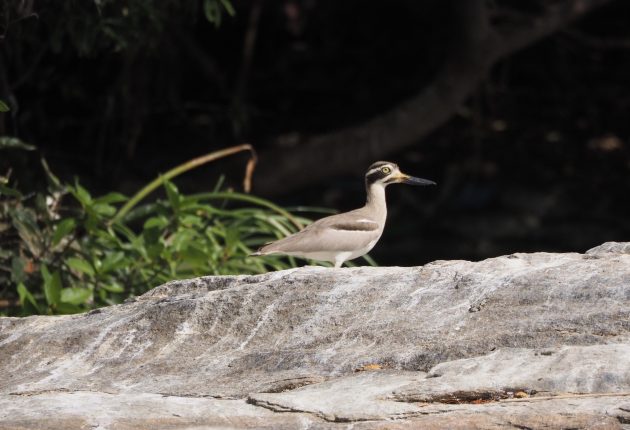
Great Stone-curlew: note the massive beak
Both the Great and the Beach Stone-curlews are big, impressive birds, much larger than most of their Burhinus cousins. They both have massive beaks, too, enabling them to catch and eat even large crabs. I recall finding Beach Stone-curlews quite easily in Queensland, but it’s many years since I last visited Australia. I photographed my Great Stone-curlews from a boat at Ranganathittu bird sanctuary, near Mysore in south-east India, a great place to visit if you want close encounters with a wide range of birds, from pelicans to egrets. I wasn’t expecting to see the Stone-curlews here, so they were a pleasant surprise.
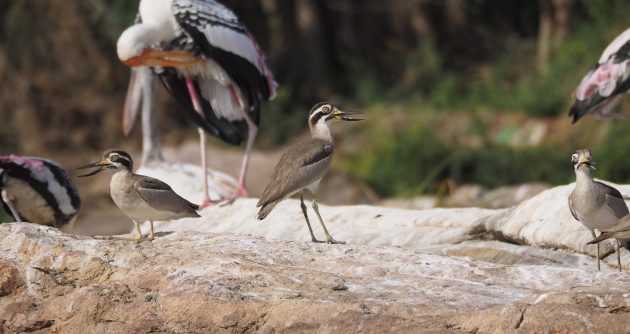
Great Stone-curlews on a hot day at Ranganathittu, panting in the sun
Perhaps the oddest of the Burhinus birds is the Bush Stone-curlew, a widespread Australian endemic. It is very big – even slightly taller than the Beach Stone-curlew – but its colouring is much more like the other Burhinus birds, and its beak is a more sensible size. Like the Beach Stone-curlew, it’s a bird I’ve also encountered in Queensland. It can be found in a variety of habitats, including golf courses and even around holiday resorts. Here it can be tame and approachable, but it is generally much more shy in the bush, walking slowly away from intruders with its head held low. I did manage to photograph both the Australian species, but my pictures are on 35mm transparencies which I have yet to convert to digital (and probably never will).
Perhaps surprisingly, the Burhinus birds are not exclusively Old World birds, for there are two species in the Americas: the Double-striped Thick-knee (it occurs widely in Central America) and the Peruvian Thick-knee. Both species look and behave like the rest of their family. My notes tell me that I saw Double-striped Thick-knees in Costa Rica in 1993, but (sadly) I can’t remember anything about this sighting, which I believe was in the northern Pacific lowlands. According to one of my reference books, these birds are sometimes kept in semi-domesticity around South American homesteads to control insects. Has anyone seen this?
I’ve never been to Peru, so have never seen the Peruvian Thick-knee, an endemic to that country. It’s the only bird missing from my Burhinus set, but as I have just reminded myself, it’s a long time since I last saw Beach and Bush Stone-curlews, and I can’t even recall seeing the Double-striped. They’re all birds I’d love to encounter again.









Weird but fascinating birds. My first stone curlew was a dikkop, second too. I dipped on the Peruvian.
Intriguing that some members of this family are so shy while others would nest on rooftops. Fascinating group of birds! Never heard of the semi-domesticated thick-knees, but I’ll certainly keep an eye out when next I’m in the appropriate habitat.