

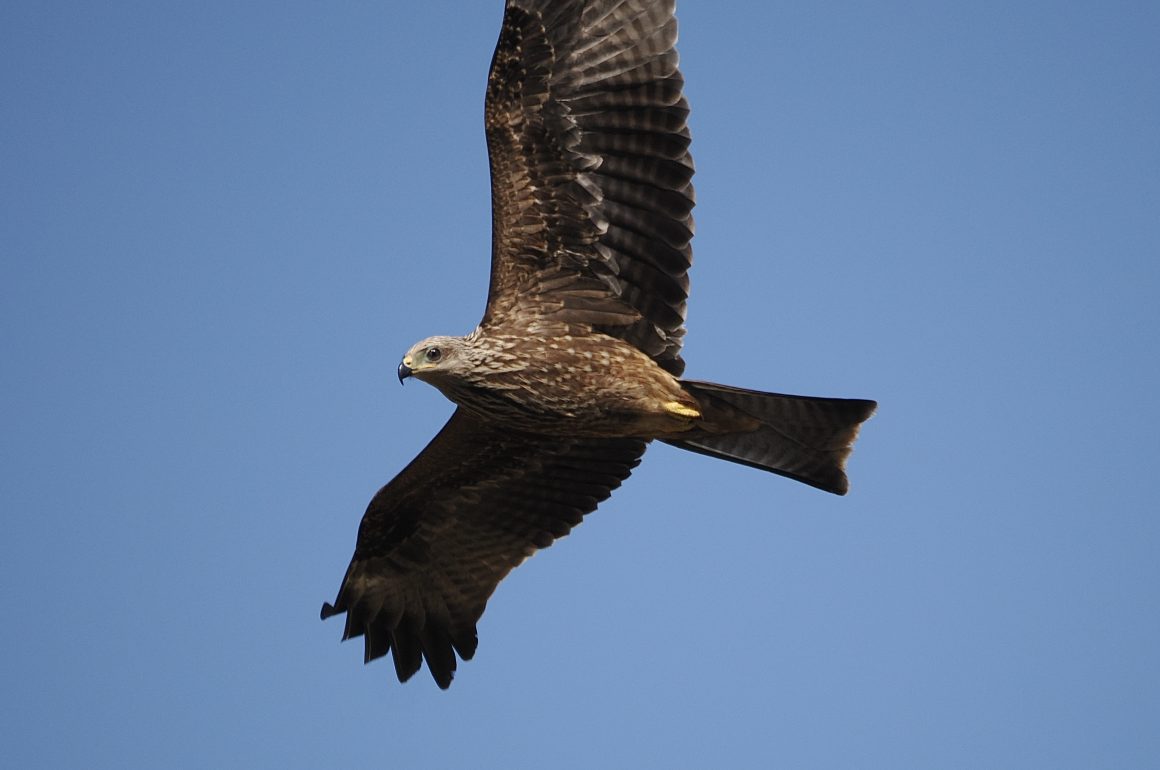
Monte da Cabranosa sounds rather more impressive than it really is. It’s a low, pine-clad hill, just a short distance away from Cabo São Vincente, the south-western most point on the European mainland. In the autumn migrating raptors tend to be funnelled towards the Cape (Cabo), due to the rising coastal plateau and the main coastal valleys. When they get to the Cape they invariably turn back inland to avoid flying out into the Atlantic Ocean, with their route taking them back over Monte da Cabranosa. Because they have lost height they are now usually flying quite low, making Cabranosa a great place to observe their passage.
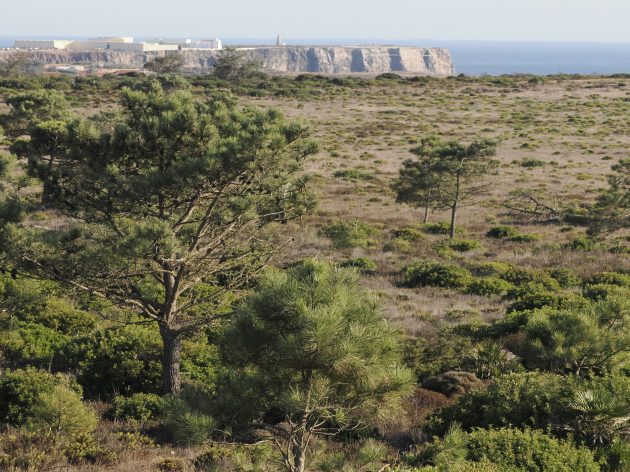
Looking south-west from Cabranosa towards Sagres, the south-western most town in mainland Europe
The raptor passage at Cabranosa starts in late August and continues through into November. The peak period is at the end of September and early October, but if you are lucky you can see an impressive variety of raptors there at any time in the autumn. Though pelagic seabirds may have been the main target of my recent visit to Portugal, there was plenty of time to look for other birds, so my companion David Tipling and I visited Cabranosa on four different days, hoping to connect with a passage of raptors.
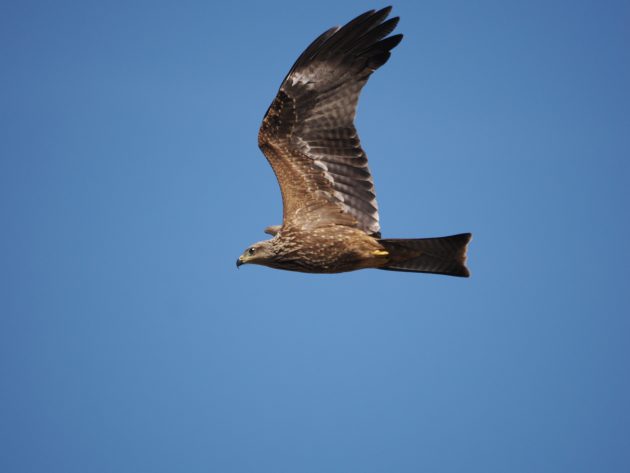
Juvenile Black Kite. Note the streaked belly that indicates its youth
The first visit wasn’t really a great success. We saw a distant juvenile Montagu’s Harrier as we approached Cabranosa, and a single very dark Honey Buzzard flew over as we arrived, but apart from Kestrels they were the only raptors we saw. There were, however, other compensations as we enjoyed a good variety of passerine migrants, including both Pied and Spotted Flycatchers, Whitethroats, Willow and Melodious Warblers and a couple of juvenile Woodchat Shrikes.
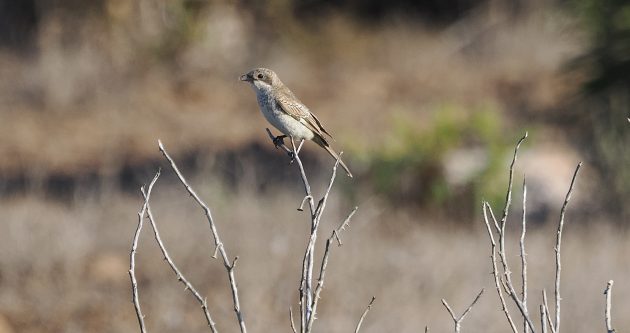
Juvenile Woodchat Shrike. Cabranosa also attracts passerine migrants
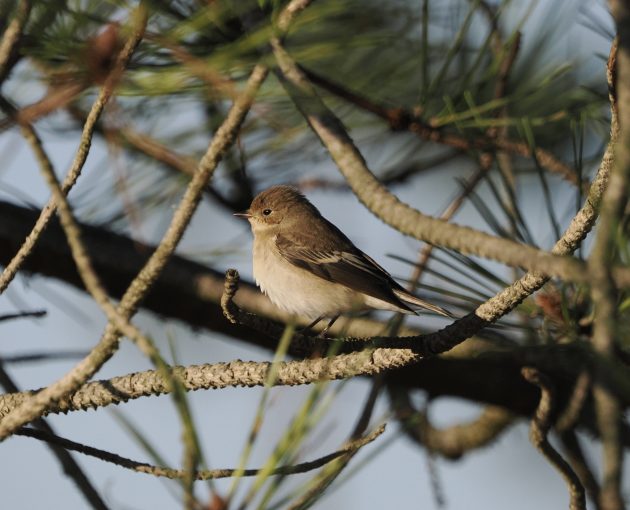
Pied Flycatcher
The following morning we returned, but there was little in the way of raptor passage: we saw four Honey Buzzards in two hours. However, our efforts were rewarded with a lengthy (though distant) view of an Eleonora’s Falcon. These falcons are rare but regular migrants in this part of Portugal, so this was a good sighting. The nearest nesting colonies of Eleonora’s Falcons to southern Portugal are in North Africa and the Canary Islands; nobody knows the source of the birds seen here.
Our third visit, the next day, was the least productive of the lot, but once again it produced a good sighting, this time of a juvenile Bonelli’s Eagle. This bird was carrying a GPS transmitter – David spotted the aerial on the bird’s back. There are a number of European projects following Bonelli’s eagles with GPS transmitters, but we have no idea where this bird was from.
It was our fourth and final visit when we finally scored with a fine passage of raptors: during the two hours we spent on the hill we recorded 11 species: Marsh Harrier, Black Kite, Buzzard, Honey Buzzard, Short-toed Eagle, Booted Eagle, Sparrowhawk, Egyptian Vulture, Hobby, Kestrel and Peregrine.
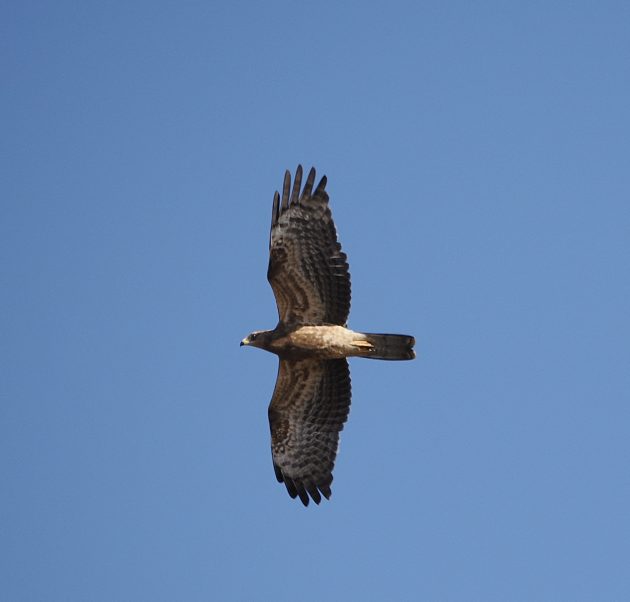
Juvenile Honey Buzzard -a typical dark individual
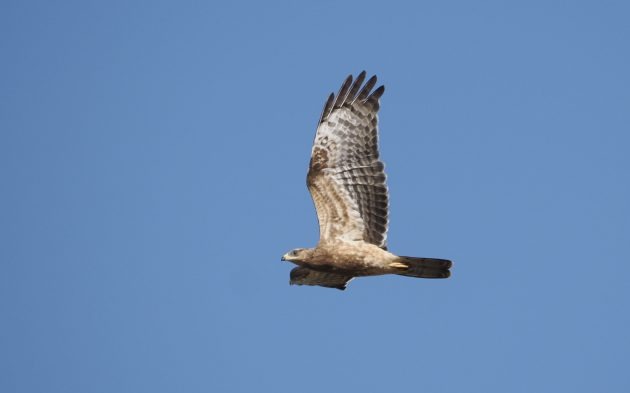
Another juvenile Honey Buzzard – note the long tail and the distinctive dark carpal patch
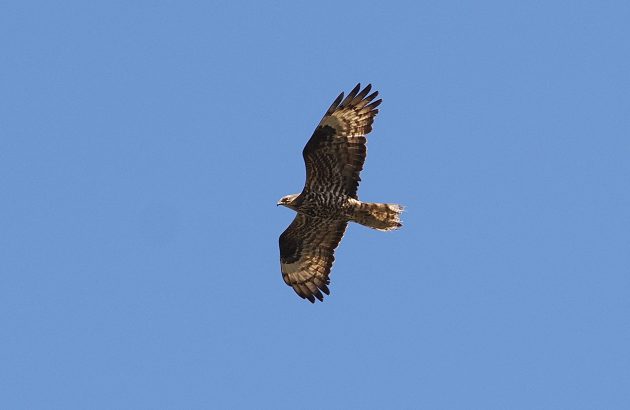
An adult Honey Buzzard. The yellow eye indicates it is a mature bird
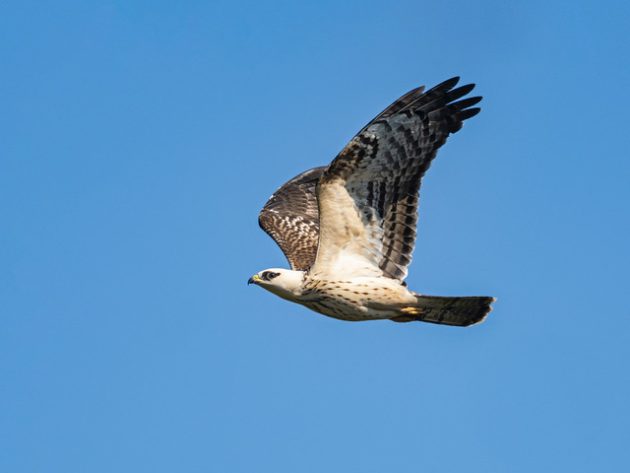
Juvenile Honey Buzzards display a remarkable variety of plumages, such as this very pale bird, photographed by my companion David Tipling
Most numerous of all were the Honey Buzzards – we probably saw 50 individuals – and we were impressed by the variety of plumages they displayed. According to the Collins Bird Guide, this species shows “very complex plumage variation, especially in juvenile”, a statement I’d agree with completely. Most of the raptors that are seen at Cabranosa are juveniles, no doubt reflecting the fact that more experienced adults avoid drifting so far off route as they migrate. All but one of the Honey Buzzards we saw were birds of the year.
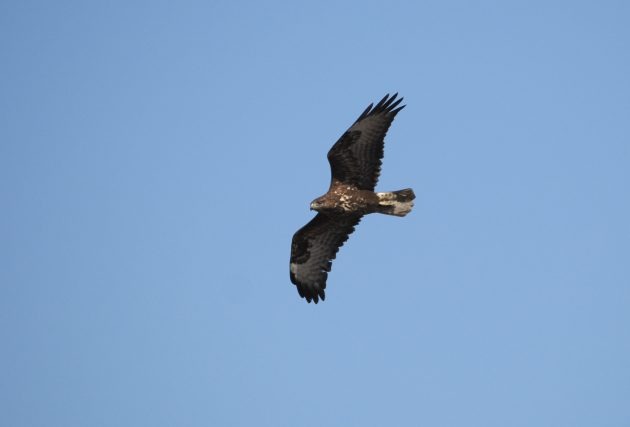
Migrant Common Buzzard
Though they are about the same size as a Common Buzzard, Honey Buzzards have a distinctively different shape, with a more protruding head and a longer, rounded tail. Their flight is quite different to that of the Common Buzzard, too, as they soar on flattish wings. However, it’s easy to list the differences, but there are times when they can be tricky to identify with certainty because of the light, or the angle you view them from.
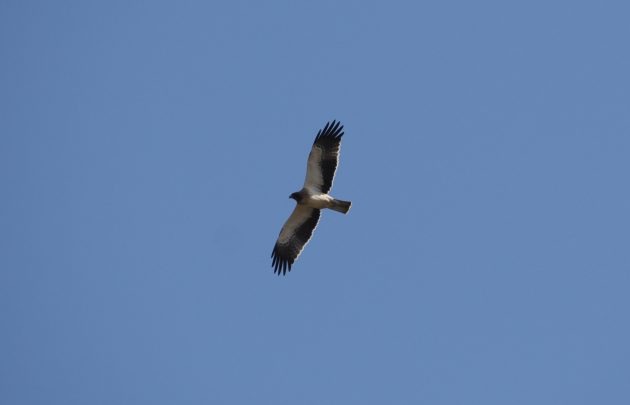
Booted Eagle: easy to identify with its pale plumage and dark primaries and secondaries
In contrast to the Honey Buzzards, Black Kites show little in the way of variation, but the juveniles are easily picked out by their streaked bellies. All the Black Kites we saw were juveniles, as were the three Egyptian Vultures. The latter are readily identified by their black plumage and wedge-shaped tails.
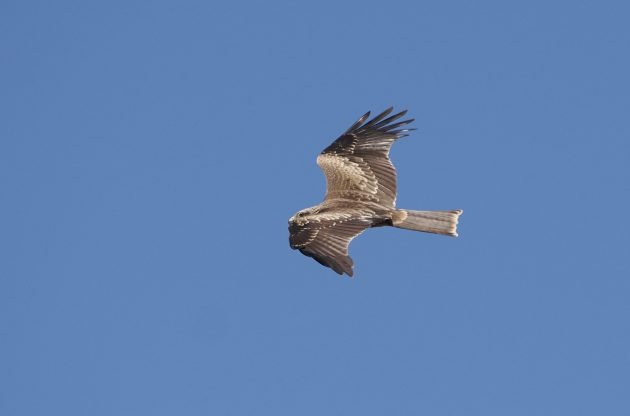
Black Kite. Many of the raptors fly low over Cabranosa, like this individual
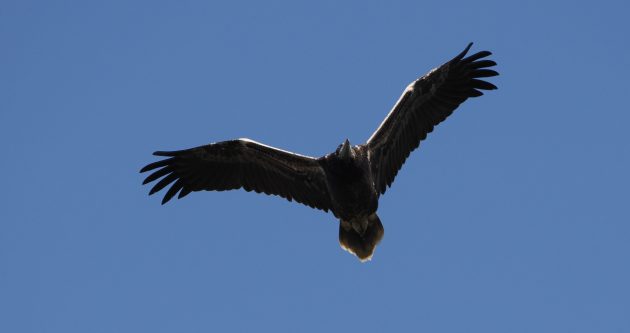
Juvenile Egyptian Vulture. Note the dark plumage and wedge-shaped tail
While Cabranosa may never witness the spectacular numbers of raptors that can be seen at other Iberian sites such as Gibraltar and Tarifa, it’s a place where almost anything can turn up. Europe’s first White-backed Vulture was seen here, and Rüppell’s Vultures (another African species) have also been recorded several times. In October both Golden and Spanish Imperial Eagles are regular, while the raptor season usually ends with a spectacular passage of Griffon Vultures. Unimposing it may be, but it’s a great place to visit if you like birds of prey.










Leave a Comment