

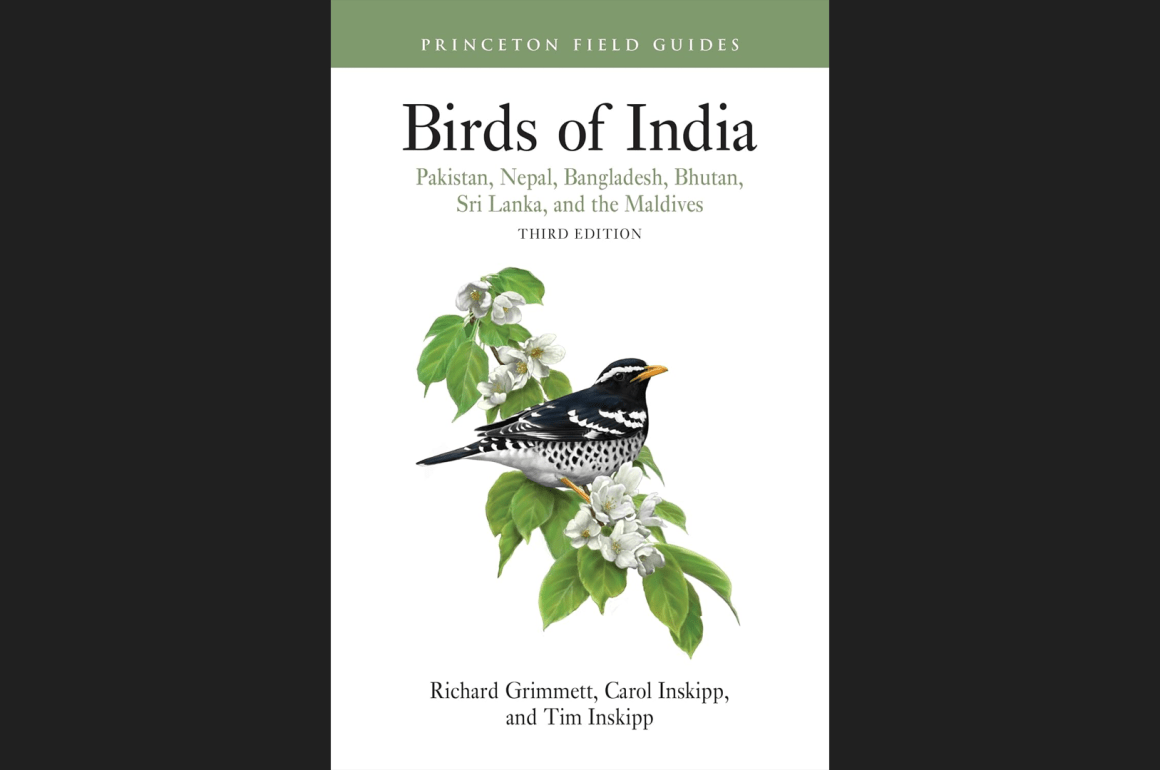
The new, third edition of “Birds of India: Pakistan, Nepal, Bangladesh, Bhutan, Sri Lanka, and the Maldives” by Richard Grimmett, Carol Inskipp and Tim Inskipp has 544 pages and in 246 colour plates depicts 1,429 species. For comparison, the previous, second edition (2016) had 60 pages, 20 colour plates and 54 species fewer. Also, while the previous edition weighed 2.05 pounds, the latest has reached 2.25 pounds, which is not exactly lightweight, especially compared to the first edition (1999) which had less than 400 pages and only 1.5 pounds (and I have fond memories of carrying it in my vest pocket)!
On my trips to India, I field-tested both #1 and #2. The #1 was easy to carry, yet, annoyingly, all the range maps were mostly grouped at the back (curiously, it was already my second field guide that ended up completely soaked and, afterwards, wind-dried out of the car window). While significantly heftier, the #2 was nearly perfect. And the #3 is seductively pretty, and only marginally heavier.
One way or another, with its 5.5 x 1.3 x 8.5 inches it still fits easily into the largest pocket of my reporter’s vest. And it comes in handy to be able to have it in your pocket in a minivan, or on an intercontinental flight. So, what is it that the third edition of Birds of India brings anew?
Out of 544 pages, the first 45 are devoted to the usual introductory chapters on how to use this book, weather and habitats, threats and conservation, and family summaries (which are usually placed among plates), including the political map of the region. The taxonomy follows eBird/Clements 2023 version.
The middle section is occupied by the 246 plates (right-hand side), with distribution maps and textual descriptions on the left. The text describes the measurements, distribution, plumages (while it is customary to show field marks in either bold or italics, it is not the case here), voice and habitat. Colour plates depict every species and many distinct plumages and races, and includes newly identified species.
The last 39 pages are occupied by vagrants (descriptions plus one small illustration each), literature references, illustration credits, and the bird index of both scientific and common names.
Updated and sixty-four more pages expanded, this third edition of Birds of India features revised colour plates, text, and distribution maps. Textual descriptions are rich with notes on identification, status, habitat and songs and calls. The distribution maps are noticeably more precise and accurate, which hardly comes as a surprise bearing in mind 71,000 eBirders in India alone. I remember seeing Crested Treeswifts in Gujarat (Gir) in 2010, and finding that the range map doesn’t show that population. The second edition corrected that, and now the third shows that the central Indian and Himalayan populations are separated by the Terai lowland belt and not connected, as in the first two editions. Also, the vagrant appendix has improved, the paintings are larger and the descriptions longer and more detailed.
Richard Grimmett is head of conservation at BirdLife International. Carol Inskipp and Tim Inskipp are freelance wildlife consultants. The authors have travelled widely in Asia and together written a series of books on the continent’s birds.
The publisher claims the guide to be comprehensive and definitive, and I have a problem with that. Never trust a field guide publisher’s claim of a definitive text, because each new edition is certain to bring more a definitive text than that from the previous edition!
Yet, I also have to agree with the publisher, this is an indispensable guide for anyone birding in this part of the world. Without any doubt – the best field guide to the birds of the Indian subcontinent.
Publisher: Princeton University Press
Publication date: March, 2026
Edition: 3rd
Print length: 544 pages
ISBN-10: 0691269823
ISBN-13: 978-0691269825
Item Weight: 2.25 pounds
Dimensions: 5.5 x 1.3 x 8.5 inches















My Birds of India edition is from 2012 and I love it. It is heavy and takes up some room in my backpack. But it’s also a good cushion for my camera also packed in my backpack. Sadly, I don’t think I’ll be able to ever get back to India. I would dearly love to add this new edition to my bookcase that is already overloaded. The thought that I would not be able to use it properly deters me. I love Princeton guides. They do such a good job with the field guides they publish.
“My bookcase that is already overloaded” must be a pretty sight. While others only have dreams, you have memories of India – cherish them.
Mine is called “Birds of the Indian Subcontinent” – are there two versions? Seems more accurate to refer to the subcontinent rather than just one of 7 countries.
That would be the “European 2nd edition” by Helm, Peter, this it the “American 3rd edition” by Princeton. Oddly, the same book and the same edition, however you call it (2/3).