

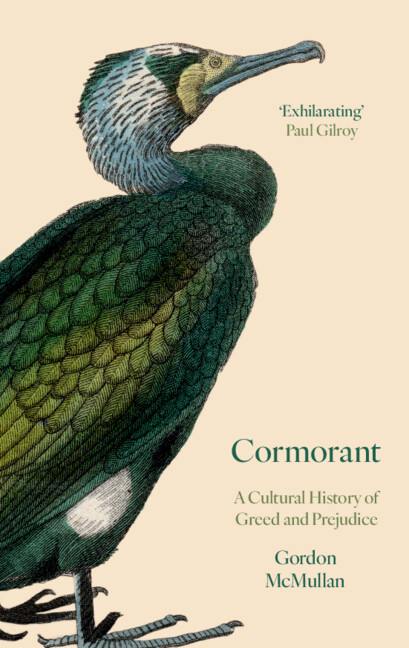
Close reading is sometimes considered the special province of English professors and other poetry devotees. It is a kind of clever sleuthing that can make sense, for example, of a Shakespearean “crux” – a word or phrase “that editors find baffling and to which solutions do not readily offer themselves,” as Gordon McMullan puts it.
His magnificent book Cormorant: A Cultural History of Greed and Prejudice, is a great example of close reading, but it’s not focused exclusively on Shakespeare, or literature for that matter. It’s a book about cultural history, and on the relationships between humans and animals – always coming back to its eponym, the “greedy insatiate glutton,” as an early British guidebook called the bird.
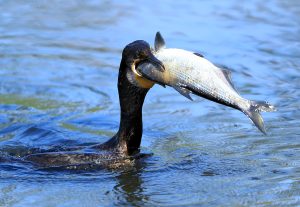
Such epithets have followed the Cormorant, it seems, forever. It may be your favorite bird – but probably not. It has no song, only a sort of croak that it sometimes emits when nesting (with webbed feet) in trees, and it is infamous for befouling those trees with excrement so noisome and copious that it soon kills them.
And it is mostly black, a color that has, like it or not, undeniable malign connotations in our culture – most cultures. Says McMullan, not too apologetically, “the binary black/white is a necessarily central concept in this book.”
On the plus side (plus if you’re a bird, for humans, more a minus) Cormorants are superb fishers, moving “more naturally below the surface [of the water] than in the air,” McMullan says. Human fishermen thus have loathed them as unfair competitors, and used to engage, every so often, in bird-pograms, killing thousands at a go.
This attitude is not necessarily (or at all) true in China and Japan, where the Cormorant, with a neck-collar that restricts swallowing, is used by humans to catch fish (as in the beloved-by-many children’s book, The Story About Ping)
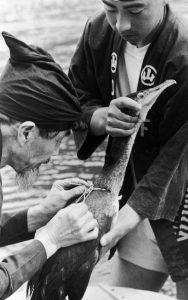
– and where, McMullan says, Chinese folklore claims that if a woman holds a cormorant just before childbirth, the pain of labor will be reduced.
As for Cormorants’ association (in the West) with evil, or Satan, it’s complicated — which is where the close reading comes in. One starting point (there are possible others) in Western culture might be John Milton’s “Paradise Lost.” As McMullan shows, Milton could have chosen, as his ultimate simile for Satan in the Garden of Eden, a wolf or a thief, but instead used a bird, and a particular bird:
Thence up he flew, and on the tree of life,
The middle tree and highest there that grew,
Sat like a cormorant; . . .
This is the awful, ominous parody of Christ on the Cross, even more perfect when one knows that the Cormorant often sits motionless, drying its outspread wings, as if in crucifixion. (It has to do so because, as McMullan later explains, it is the only diving bird with wettable plumage.)
To say that Cormorant is cross-disciplinary is an understatement: it deals with lots and lots of interesting things. A good part of the book covers a profoundly important but little-known event — the South American guano trade in the mid-nineteenth century, and the “scores of thousands” of Chinese indentured workers imported to mine the stuff in hellish conditions.
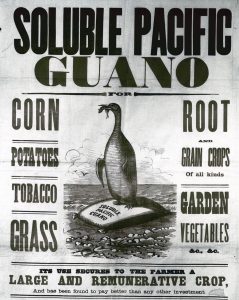
Cormorant guano is one of the most beneficial organic fertilizers in the world, and thus worth a lot of money – the mining of guano mountains off Peru was responsible, McMullan says, “for nothing less than the emergence of the global economy.” (Or, as another commentator writes without hyperbole, “Marine bird excrement is at the root of modern existence.”)
Because of what McMullan calls “the near-universal cultural preference for seabirds that are more culturally approachable than the cormorant,” the guano was marketed using images of other birds, including this strange semi-penguin looking thing:
Throughout the book, McMullan pursues, as a leitmotif, the tendency in our cultural thinking and tradition – especially as regards the Cormorant – to find a sort of equivalence or strange alike-ness in or merging of seeming opposites: Satan and Jesus Christ; or the Christian merchant Antonio and the Jewish usurer Shylock in Shakespeare’s Merchant of Venice; even James Bond (the fictional 007, that is, not the real James Bond who authored Birds of the West Indies) and his nemesis Dr. No (whose creator, Ian Fleming, had, McMullan thinks, “a soft spot for cormorants.”)
Another such pairing is the mostly black Cormorant and the mostly white Pelican – which makes for one of those Shakespearian cruxes, in Merchant of Venice, when Shylock calls Antonio a “fawning publican,” an epithet that makes little sense. McMullan’s three- or four-page close explanation of why this was, in all probability, not what Shakespeare wrote but, rather, a typesetter’s misreading of “fawning pelican” is good as any mystery story.
We in the 21st century have forgotten or given up much of the lore-based knowledge that Milton’s and Shakespeare’s original readers had at close hand (not to mention Christianity) in exchange for the supposed certitude of science. Thus, again, the need for close reading. But this book is not just for former English majors. Early on in Cormorant, introducing his subject and his method, McMullan asks “Might there be ramifications for science in this work?” and answers “I believe so” — and he’s right. He’s writing, he says, about “what happens when nature, culture, and prejudice collide over time.”
Cormorant is a protean, wonderful piece of work, finding and drawing relationships between zoology and culture that make perfect sense — but that you would never have conceived of on your own. Utterly fascinating.
_________________________________________________________________________________
Cormorant: A Cultural History of Green and Prejudice, by Gordon McMullan. Cambridge University Press, April 2, 2026, $45, 430 pp. ISBN978-1-009-65298-8.













Certainly will be looking out for this in the bookstore!
Nice post on one of my favourite birds. However, I do take issue with the statement “supposed certitude of science”. Science is about questioning. Once everything is certain, science will stop.