

If you had to learn how to use a new tool, would you rather figure it out yourself or watch someone else do it first? For hornbills, it seems the answer is the one always beloved by consultants: “It depends”.
In an experiment, hornbills were presented with three different situations:
In one, they already saw how pressure applied to a food-dispensing tool had worked. So, they could see the result, but nobody showed them how to produce it.
In the second, the birds were trained to release the food by pushing the appropriate area of the tool and were rewarded with food for successful actions.
In the third, a human demonstrated the actual action: picking up/grabbing the stone and lifting it into the apparatus. The birds watched the action and then learned the task.
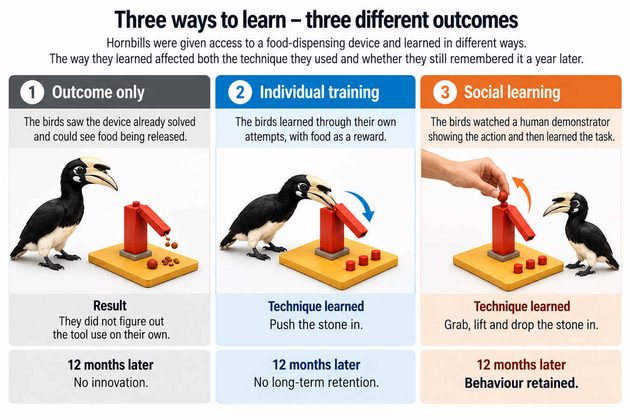
The most interesting result of this experiment was not that the birds could learn – we know they can (they would long be extinct in the wild otherwise). Instead, while the individual training brought quicker results (the birds learned faster), they also forgot faster. Only in the group trained by watching others (“social learning”) did the birds still remember their lessons after one year.
The most interesting result of the experiment was not that the birds could learn. We already know they can — otherwise hornbills would have been extinct in the wild long ago.
Instead, the interesting part was how the different ways of learning affected what happened later.
Individual training had quicker results: the birds learned the task faster. But they also forgot it faster.
The birds that learned by watching others learned more slowly, but retained it much better. After one year, only the socially trained birds still remembered the lesson.












Leave a Comment