

By Vitaly
Vitaly runs Hush Hollow (thehushhollow.com), a small online store of field-guide-inspired apparel. Crows have a habit of turning up exactly when he is not looking for them.
Few birders would say it in the field. You say a flock, or eleven crows, and move on. And yet “a murder of crows” turns up in novel titles, band names, headlines and museum captions, and it is probably the only collective noun most people can produce after “a pride of lions”. For a phrase ornithologists rarely use in any technical sense, it has done remarkably well for itself.
The story you usually hear is that it comes from the Book of St Albans, printed in 1486 and traditionally attributed to Dame Juliana Berners. That book is real, and it does carry a long list of collective nouns, including an unkindness of ravens. What the surviving 1486 text does not appear to carry is the murder.
The Oxford English Dictionary points to a slightly earlier source instead, recording “a morther of crowys” around 1475 in the Porkington manuscript. The phrase was also printed by Caxton in 1476-77, in a collective-noun list appended to an edition of Lydgate’s The Horse, the Sheep and the Goose. These lists were not rare or precious. The Egerton manuscript carries 106 such terms, two Harley manuscripts hold 93 between them, and more turn up in the Porkington and Digby manuscripts. Somebody in fifteenth-century England was clearly enjoying themselves.
Here is the part I find more interesting than the usual folklore about gallows and battlefields. The OED attaches a quiet warning to its own entry, describing the murder as one of many alleged group names found in late Middle English glossarial sources. That is a lexicographer being polite about the possibility that somebody simply made it up.
It helps to remember what these lists actually were. They were a game. Alongside the birds you find a superfluity of nuns, a diligence of messengers, a gaggle of women. They were a display of vocabulary for people who wanted to sound like they belonged at court, and knowing them mattered socially in roughly the way that knowing wine or knowing football mattered later. Nobody was standing in a winter field, watching corvids, and arriving at the word murder through observation. Somebody was being clever on parchment.
So the phrase was probably never a description of crow behavior at all, which raises a better question than where it came from. Many of these terms disappeared from ordinary use. A murmuration of starlings survived. An exaltation of larks survived, helped along considerably by James Lipton’s 1968 book of that name. The rest are gone, and nobody says a shrewdness of apes today without checking a list first. Why did murder last?
The uncomfortable answer is that it happened to land near something true, even though the person who coined it had no way of knowing it.
Crows do gather around their dead. Kaeli Swift and John Marzluff documented it properly in Animal Behaviour in 2015, in a paper with the admirably plain title Wild American crows gather around their dead to learn about danger. A Seattle field experiment sent volunteers wearing realistic masks to handle a dead crow, and the local birds responded loudly and in numbers, and afterwards avoided both the place and the face.
The popular coverage called these funerals, which is the wrong word, though an understandable one. On the evidence, what the birds are running is closer to a threat briefing than a memorial. A dead crow marks a location where crows die, and possibly a face worth remembering, and the gathering is how that information travels through a population that is unusually good at holding onto it.
So the medieval joke and the modern data end up looking at the same scene from opposite directions. A fifteenth-century glossarist reached for the darkest word he could pin to a black bird, perhaps because it sounded good next to crows, and five centuries later a research team sending volunteers into Seattle neighborhoods in masks found crows genuinely assembling over a body, for reasons no one in the fifteenth century could possibly have guessed at.
The name is still wrong, of course. It casts the crows as the killers, when what they are actually doing is taking notes. But it is wrong in a direction that turned out to be worth following, which is more than anyone can say for a superfluity of nuns.
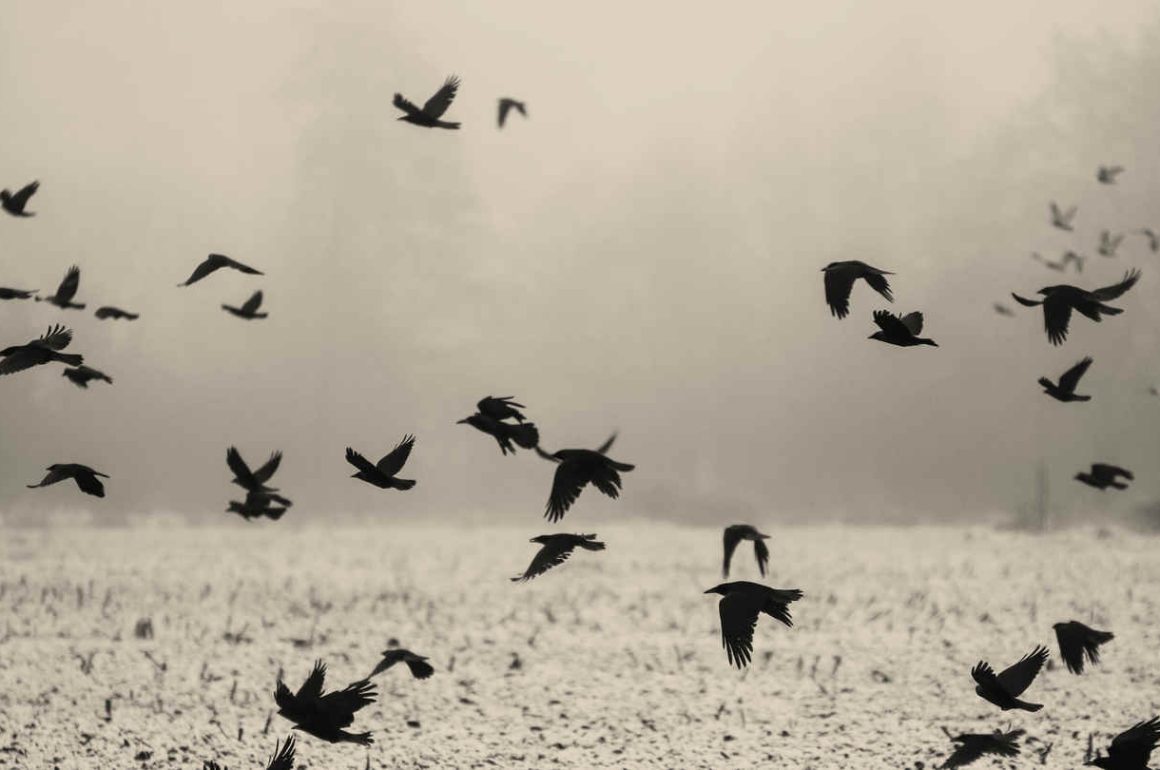
Cover photo (a flock of crows over a frozen field) licensed from Adobe Stock by author













Oh wow!!
Some good old blogging like we did 20 years ago.
Thank you!!
Highly appreciated.
I thank the Guest writer for an outstanding article. I have been interested in these terms of venery for a long time. I am a bit disappointed that you did not menion the word venery, and I apologise if I missed it in the article. The word “venery” comes from the Latin word venari, meaning “to hunt”.
I believe that these collective nouns came about when the medieval upper class gathered in their hunting lodges. At the end of a long day chasing stags or wild boars and after a big dinner of fresh meat, they would gather around the fire and drink and drink and drink. Making up drunken terms of venery became a ‘party game.’ They must have had someone around that was sober to write down their creations.
You mentioned a couple of sources for the collective nouns. Do these sources agree on the words and their meaning?
Again, thank you!
Jochen, thank you. “Good old blogging” is exactly the compliment I was hoping for.
James, you are right that venery deserved a mention. The word was already being used for these lists in the fifteenth century. One manuscript of about 1452 calls its list Termys of venery &c., while the Book of St Albans uses the heading The Compaynys of Beestys and Fowlys. I used collective nouns because the lists quickly wander beyond hunted animals into birds, professions and human groups.
Your hunting lodge scene may be impossible to prove, but the game part is probably close. The lists seem to have begun with specialist hunting vocabulary and then expanded into courtly wordplay, jokes and invention. The fire and the quantity of wine involved are beyond what the manuscripts can tell us.
Do the sources agree? Only partly. They share many terms, but there was no single settled list. Sometimes the same creature receives several different names, occasionally within one list: Caxton’s list gives both a bevy of larks and an exaltation of larks, while the Book of St Albans gives an exalting of larks.
Even the crows were not completely settled. Several early sources give forms of murder of crows, but one manuscript allows a building of rooks or crows. Murder survived, but it was not the only recorded term.
On meaning, the sources usually give us nothing more than a term and its subject. They do not explain why one word was chosen over another. Some of the wordplay can be reconstructed, but the familiar stories about gallows, battlefields and carrion do not come from the medieval lists themselves.
Thank you both for reading so closely.
Thinking of a “gaggle of geese” and a “parliament of owls”
We should probably just invent the “committee of secretary birds”
Peter, those two make a neat pair, because one is genuinely old and one is not.
Gaggle really is fifteenth-century. It sits in the list Caxton printed as a gagyll of ghees, and the manuscripts have a gagyllyng of gese standing right next to a gagyllyng of women, which tells you exactly what kind of book it was.
The parliament of owls is younger than it sounds. Chaucer’s Parlement of Foules is about fowls in general, and the owls version seems to arrive with C. S. Lewis, who used A Parliament of Owls as a chapter title in The Silver Chair. It has been quoted as medieval ever since.
As for a committee of secretary birds, that is precisely what the compilers would have done. Their lists are full of it: a sentence of judges, a diligence of messengers, a superfluity of nuns. Inventing new ones is not a departure from the tradition, it is the tradition.