

By Tom Gray
Tom is a British birder and conservationist who has been based in tropical Asia since 2005. He has worked for a number of conservation NGOs in the region, focusing on understanding and protecting threatened wildlife, and has authored more than 100 peer-reviewed academic papers on the region’s biodiversity. A birder since youth in Suffolk, England, his current mission – which he is far from achieving – is to see at least one species from every Asian bird genus. He currently lives in Kuala Lumpur, Malaysia, with his wife and two children, and, having found one first record for Malaysia on his local patch, is looking for more!
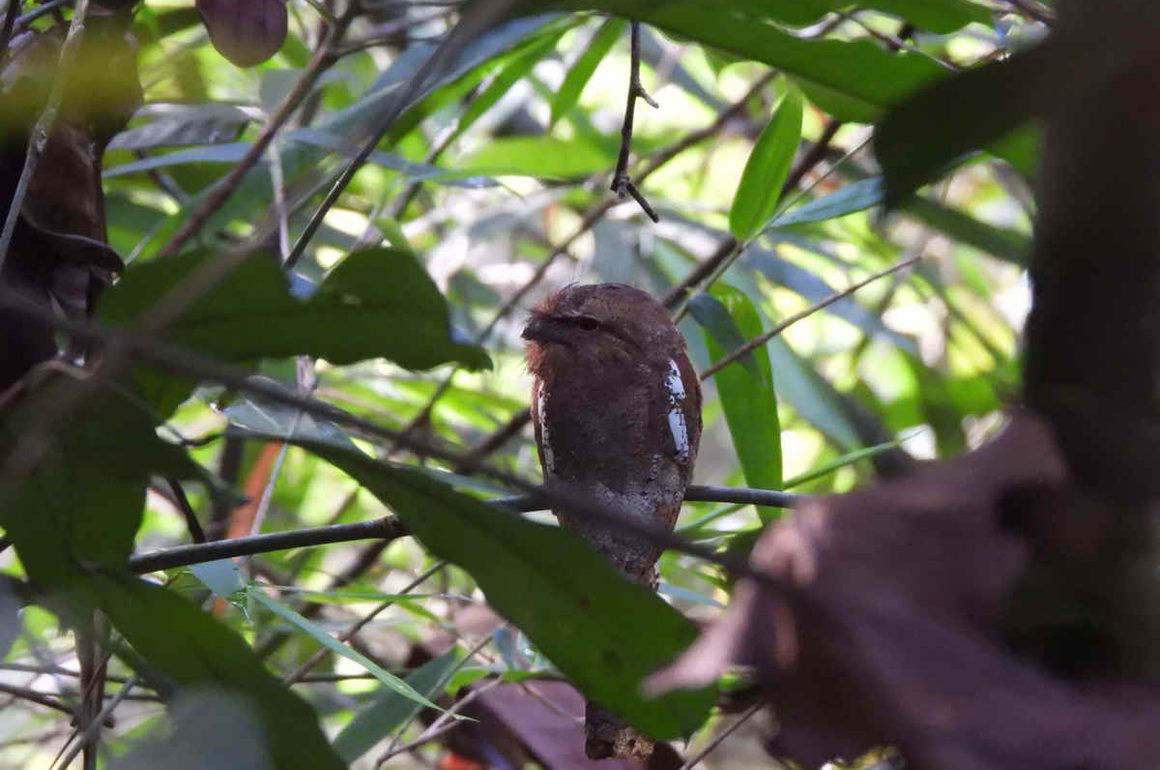
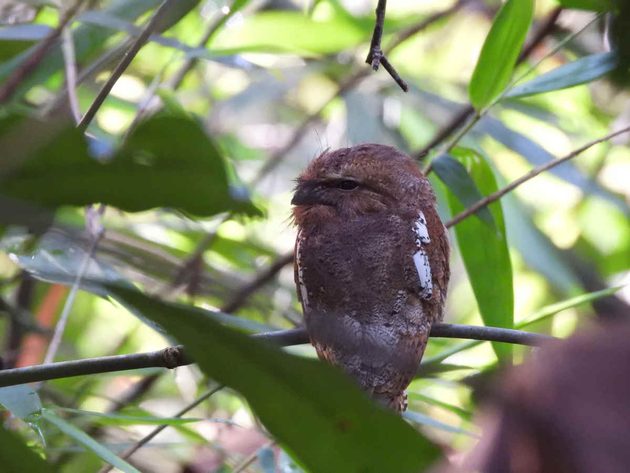
The mosquitoes are incessant. The crumbling tarmacked track is steep. The directions confusing. But somewhere nearby, amidst the tangled vegetation, the target is sleeping. It has spent the night searching for insects and now rests, hiding from the tropical sun in dense brush. Secretive and obscured; impossible for the human eye to find. But my human eye has a cheat code. A 15-cm piece of faintly sticky, rubber-coated technology. A thermal scope – able to pick up heat in the forest. My discarded backpack glows white on the side of the track, expelling latent heat and sweat. A glow hangs on the edge of a leaf before leaping to a tree trunk and revealing a tail. A squirrel; not our target. But then, scanning the other side of the track, a solid white glow. Stationary and dumpy. Hidden in the vegetation. Binoculars, another cheat for the human eye, raised, and the glow becomes real. Chocolate brown, silver flashes on the flanks, and the characteristic broad-billed face of a frogmouth. Batrachostomus affinis, or Blyth’s Frogmouth. A species whose English name commemorates Edward Blyth (1810-1873): a 19th-century English Zoologist and one of the most prolific describers of species Asia has ever seen.
Between 1841 and 1862, Blyth was the curator of zoology at the museum of the Asiatic Society of Bengal in Calcutta (now Kolkata). During these remarkably productive years, Blyth provided the first (Western and Scientific) descriptions of 200 Asian bird species. Many of these were published in the Society’s journal: The Journal of the Asiatic Society of Bengal. At the time Calcutta was the capital of the British Indian Empire, and Blyth received parcels and specimens from across an empire over which, famously, the sun never set.
Blyth received the frogmouth amongst a ‘package of bird skins procured in the neighbourhood of Malacca ’ (now Melaka, Malaysia) and sent to him by an RWG Frith, a Calcutta-based naturalist. The new frogmouth was described in the September 1847 issue of the Society’s journal and given the scientific name Batrachostomus affinis. This species epithet is one of the more amorphous, and is applied to more than 85 bird species and means, simply, ‘related to / similarity with’. In this case the frogmouth reminded the 36-year-old Blyth of the Javan Frogmouth Batrachostomus javensis which had been described by Thomas Horsfield (1773-1859) from a Javan specimen 26 years earlier.
This similarity between the species, confounded by the same cryptic colouration of the frogmouths which hindered my spotting of the bird, resulted in many authors considering Javan, Blyth’s, and several other South-east Asian frogmouths to be a single species, with the complex finally split, based largely on vocalisations, as recently as 2014.
In the mid-19th century, ‘new’ bird species were rarely given English names, and the earliest reference I have found to the species being called ‘Blyth’s frogmouth’ was in 1895 in a “Fauna of British India” published 22 years after Blyth had died in London, likely of heart disease after years of mental decline. Precisely how and why Blyth’s name got associated with the species in English is unclear: of the 200 species he described, he is commemorated in the English names of only seven. And from the 1940s I’ve seen references to the species as ‘small Malayan frogmouth’. Indeed, across the 23 languages listed in eBird, the name of the species commemorates Blyth in 7 (e.g. Podarge de Blyth in French), refers to geography, principally ‘Malaya’, in 10 (e.g. Malaienschwalm in German), with 6 describing habits or abundance (e.g. cucur biasa or common frogmouth in Malay).
Back in 21st-century Selangor, I depart to leave the frogmouth in peace but pause as I hear the distinctive metallic calls of a woodpecker. Which of the almost 20 species present in this lowland forest on the edge of Malaysia’s capital city? Again, technology to the rescue – a flick of the Merlin Bird App, algorithm-driven analysis of the unique spectrograms of bird song – and as the bird calls again, the identification is confirmed. Maroon Woodpecker. Blythipicus rubiginosus.
Blythipicus?
Yes, an entire genus named after Edward Blyth. This deep red bird with a wonderfully striking banana yellow bill of Asian forests will forever be associated with a full bearded biologist born in London two days before Christmas in 1810.
The genus Blythipicus – literally Blyth’s Woodpecker – was named to honour Edward in 1854 by another 19th-century luminary of zoology and nomenclature with a very famous name – Charles Lucien Bonaparte – nephew of Napoleon and inveterate chronicler of new species and genera. Indeed, he named a genus of American doves, which includes the ubiquitous mourning dove, Zenaida, after his wife Zénaïde Laetitia Julie Bonaparte. Who, as her family name suggests, was also his cousin.
Remarkably, Bonaparte actually also described, or thought he had, Blyth’s Frogmouth. In 1850 he published a species description for “Batrachostomus parvulus” (small frogmouth) from a specimen collected from the Kapuas River in West Kalimantan, Indonesian Borneo and sent to him. Whilst the precise identity of those birds is unclear, the fact that Blyth had named the species three years earlier meant his (affinis) name had historical priority, and more than 175 years later we are, in English at least, talking about Blyth’s, and not Bonaparte’s, Frogmouth.










Leave a Comment