

By Marco
Marco writes birdshistory.com, where he builds small, fully sourced datasets about extinct and endangered birds — last confirmed records, the lag before a formal declaration, the founder populations behind recoveries — and writes them up as reference pages. Every figure on the site is traceable to a primary source.
Of the extinct birds I have built sourced timelines for, the ones that could not fly have a median last record of 1701. The ones that could fly: 1933.
That is a gap of 232 years, inside the same small dataset, assembled the same way.
I did not go looking for it, either. I had been coding each species for cause of extinction and date of last confirmed record, and the flight column was there mostly so the explorer on my site could filter on it. The split only became obvious when I sorted the table.
The usual caveat applies and it matters more here than it did last time: this is 37 species that I have written up, not a global census. The birds I have written up are the birds I found enough primary material for, and flightless birds are over-represented in the popular record precisely because they are conspicuous and their stories are famous. A selection effect could inflate a gap like this. I will come back to how much of it survives that objection.
Here is the flightless half of the sample, in order.
| Last record | Species | Where | Cause |
|---|---|---|---|
| c. 925 | Elephant bird | Madagascar | hunting |
| c. 1400 | Moa (nine species) | New Zealand | hunting |
| c. 1425 | Little bush moa | New Zealand | hunting |
| 1662 | Dodo | Mauritius | introduced predators |
| 1693 | Red rail | Mauritius | introduced predators |
| c. 1710 | Réunion ibis | Réunion | hunting |
| c. 1760 | Rodrigues solitaire | Rodrigues | introduced predators |
| 1844 | Great auk | North Atlantic | hunting |
| c. 1865 | Tasmanian emu | Tasmania | hunting |
| 1899 | Stephens Island wren | New Zealand | introduced predators |
Ten entries, and one of them stands for nine species, which is its own comment on how the moa are recorded.
Seven of the ten were gone before 1800. Among the birds in the sample that could fly, the figure is one in twenty-six.
It is not that they were frailer. It is what reached them.
The obvious reading is that flightless birds are simply more fragile, and that is true in a loose way but it is not quite what the data says, because the useful signal sits in the cause column rather than in the dates.
Every single flightless bird in this sample died of one of two things: hunting, or introduced mammals. Six and four, and nothing else appears in that column at all.
The birds that could fly died of a much broader list: disease in nine cases, hunting in seven, habitat loss in six, introduced predators in two, loss of prey in one, and one that is still argued about.
Those two lists describe different kinds of event. Hunting and introduced predators are direct killing, and direct killing works at the speed a person or a rat can cover ground. Disease and habitat loss work at the speed of an epidemic or a logging industry, which is to say over decades, and they do not require anyone to catch the bird at all.
So the question “why did the flightless go first” has a fairly mechanical answer. Flight is not protection against extinction. It is protection against being caught. A bird that can fly is still fully exposed to avian malaria arriving in a mosquito, or to its forest being cut down. What it is not exposed to is a sailor with a stick.
That is why the flightless dates cluster on arrival events rather than on industrial ones. The dodo’s clock did not start when the species evolved. It started in the 1590s when ships began calling regularly at Mauritius, and it ran out in about seventy years.
The two that held on until the 1940s
Two flightless birds are missing from that table, because they are on my site but not yet in that particular dataset, and leaving them out would make the pattern look tidier than it is.
The Laysan rail was last reported from Eastern Island, Midway, in July 1944. The Wake Island rail went somewhere between 1942 and 1945. Both are flightless, and both are three centuries later than the dodo.
They do not break the mechanism so much as confirm it, because of why they lasted.
Both lived on Pacific atolls so small and so remote that the relevant mammal simply had not arrived. The Laysan rail even survived the destruction of its own island by introduced hares, because people had moved birds to Midway in 1891 and that population thrived for half a century. What ended it was rats escaping from a US Navy landing craft in 1943. The Wake Island rail lasted until a besieged Japanese garrison, cut off by an American blockade and starving, ate it.
In both cases the clock started late because the ship arrived late. Once it did, a flightless bird on a small island lasted about a year and a half.
What the record itself is hiding
The strongest version of this argument is not mine, and it addresses the selection problem head on.
In 2020, Ferran Sayol, Manuel Steinbauer, Tim Blackburn, Alexandre Antonelli and Søren Faurby published an analysis in Science Advances with a title that gives away the finding: “Anthropogenic extinctions conceal widespread evolution of flightlessness in birds.” Their point is that if you count flightless birds among living species, you dramatically undercount how often flight loss has actually evolved, because the flightless were preferentially removed before anyone counted.
That reframes my small table considerably. The 232-year gap in my own data is a sample effect in the sense that I picked the species. It is not a sample effect in the sense that matters, because the same process that produced the gap also produced the fauna we are allowed to sample from. Flightless birds look like a historical curiosity in the modern bird list largely because they were deleted first.
If you have ever wondered why there are so few flightless birds alive now and so many in the extinct column, that is the answer, and it is not that flight loss is rare.
The flightless birds that are still here
There are not many, and the status of the ones there are makes the point better than my table does.
| Species | IUCN status |
|---|---|
| Kakapo (Strigops habroptilus) | Critically Endangered |
| Guam rail (Hypotaenidia owstoni) | Critically Endangered |
| Takahe (Porphyrio hochstetteri) | Endangered |
| Flightless cormorant (Nannopterum harrisi) | Vulnerable |
| Inaccessible Island rail (Laterallus rogersi) | Vulnerable |
Not one of those is a species you could stop working on. The kakapo reached 325 birds on 1 September 2026, which is a recovery-era high and the first time the population has been over 300 in perhaps seventy-five years. It started the modern programme in 1995 at 51 birds, of which 20 were female. Every one of those 325 is individually known, transmittered and managed on predator-free islands, and the current constraint on the programme is reportedly running out of islands to put them on.
The Guam rail is the sharper case, because it was Extinct in the Wild after the brown tree snake went through Guam, survived only in captivity, and has been brought back to Critically Endangered by breeding and release onto a different island. It is the second bird in history to make that move, after the California condor.
The Inaccessible Island rail is the outlier, and it is instructive. It is the smallest flightless bird alive, it has never been through any of this, and the entire reason is that its island has never had an introduced mammal. It is Vulnerable rather than Endangered for one reason: nothing has landed yet.
That is the same sentence as the Laysan and Wake rails in 1890, and it ought to be read the same way.
What this changes about reading an extinction date
Three things, I think, and the first two are practical.
A last record of 1750 and a last record of 1950 are not the same kind of fact. The early dates are overwhelmingly flightless island birds killed directly, often within a human lifetime of first contact, and often recorded by the people doing the killing. The late dates are overwhelmingly flying birds that declined for years while being watched. Those two situations produce completely different evidence, and treating them as points on one timeline flattens something real.
A flightless species on an island with no mammals is not safe. It is untested. The Laysan and Wake rails were in exactly that position for as long as the shipping lanes left them alone. That is worth remembering for the flightless birds that are still here, which is the short list in the table above.
And the third thing is less practical but it is the one I keep returning to. The dodo is the standard shorthand for human-caused extinction, and it is a bad example, because it is the easiest possible case: a large flightless bird on a small island with no predators, meeting sailors. Almost nothing since has been that simple. The birds we are losing now mostly can fly, and they are going for reasons that are much harder to point at and much harder to stop.
All figures above are computed from a dataset of 37 species with primary-source last records, which is published and downloadable at birdshistory.com/bird-last-records/, alongside the cause coding at birdshistory.com/extinction-causes/. The two Pacific rails discussed above are written up at birdshistory.com/laysan-rail/ and birdshistory.com/wake-island-rail/.
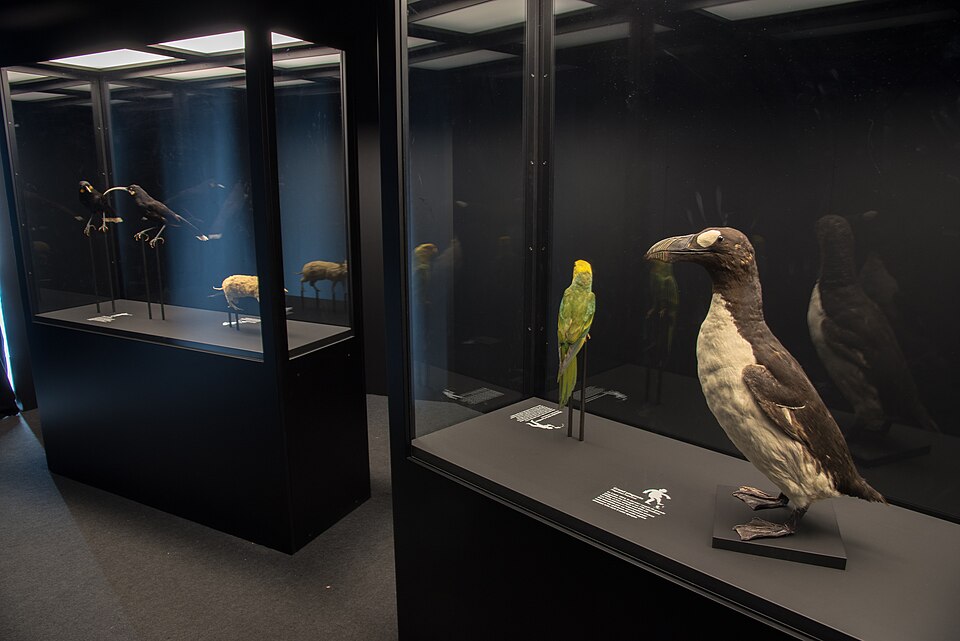
Cover: A great auk and a Carolina parakeet in the same case. CC BY-SA 4.0, credit: Photo by Michel Krafft, via Wikimedia Commons, CC BY-SA 4.0.












Leave a Comment