

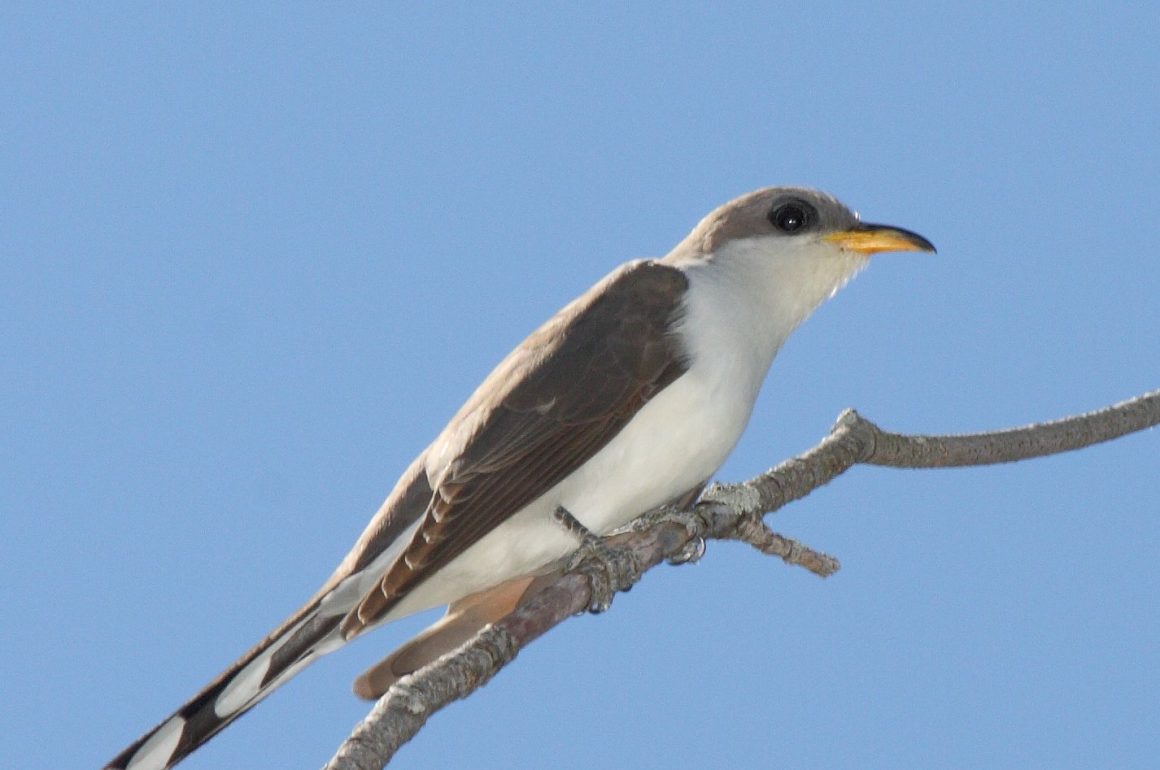
Earlier this year (Feb 18), I wrote about seeing my lifer Mangrove Cuckoo in Florida. That bird had eluded me for 18 years. It made me think that maybe this year, I could see all three North American cuckoos. As all long-time birders know, we are always trying to find ways to challenge and amuse ourselves.

Mangrove Cuckoo
Yellow-billed Cuckoo and Black-billed Cuckoo are considered uncommon in Toronto, but with persistence you can still find them. These birds are shy skulkers, who hide in leafy trees. While most birds can’t handle hairy caterpillars, these two feed on tent or gypsy moth caterpillars, which sometimes bring them out into the open. Unfortunately, that wasn’t my experience this spring, as I kept missing reported birds.
A fellow birder suggested we visit a couple of local cemeteries to look for cuckoos. Cemeteries are great for birding, because they have mature trees, flowering bushes, and water.

Black-billed Cuckoo
One day, we visited a cemetery in the eastern part of Toronto. It has a little creek, with a grove of trees, which are attractive to Yellow-billed Cuckoos. We were walking along there, when a slim, long-tailed bird rocketed out of the grove, across the field, and into trees on the far side. That is typical cuckoo behaviour, because they don’t like to be in exposed areas. Now I had found two cuckoos this year, with one more to go!
A week later, we visited a cemetery in central Toronto, to search for a reported Black-billed Cuckoo. Another birder was kind enough to give exact directions to where the bird had been last seen. We wandered around that spot. My friend heard it making its soft coos first, because it’s a bird that is more often heard than seen. At almost the same time, it flew over my head and into the trees. Success! It only took me 52 years of birding to accomplish this triple-cuckoo feat.
Note: All photos are from Wikipedia Commons, an online source of copyright-free photos: Mangrove Cuckoo by U.S. Fish and Wildlife Service Headquarters; Black-billed Cuckoo by Rhododendrites; Yellow-billed Cuckoo (at top of article) by Rhododendrites.









Aren’t there more than three species of cuckoo in North America? Squirrel cuckoo?
Wow 18 years for a ” lifer”. We are lucky on Tobago, see them regularly. Mangrove.
Squirell. Trinidad.
Black Billed . Rare
Yellow Billed . Migrant ( yearly)
Squirrel Cuckoo and Ani in Central America