


Twitching rare birds has never been my scene: chasing across the country to add a tick to my list has always had limited appeal, especially when the so-called rare bird is one that I am familiar with in a place where it is common. However, every now and again a bird comes along that I think is worth going to see, usually because it’s a species I’m unfamiliar with. This was the case earlier this week, when my birding pal Andrew and I drove across the county (nearly 50 miles) in pursuit of a Hudsonian Godwit.
I don’t have a British list, but if I did, then Limosa haemastica would have been an addition. My only previous encounter with the species was 32 years ago, in Patagonia, and I have to admit that I can’t remember anything about it. I saw many new birds on that Argentinian trip, and Hudsonian Godwit was just one of them.
These handsome godwits are exceedingly rare birds in Britain. The bird I went to see was the seventh to be recorded in Britain, but is most likely only the fifth individual; there is some confusion as the first three records (in 1981, 1982 and 1983) are thought to refer to the same bird. As North American readers will be well aware, this is a bird that has declined in North America, where it’s not an easy bird to connect with. It breeds in northern North America and winters in southern South America, undertaking a spectacular migration from summer gathering grounds on Hudson Bay to southern Argentina. It’s thought that this migration is non-stop, making it a flight that’s comparable to that of the Bar-tailed Godwits that breed in Alaska and winter in New Zealand.
Hudsonian Godwits are also renowned for the accuracy of their migration, for lost or off-course birds are unusual, and trans-Atlantic vagrancy extremely rare. The bird I went to see was first recorded at Minsmere nature reserve, on the Suffolk coast, on 1 July. It was photographed in company with Black-tailed Godwits. After the initial sighting there were no records for a few days until it was relocated some miles to the south, on the river Stour, where it apparently found conditions to its liking.
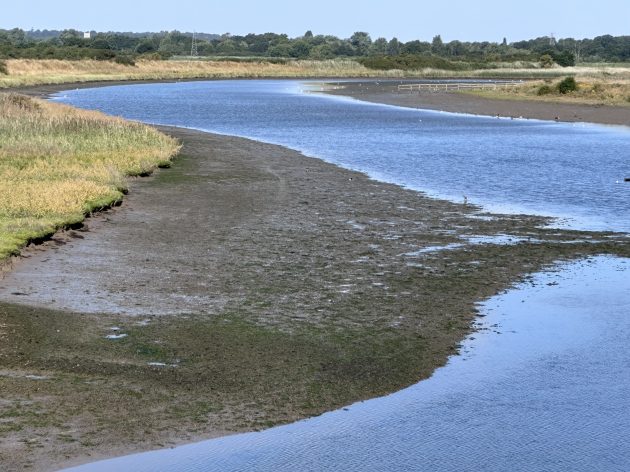
The river Stour at Cattawade The Hudsonian Godwit can just be seen – the speck on the edge of the river
It was on the Stour where I saw it, several days after it had first been sighted there. All the serious twitchers had already been to see it, so there was just a small group of admirers watching it. As twitches go, it was simple stuff. Park in the recommended car park, walk 400 yards to the bridge over the Stour, look towards the Essex bank (the Stour is the boundary between Essex and Suffolk) and there it was. No another godwit in sight to confuse it with, just the Hudsonian.
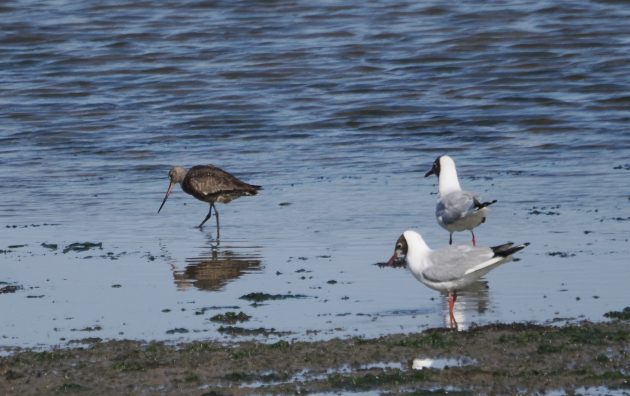
Hudsonian Godwit with Black-headed Gulls. Note the godwit’s upturned beak
When it was first seen it was still in almost full breeding plumage, but 20 days later it wasn’t looking quite so smart, though it still had plenty of colour: I must have seen grey, winter-plumaged birds in Argentina. We watched it for perhaps 45 minutes – I’ve never watched a godwit for so long before – long enough to study all its salient features. At first glance it looked rather like a short-legged Black-tailed Godwit, but closer inspection revealed its slightly upturned beak, an important ID feature. Bar-tailed Godwits also have up-turned beaks, but the jizz of this bird was quite different.
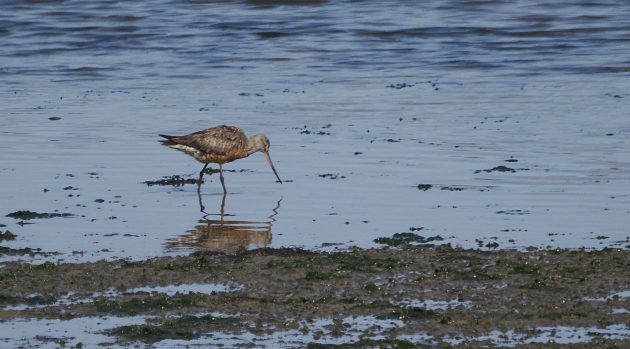
Hudsonian Godwit. It was just too far for me to take a sharp photograph
During the time we watched it preened, fed, slept, then preened again. Once it raised its wings, revealing its black underwing, a feature which sets it apart from both its Bar-tailed and Black-tailed cousins. Frustratingly, though it seemed totally unaware of the small cluster of watchers on the bridge, it never came closer than about 80 yards, which was just too far for a decent photograph, at least with my camera. The pictures you see here are my best efforts. I was hoping for a flight shot, but it never obliged.
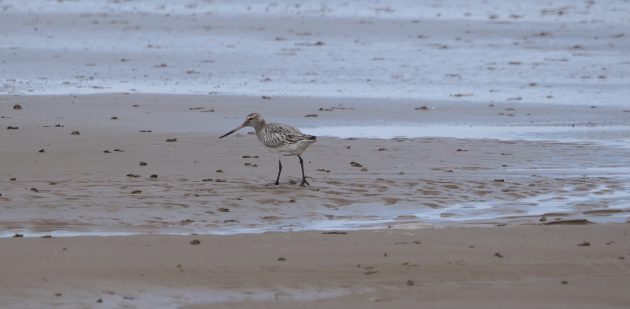
Bar-tailed Godwit. It also has an upturned beak, like the Hudsonian, but has a quite different jizz
We can only guess at the bird’s origins, and what route it took to reach the east coast of Britain. A similarly plumaged Hudsonian Godwit was recorded in Portugal just a week before this bird was first seen in England, and it is generally thought that it was the same individual. This does seem strange, as why would even a lost migrant fly north, rather than south, in July?
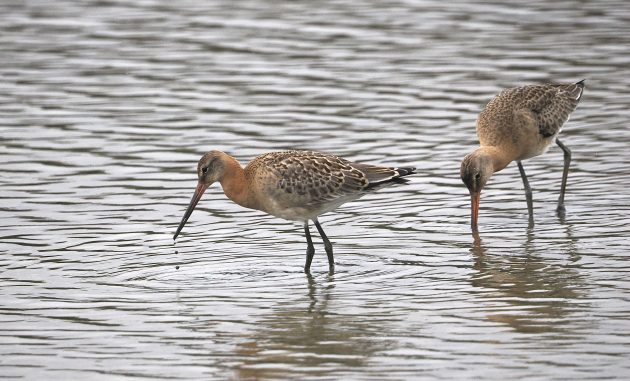
Black-tailed Godwits. Note the straight beak
I’ve now seen a number of North American waders in the UK, ranging from Wilson’s Phalarope to Pectoral Sandpiper (the latter an annual migrant). The Hudsonian was memorable for its extreme rarity, while I appreciated the chance to compare it with the two godwits I’m most familiar with – Black-tailed and Bar-tailed. It was a worthwhile twitch.







Enjoyed reading and learning here!
Great twitch report David and congratulations on seeing the Hudsonian. We have them annually in Michigan in both spring and fall, but you’re correct to say that they are not common. I haven’t seen one on quite a few years, but it also seems that reports of them are less frequent. It’s a bird that birders will make a point of trying to see. Godwits, in general, are very special shorebirds. Rather big with their elongated bills and unique plumage, godwits are always attention grabbers, as they should be. BTW: your photos are just fine, even though I understand the desire for better photos. Readers can tell by the habitat that a near photo would not have been possible. From the photo, the River Stour appears to be a tidal river.