

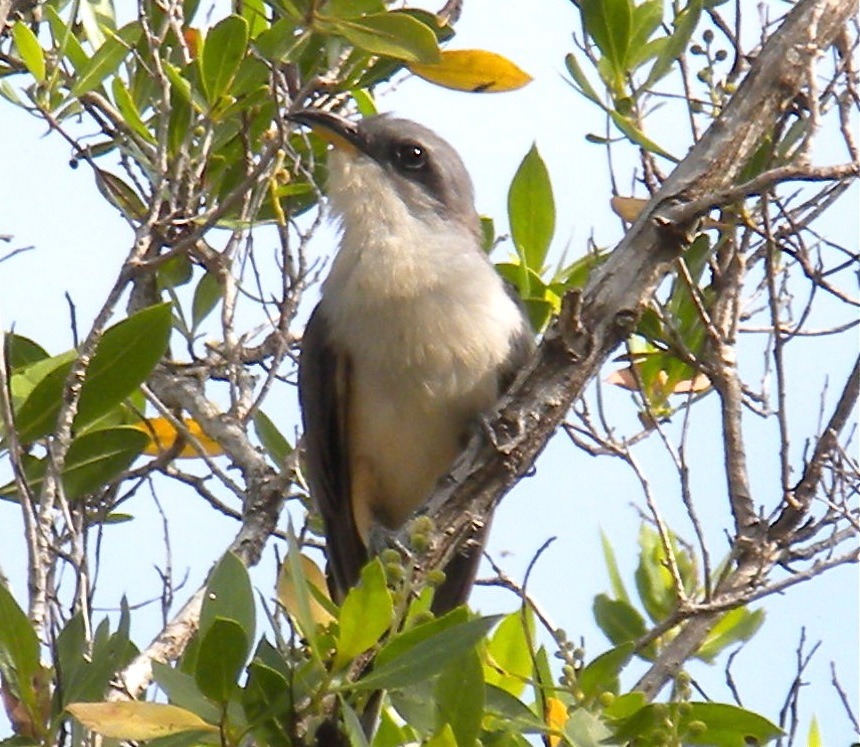
I am a birder who hates to get up early. For this day in early February, I was determined to get my target bird, which was Mangrove Cuckoo. Every time we visited Florida, I chased after the bird. Each time I went to a location that had recorded a sighting, I didn’t see it. Birders who were there would often say “You missed it. It was right here in front of me; here are my pictures.” Very frustrating!
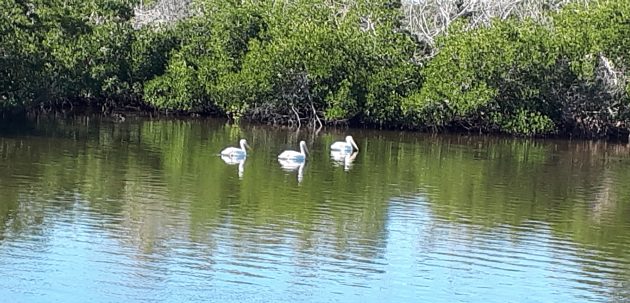
American White Pelicans swimming in front of mangrove trees
Leaving before sunrise, we drove to J.N. “Ding” Darling National Wildlife Refuge on Sanibel Island, which is a 1.5 hour drive north of Naples Florida. People go there to admire the scenery and to marvel at the migratory bird populations. They walk the paths or they will bike or take their cars on the 7km Wildlife Drive. I wanted to be there by 8am, to avoid the crowds whose noise might have scared the bird away.
It was quiet at that time of the day and there were only a few cars in the visitors’ parking lot. We paid our $10 entrance fee, drove in, and parked near the Indigo Path. I had seen reports that noted that the Mangrove Cuckoo had been observed there. You walk on a gravel path, between the mangroves. We had walked for 30 minutes, when a slim bird zipped across the path. It sat for a moment on a low branch. Mangrove Cuckoo! It flew back across the path, letting me see its buffy belly. It called, and Merlin confirmed it as a Mangrove Cuckoo. My sighting wasn’t as perfect as I would have liked, but still good enough to ID this difficult-to-find skulker. It only took 18 years of missed opportunities and close calls to finally see my nemesis bird and add it to my life list!
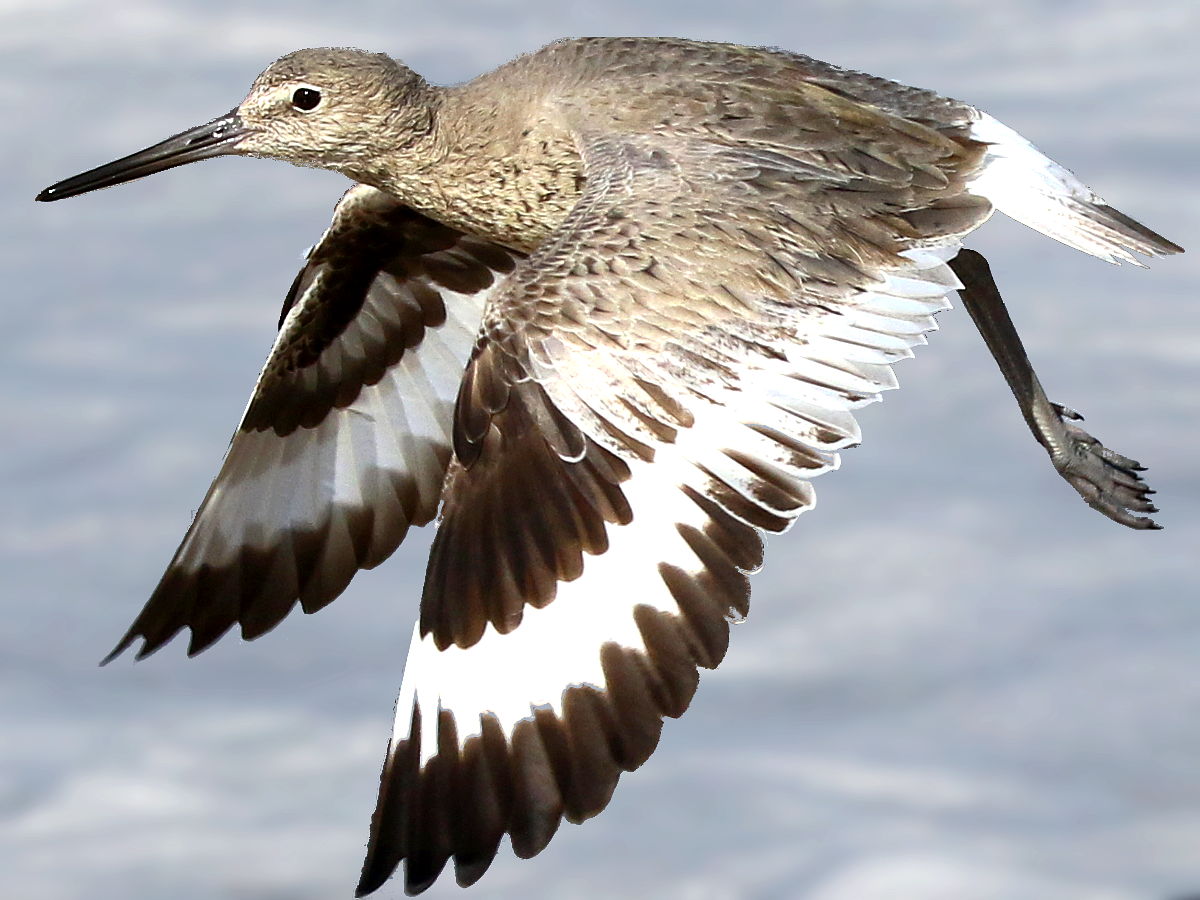
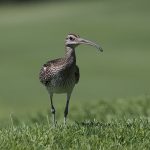
Willet
After this excitement, I could relax and enjoy our visit to Ding Darling. The refuge protects a massive mangrove ecosystem. It borders the mangrove estuary of Pine Island Sound on its northern side. It’s also situated near Tarpon Bay, the Gulf of Mexico, and San Carlos Bay. The Wildlife Drive meanders through the estuary and you can stop anywhere along the way. Mud flats were exposed, but you could see the tide coming in, which would eventually cover them again.
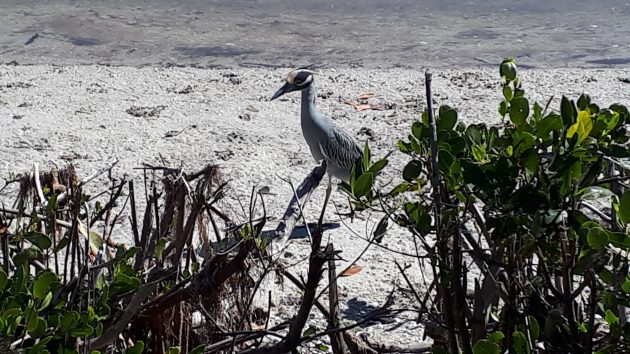
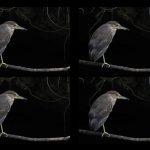
Yellow-crowned Night-Heron
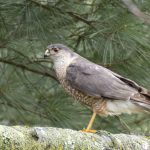
We saw large groups of American White Pelican. Feeding waders included Great Egret, Roseate Spoonbill, Black-crowned Night-Heron, Yellow-crowned Night-Heron, Tricolored Heron, Green Heron, and Little Blue Heron. Shorebirds were represented by Ruddy Turnstone, Dunlin, Short-billed Dowitcher, Semi-palmated Plover, Western Sandpiper, and Willet. Overhead, there were Osprey, Turkey Vulture, and Black Vulture. My last sighting was of a Cooper’s Hawk, which was hunting the warblers and song birds that also move through the mangroves.
The visitor center is worth checking out for the interesting displays. When planning a trip, I highly recommend arriving early and leaving Sanibel Island early. There is only one bridge between the island and the mainland, and traffic backs up early for people trying to leave the island. We left at 12:30pm with no problem. Other times when we left at 3pm, we spent more than an hour in line waiting to get to the bridge.
I went home tired and happy. I couldn’t believe that I had finally got that bird after all these years.
Note: Photo of American White Pelicans and Yellow-crowned Night-Heron by Leslie Kinrys. Other photos are from Wikipedia Commons, an online source of copyright-free photos: Mangrove Cuckoo (top of article) by Rachel Frieze; Willet by Peter W. Chen.




Sounds like a beautiful place to go birding. I’ve put this wildlife refuge on my list of places to visit. Thank you, Leslie!
Haha, so happy to hear you finally got to see your nemesis bird! I wonder if there will be another one rising to take its place and keep you busy some more years 🙂
What’s your new Nemesis bird? ?
Bachman’s Sparrow! It is another skulker. They start to sing in Florida in March. That is the best way to find them. I joined the local bird club to look for it last year. We didn’t find it. Hopefully, this year we’ll be luckier.