

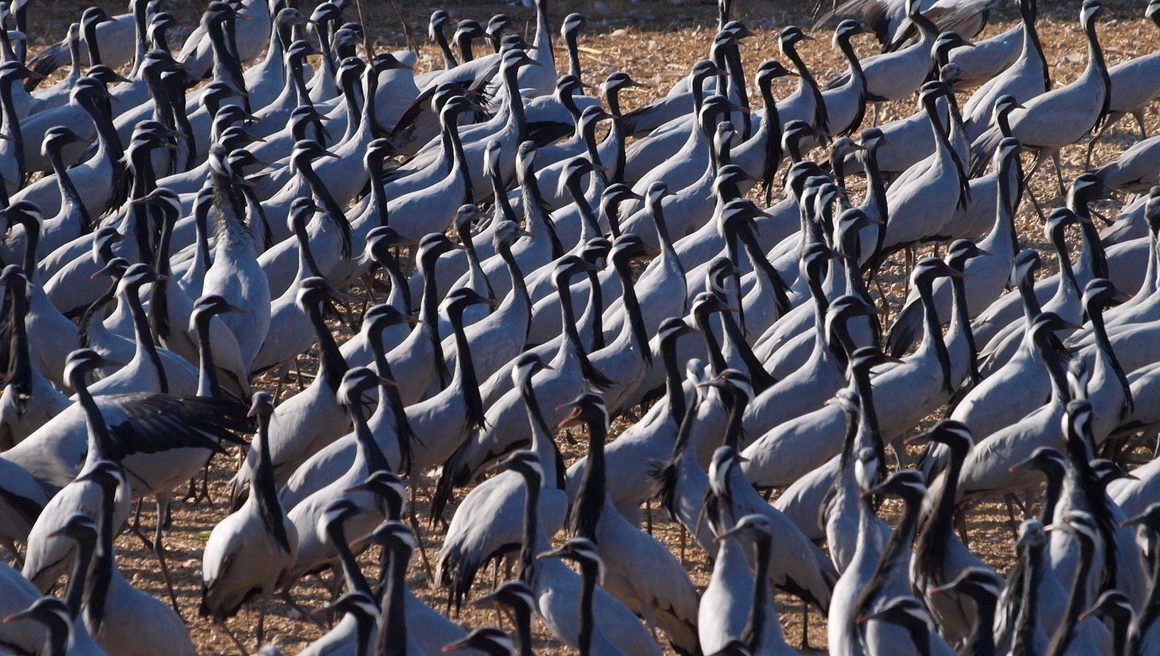
There are few more impressive families of birds than cranes, as we were reminded by Kai Pflug’s recent post, The Beauty of Most Cranes. There are 15 species in the world: to see them all you have to travel widely, from America to Africa to Australia and on to Asia. I’ve managed to see 10 of the 15 species, but I would have to visit China and Japan to see the five that elude me. Kai’s great photographs tantalise me with the birds I have never seen: Siberian, White-naped, Red-crowned, Hooded and Black-necked.
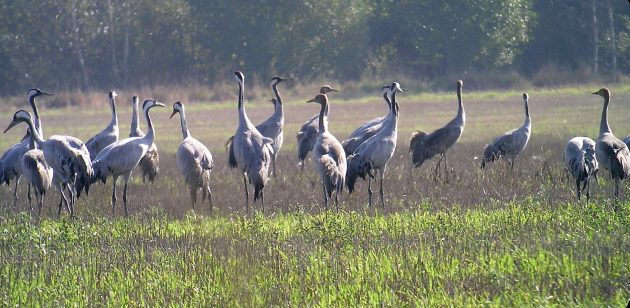
Common Cranes on autumn migration, photographed in Estonia
The Common Crane lives up to its name by having a vast breeding range, extending from northern Europe all the way to China. It was extinct in Britain for several centuries, but natural recolonisation started nearly half a century years ago when a few pairs started breeding in the Norfolk Broads. Today Britain’s population is growing steadily, helped by the Great Crane Project which released hand-reared birds in the Somerset Levels. We have upwards of 70 breeding pairs in England.
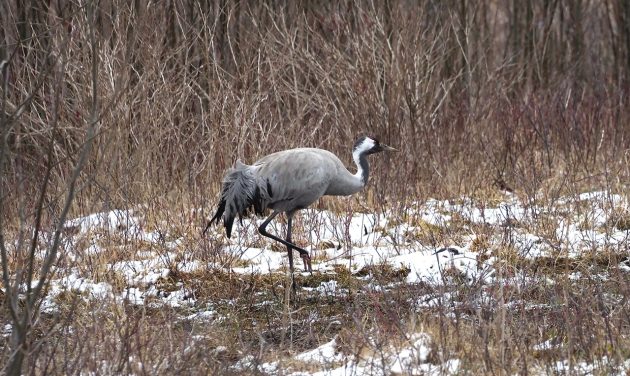
I now see Cranes regularly, and there are a number of sites when I can be virtually certain of finding them. Despite increased familiarity, every sighting is a thrill, for these are special birds. You don’t even have to see them: their wonderful trumpeting calls are so far-carrying that you can hear them a mile or more away.
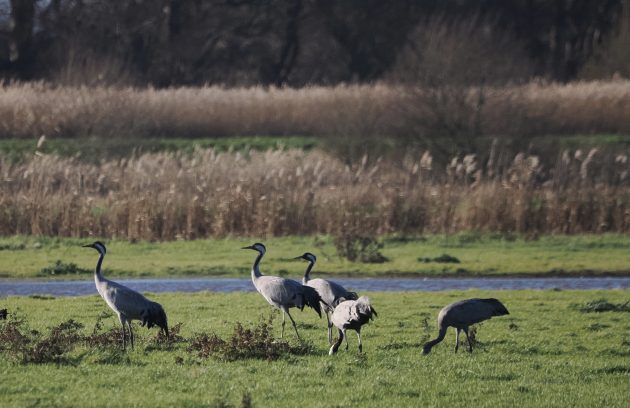
Common Cranes in the Norfolk Broads, December 2025
I’ve been lucky enough to have seen great flocks of cranes on their wintering grounds in Extremadura in Spain, where they feed in the dehesas, feasting on the acorns of the cork oaks. The birds I’ve watched in Spain breed in northern Europe, and their annual migration takes them through France, where they have traditional stopping places. The best place to see them is Lac du Der-Chantecoq. When I first went to Chantecoq in the 1980s I felt myself lucky to see a few hundred birds, but today you can expect to see many thousands there in November and again in March. Numbers are at a record high in Europe, largely due to strict protection both on their breeding grounds and their migration flyway.
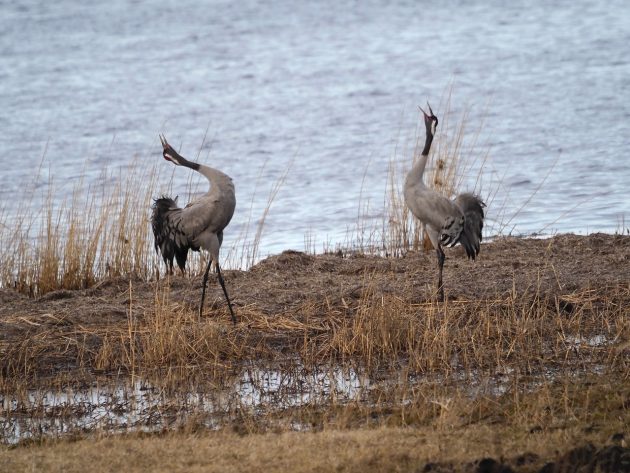
You can hear trumpeting Common Cranes at a mile or more
While it’s now easy to see Common Cranes in Europe, it remains a challenge to see Demoiselles, the smallest of the tribe. Historical records note that this species may well have bred in Spain in the 19th century, and there’s even a supposed breeding record from the Guadiana Valley in Extremadura, where apparently chicks were captured around 1923-24. My first Peterson Field Guide (1959) stated that they bred in Romania, but I’ve never managed to find out whether they really did. They no longer nest in North Africa, nor Eastern Turkey, both sites where they bred until recently, but apparently they still do in the Crimea. Sadly, thanks to Putin, this is a no-go area for birding.
Today your best chance of seeing these elegant little cranes in Europe is to visit Cyprus in late August/early September. Flocks of Demoiselles pass through the island en route to Africa, where the main wintering grounds are in the Sudan. Small numbers rest overnight on Cyprus’s Akrotiri Salt Lake. I have managed to see them there, but the birds were distant.
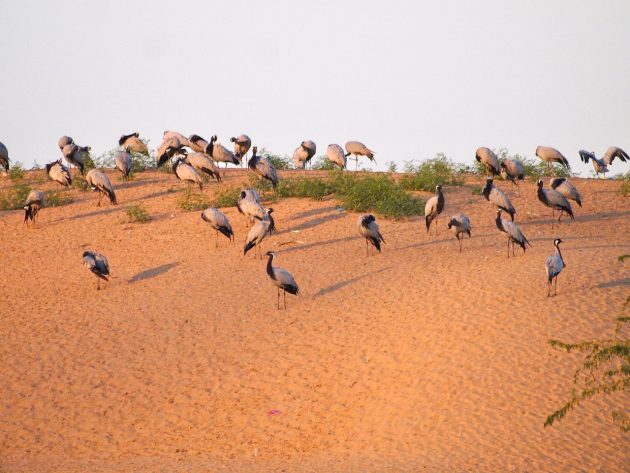
Demoiselle Canes waiting on the dunes at dawn before flighting in for their morning feed in Khichan
Though I have also seen Demoiselles on their breeding grounds on the steppes of Kazakhstan, my most memorable experience of these splendid birds was in India. In 2010 I travelled to Khichan specially to see the wintering flocks of Demoiselle Cranes. Khichan is 95 miles north of Jodhpur in the northern part of Rajasthan’s Thar Desert. It is a small and somewhat sleepy village well off the beaten tourist track: the tourists who come here do so for one reason only – to see the cranes.
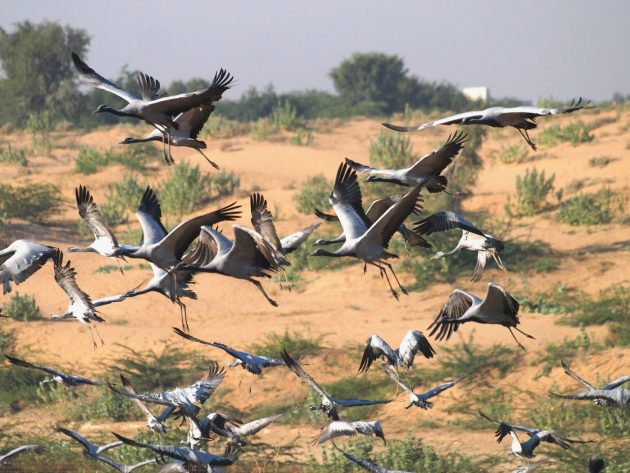
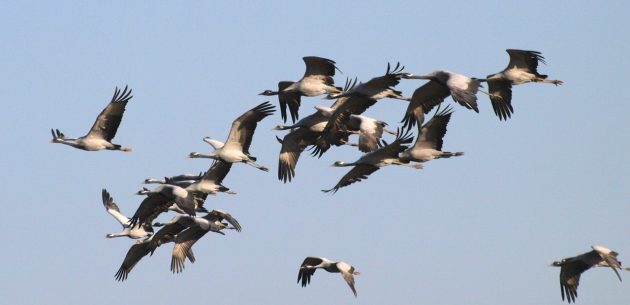
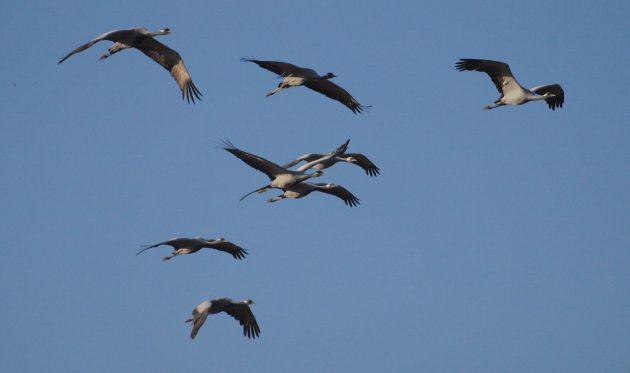
Feeding time – the cranes leaving the dunes
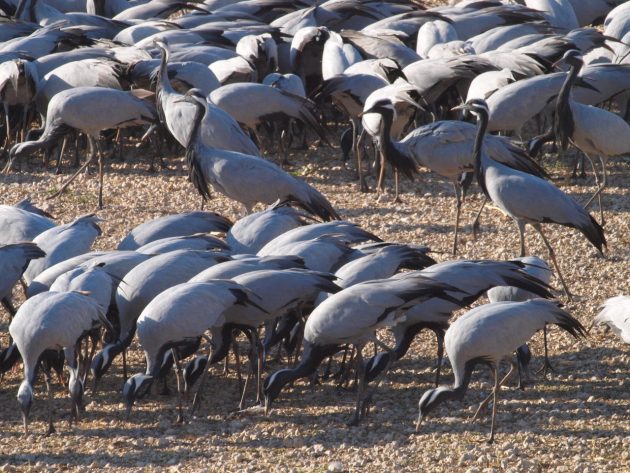
Since the early 1970s the villagers have provided food for the cranes. The villagers are mainly Jains, an ancient Indian religion that believes in non violence to all living creatures. Today the free handouts attract a wintering flock of several thousand birds. The first arrive in late August shortly after the monsoon, with numbers building up in following weeks and remaining until the spring. Their daily pattern follows the same routine. Shortly after dawn they gather on the nearby sand dunes that fringe the village, waiting for the morning feed. The first family groups then flight into the feeding area in an enclosure in the village, soon followed by many hundreds more.
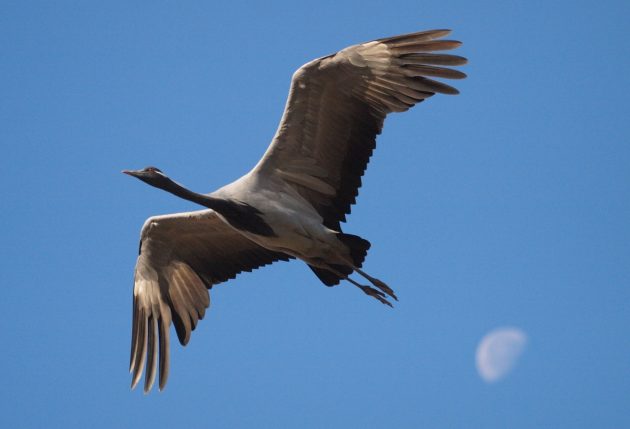
Watching them flight in, from the flat roof of a nearby house, is a spectacular and noisy experience. They feed quickly, before departing to spend the rest of the day foraging in the seemingly barren fields surrounding the village, or drinking in the small reservoirs that are a feature of the desert here.
It’s 16 years since my visit, but the cranes still gather at Khichan every autumn and winter. Visiting Khichan has been one of the highlights of my birding career. It wasn’t just the cranes that made it so memorable, so too was staying in the nearby Zone Palace by The Park hotel in the next-door town of Phalodi. This is a wonderfully atmospheric hotel housed in a centuries-old building, complete with stone arches and pillars. I made the mistake of asking for an egg for breakfast, forgetting that the hotel was strictly vegan, for Jains don’t eat eggs. I felt guilty for asking.
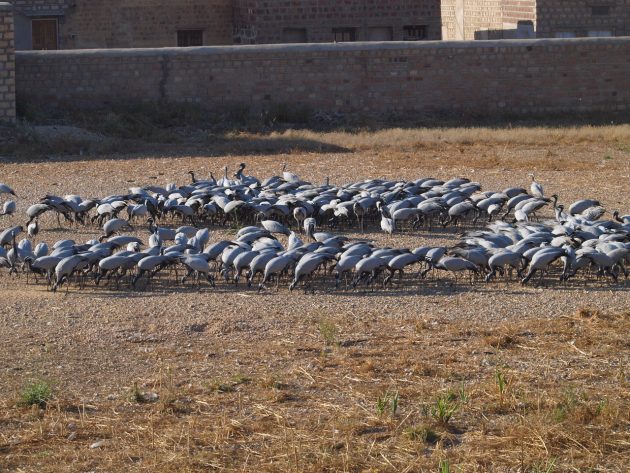
The cranes enjoying their morning feed in Khichan












Common Cranes have also been reintroduced to the UK. Together with the Wildfowl and Wetland Trust (WWT), crane eggs were collected right here in the Uckermark region where I live, in northeastern Germany, and hatched in the UK. The chicks were then released into the wild with considerable effort.