

On January 31st, a post by Corey from New York, birding in Maricao, Puerto Rico. was republished from the archives. I was not reading closely enough and I thought is was a new post and, further, I also thought that our visits had some overlapping dates. I even commented on the post as though it was new. Corey’s visit occurred in January, 2017! For some reason, I checked again and thank goodness I noticed that it was archival. Nevertheless, I was very happy to read it now; as well as a couple of other trip reports that Corey provided from Puerto Rico.
For this post I include a few photos and stories to open the door to Puerto Rican (PR) birding. Of note, this was a trip of the big cameras. I guess most birding trips are these days. I have a small camera. I think others who also use small cameras for birding will know what I mean.
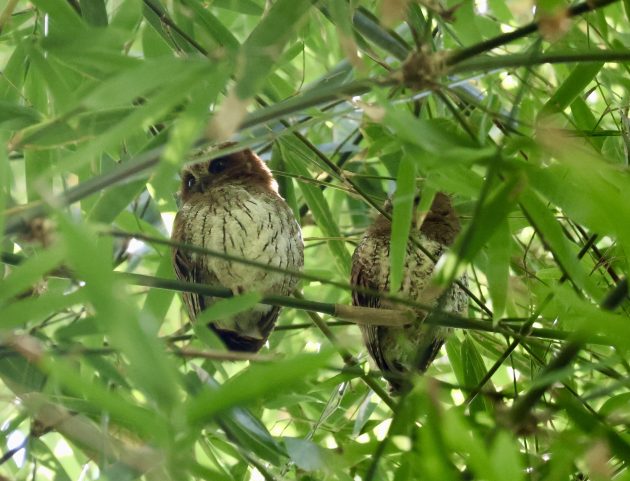
The story of seeing the owls is a good one. Thinking we had finished birding Maricao State Forest, we were on our way out when we drove by several stands of enormous bamboo growths. Our guides speaking, more or less, to themselves commented that it looked like a good spot for owls. In a great minds think alike moment, suddenly the van made a U-turn and we were headed back to the bamboo stands. Dušan had a thermal monocular, a compact, handheld device that detects infrared radiation (heat) and converts it into a visible, real-time image. He had used the thermal monocular device the night before for everyone to see the Puerto Rican Nightjar (Antrostomus noctitherus). Once found, and with the aid of high-powered flashlights, we somehow all managed good looks at several nightjars, in pitch darkness, through the spotting scope. For the daytime search for owls, Dušan found the thermal monocular effective as long as it was overcast and the sun was not shining on the subject. It was in this way that he found the owls perched together, way up high, in a stand of bamboo. After our challenging binocular search and locate, came our photo attempts; everyone angling for a clear camera view and, with the help of our guides, smartphone digiscoping. It’s hard to describe the degree of difficulty, but I think everyone was satisfied with their views and with their photos. We no longer had any need to go out at night for the owls and a new daytime roost site for the PR Owl was discovered. I was pleased with my camera photos and my smartphone digiscoped images are also nice.
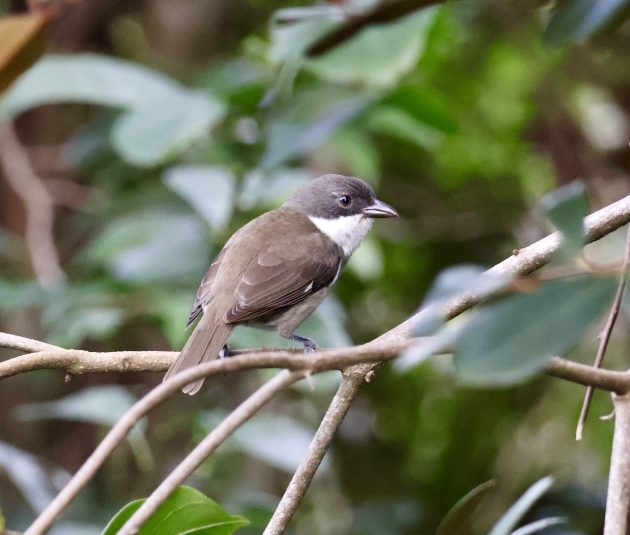
I don’t know if a duller-appearing tanager exists, but the PR Tanager (1) is endemic to Puerto Rico and is relatively common at moderate and higher elevations. For family listers, Nesospingidae (1, 2), of which the PR Tanager is monotypic, is also endemic to Puerto Rico. I invite you down a rabbit hole with me. Recent studies have given consideration to placing the PR Tanager amongst the Greater Antillean tanagers in the Phaenicophilidae family. The eBird police show PR Tanager belonging to the Phaenicophilidae family. But other documentation reveals it to still be in its monotypic family. I’m not a family lister and I’m not sure how these decisions are made except by doing genetic studies, followed by papers being written and committee discussions. When I studied photos of Black-crowned Palm-Tanager, Gray-crowned Palm-Tanager, White-winged Warbler and Green-tailed Warbler, all found on Hispaniola and all in the family Phaenicophilidae, I am inclined to agree that the PR Tanager still resides in its own monotypic family, Nesospingidae. Wait, there is more. This is further complicated by the AOS which considers PR Tanager’s closest relative to be the family Spindalidae, which is most closely related to the family Phaenicophilidae. Puerto Rico also has the endemic Puerto Rican Spindalis (Spindalis portoricensis). Our group saw the PR Spindalis in the same location as the PR Tanager. The AOS still has PR Tanager in its own family, Nesospingidae. It is not up to me, of course, but I took you down the rabbit hole. There was a family lister on the trip and he was in Puerto Rico to add the PR Tanager and the family Nesospingidae to his list. Based on what I was able to learn, I hope that his current list with Nesospingidae is safe, at least for now(?). Feel free to disagree.
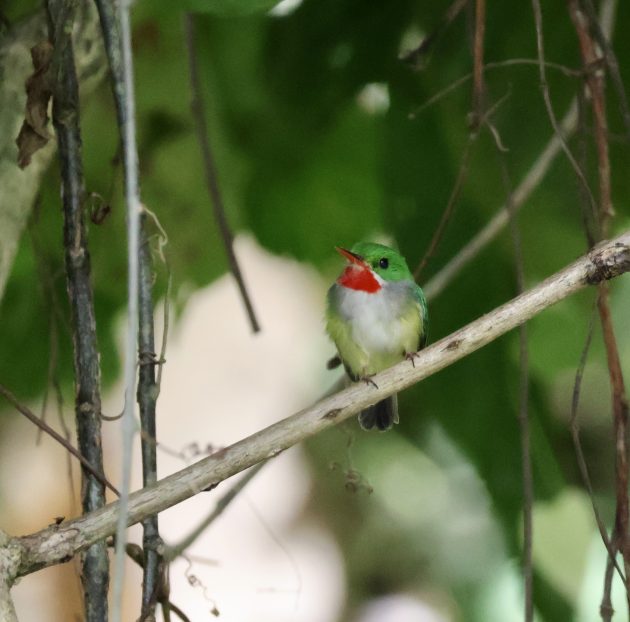
Surely it is no surprise that everyone wants to see a tody. When one is called out, the excitement barometer goes way up—at least it did for this birder. Literally, a little gem.
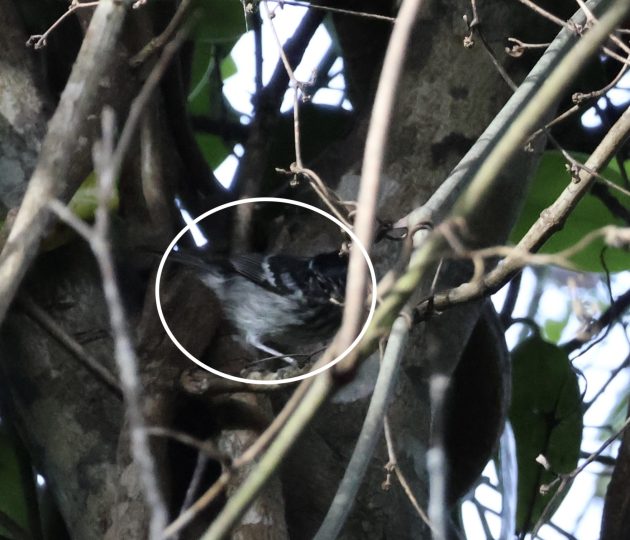
A marvelous little bird that we saw well—male, female and juvenile—and I was shocked to be able to get any photo at all. You must look closely to see it, but the bird’s eye is visible.
Other random observations about a few Puerto Rican birding experiences include: Gray Kingbird (Tyrannus dominicensis) is a beautiful flycatcher and they are everywhere you are. Puerto Rican Bullfinch (Melopyrrha portoricensis) vocalizes freely, but prefers not to reveal itself. Try getting a good photo. Puerto Rican Parrot (Amazona vittata) is a very fun bird to chase. The Yellow-shouldered Blackbird (Agelaius xanthomus) is also a fun bird to chase and does not always have yellow shoulders. Many wintering neotropical warblers were seen; Prairie Warbler (Setophaga discolor) being the most common. Clapper Rails (Rallus crepitans) can behave comically when seen well in the open as we saw them. White-cheeked Pintails (Anas bahamensis) are beautiful ducks. The pintails and West Indian Whistling Ducks (Dendrocygna arborea) made up the bulk of our waterfowl sightings. We missed Plain Pigeon (Patagioenas leucocephala), now very rare in Puerto Rico. We heard, but did not see Key West Quail-Dove (Geotrygon chrysia). The Puerto Rican Nightjar was thought extinct from 1888 to 1961. Still classified as endangered, its range now seems to be expanding (Raffaele, Petrovic, et.al. page 110) (3).
It’s fair to say that Puerto Rico is a very small island known mostly for its beaches but, not being a beach person, I found the birding to be great. Chasing and finding all of the endemics and seeing them so well was such good fun. Many of the endemics are not easy to see. As a tribute to our guides we saw them all and saw them well, even the nightjar. This was my first visit to Puerto Rico. In fact, aside from Cuba in 2006, it was also my first visit to any Caribbean island. There is non-stop air travel from my home city to San Juan and I’ll be visiting again. There are still so many areas I would like to explore and still much to see. It is also a fantastic escape from winter, especially considering the winter I am experiencing now.
Need the Puerto Rican endemics for your list? I recommend Island Birdwatching and Alcides Morales (2) as your local guide—wonderful person with remarkable eyes and ears. Please note the Birds of the World author of Puerto Rican Tanager in the second citation below.
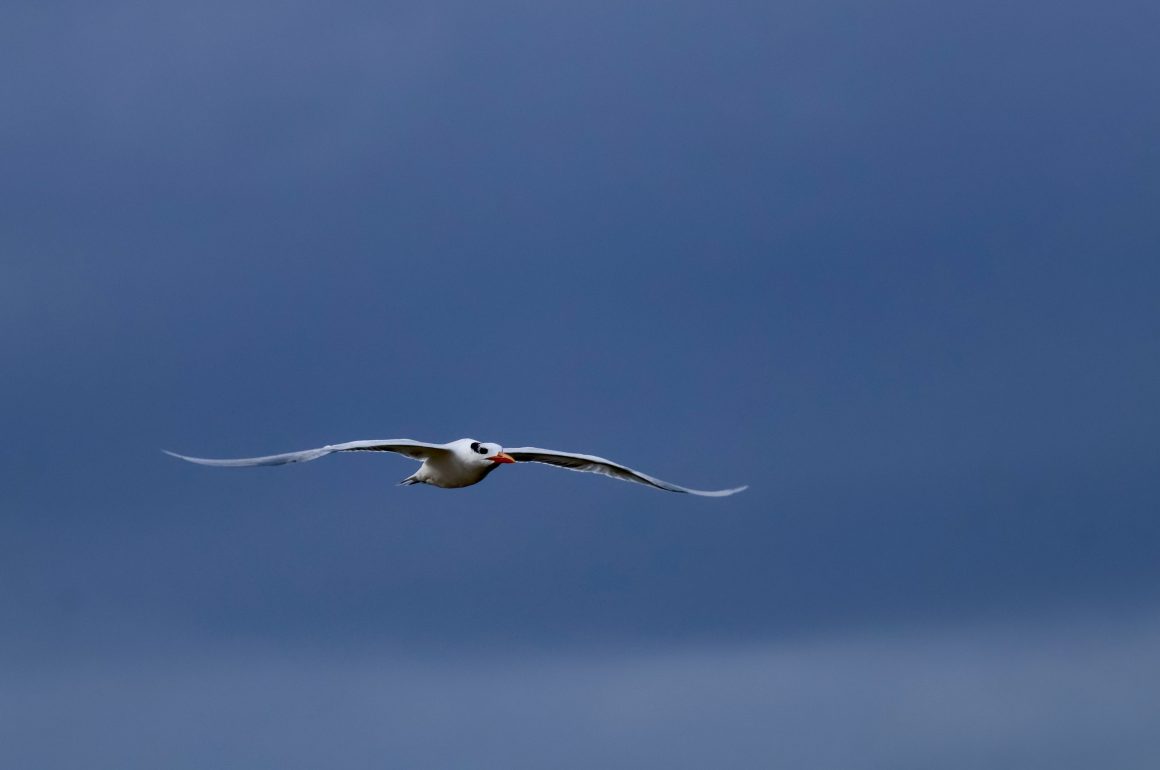
Cover photo: Royal Tern (Thalasseus maximus). Even though we went to three different beaches, we saw remarkably few gulls and terns. Shorebirds were also scanty, but wading birds were fairly well-represented.
- Bird Families of the World, Puerto Rican Tanager Nesospingidae. Monotypic Nesospingidae recognized in 2013.
- Cornell Lab: Birds of the World. Puerto Rican Tanager Nesospingus speculiferus, Family Phaenicophilidae by Alcides L. Morales. Updated October 25, 2025.
- Birds of Puerto Rico and The Virgin Islands, Herbert A. Raffaele, Clive Petrovic, et.al, Princeton Field Guides, copyright © 2021 Princeton University Press.






Leave a Comment