

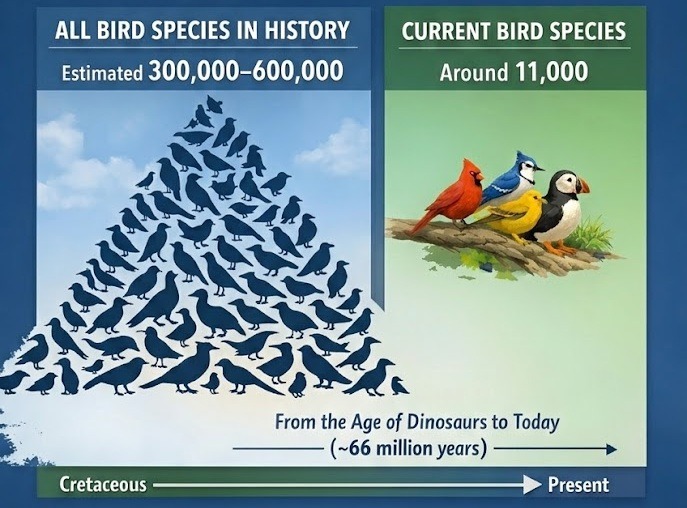
This is one of those questions serious ornithologists prefer to avoid. The fossil record is patchy, the assumptions are fragile, and the margin for error is vast.
Still, people have tried.
As early as 1960, paleornithologist Pierce Brodkorb attempted an estimate. He assumed an average species duration of about 500,000 years and multiplied the number of species existing at any given time by the number of such turnover cycles. This produced the suspiciously precise figure of about 1,684,000 bird species over evolutionary time.
That sits at the upper end of the range of 150,000 to 1.5 million species suggested by ornithologist Roger Lederer in his blog.
A more recent line of reasoning starts with estimates of average species lifespans of roughly 1–2 million years (based largely on mammals, and cautiously extended to birds). If one then begins with the major radiation of modern birds (Neornithes) about 66 million years ago and — a heroic simplification — assumes that something like today’s roughly 11,000 species existed consistently throughout that time, the result is a narrower estimate of roughly 330,000 to 666,000 avian species having existed in total.
In the end, the estimate depends more on the assumptions than on the fossils.
Still, it does make me glad not to be a lister. Without a time machine, even the most ambitious world lister would struggle to exceed about 3% completion.














Leave a Comment