

About 19% of all bird species are regular seasonal migrants. But how do they migrate – alone, in small groups, in large flocks?
Nature being complicated and sometimes seemingly indecisive, the answer is “All of the above” – but some groupings are more important than others.
Migrating Alone: Roughly 50-60% of the regular seasonal migrants travel alone, often at night. Most small migrating passerines migrate this way, as well as many shorebirds and cuckoos. Typically, this means that their migration routes are inherited – there is nobody to learn from.
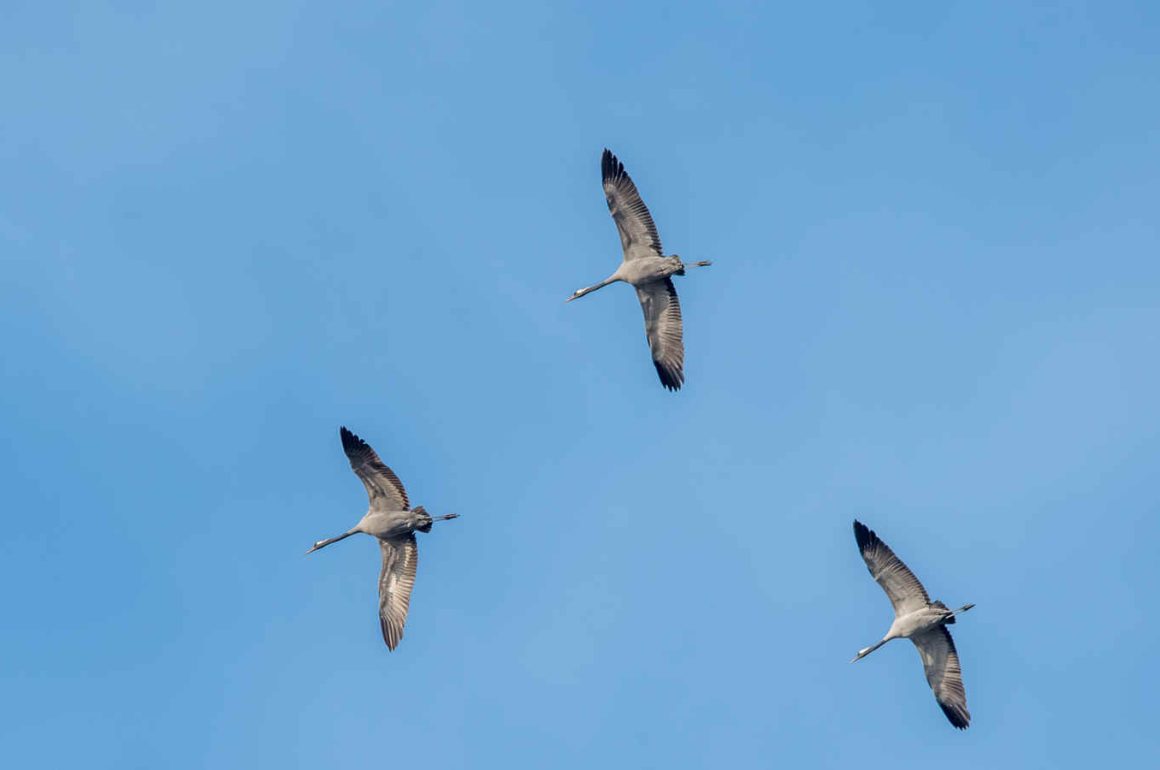
Migrating as a Family: Another approach is for members of the same family to migrate together. This is true for many bigger, long-lived birds such as cranes and swans. The young birds learn the migration routes from their parents – a cultural transmission of information. While this grouping is only observed for a small number of species – probably 5% or so – it is highly visible as it applies to quite a few large and charismatic birds.
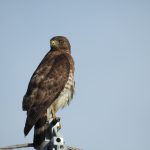
Migrating in Same-Species Flocks: Many species (perhaps 30-35% of all regular seasonal migrants) migrate in flocks of (mostly) unrelated birds of the same species. Typical examples are starlings, blackbirds, and raptors. Migrating in such large groups has its advantages (more birds looking for danger, energy savings from flying in formation), but also disadvantages (more competition for food).
Migrating in Mixed-Species Flocks: While some of these – like the raptor migrations Clive describes from Gibraltar – may not be much more than different raptor species gathering at the same migration bottlenecks, others are more repeatable. Very recent tracking studies have shown that many small songbirds associate socially with other species during nighttime flights. And these associations are the strongest between species with similar calls and flight speeds. So, it is possible that the inter-species communication during these nighttime flights provides information related to navigation, weather conditions, or stopover decisions (the paper is not available for free download, but I would not be surprised if it ends with a plea for more research on the subject). Such mixed-species migration might account for 5-10% of all regular seasonal migrants, though to be fair, all these percentages are only rough estimates anyway.
Photo: Common Crane, Visselhoevede, Northern Germany, January 2018









With whom do ducks migrate? – ( ‘)>
And, where do ducks migrate? – ( ‘)>