

Adam Cruickshank is a team member at Birding Ecotours and the host of The Birding Life Podcast. He is based in South Africa and spends much of his time exploring African birding destinations, sharing personal field experiences, and working with local guides across the continent.
Many birders who visit South Africa focus on the endemic-rich Western Cape or the productive eastern subtropical regions, but a trip into the Karoo reveals a very different side of the country, shaped by vast arid landscapes and a sense of space that is becoming increasingly rare.
This is an area defined by wide open spaces, landscapes that seem to stretch on forever, and long stretches of road where you will see no one else. Yet hidden within this harsh and unforgiving environment are birds and other wildlife that have adapted over centuries to survive and thrive in conditions that at first glance seem inhospitable.
In its starkness, there is a beauty that leaves a deep and lasting impression. It is easy to understand why photographers are drawn to this region, but what stays with you goes beyond what a photo can capture. Time in the Karoo allows you to connect, in a quiet and personal way, with those who have called this environment home for generations. It has a way of settling into you, becoming part of your own story long after you have left.
In September last year, I had the opportunity to visit this region along with a small group on a Birding Ecotours private birding tour. The aim of the trip was to target a select list of species, and over the course of just under a week we recorded birds such as Sclater’s, Red, and Karoo Long-billed Larks, along with Black-eared Sparrow-Lark, Karoo Eremomela, Cinnamon-breasted Warbler, Fawn-colored Lark, and Ludwig’s Bustard.
This trip also allowed me to tick off one of my long-held goals, which was to experience the wildflowers of the West Coast National Park. These blooms, which usually peak between August and September, transform the landscape into a striking display of color. We visited toward the end of the flowering season, so we did not see the landscape at its absolute peak, but even so, there were still pockets of color scattered across the landscape. It was enough to understand why people travel from all over the world to witness it, and it remains an experience that has stayed with me.
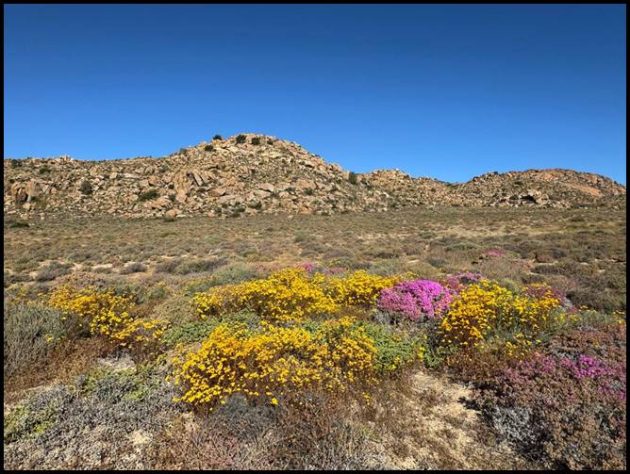
The West Coast wildflowers in full display, transforming the landscape into color (photo John de Beer)
This is also an area where having a knowledgeable guide makes a meaningful difference.
One of the key reasons for this is the number of tricky LBJs (‘little brown jobs’) that the region is known for, and being able to work through subtle identification features, as well as calls, is often essential for locating target species.
Beyond identification, the logistics of traveling through the Karoo should not be underestimated. While it is certainly possible to self-drive with careful planning, the long distances, limited cell phone reception, and stretches with very little infrastructure mean that having someone who knows the area well removes a significant amount of pressure and allows you to focus on the experience itself, which in a place like the Karoo makes all the difference. When you are not worrying about logistics, you begin to notice more, listen more carefully, and connect more deeply with the landscape around you.
There is a lot I could share about the trip, but there are three experiences that stand out for me, each one capturing a different aspect of what makes the Karoo so special.
1. Pursuing Red Lark
The Karoo is the driest region in the country, yet it seems to have a way of producing rain at exactly the wrong time. On the third day of the trip, we had set aside time to visit an area known to be good for Red Lark, and we headed out early with a sense of anticipation for what the day might bring. As we arrived, the rain started.
Fortunately, it was not too heavy at first, so we decided to continue. We moved slowly through the shrubland, listening carefully and scanning for movement, when someone in the group suddenly called out for us to stop. It was not the lark, but rather a small, well-camouflaged Horned Adder lying just ahead of where one of us had been about to step.
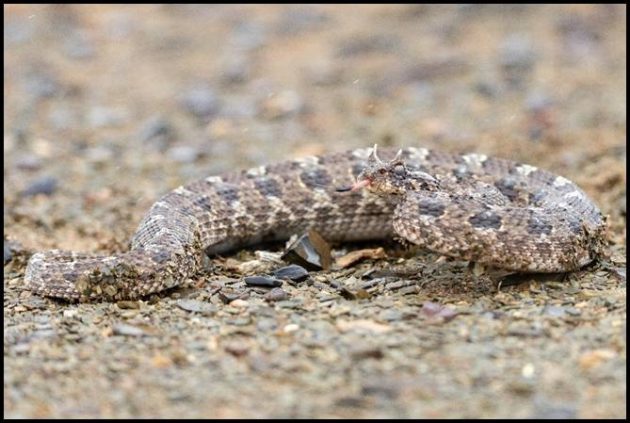
A well-camouflaged Horned Adder, its distinctive “horned” features clearly visible (photo Zach Simpson)
We paused and spent time observing and photographing the snake from a safe distance, taking in its distinctive horned appearance. It was a reminder that the Karoo is not just about birds, but about a broader diversity that reveals itself when you take the time to look closely.
We only managed to find the Red Lark later that afternoon once the rain had subsided, but when I think back on that search, it is the encounter with the adder that stands out most clearly. It is often the unexpected moments that define time in places like this.
2. A near miss with Sclater’s Lark
When it comes to listing, most birders operate on an unspoken honor system, but this trip presented a moment where that was tested.
One of our major targets was Sclater’s Lark, and we headed to a site known to be reliable for the species. One of the most effective ways to find this bird is to wait at water troughs used by livestock, where individuals will occasionally come in to drink. We had secured access to a farm, positioned ourselves well, and prepared for what we expected to be a patient wait.
The weather, however, had other plans. Rain returned, the wind picked up, and the birds simply did not come in. We moved between several farms, stopping at different troughs along the way, but with no success. Eventually, we settled at one final spot with little expectation, watching flocks of Lark-like Buntings coming into drink.
Then the group picked up a single Sclater’s Lark among them. I saw a brief shape, just enough to know something was there, but not enough to confirm it properly before it disappeared again.
It would have been easy to stretch that sighting and add it to my list, but it would not have been an honest one. So, I waited. After what felt like a long stretch of time, the bird returned, and this time I was able to get a proper view through my binoculars, along with a very average photograph that still meant a great deal to me.
That moment captured something important about birding in the Karoo. It demands patience, and it does not reward urgency. You are forced to slow down and work within its rhythm rather than trying to impose your own.
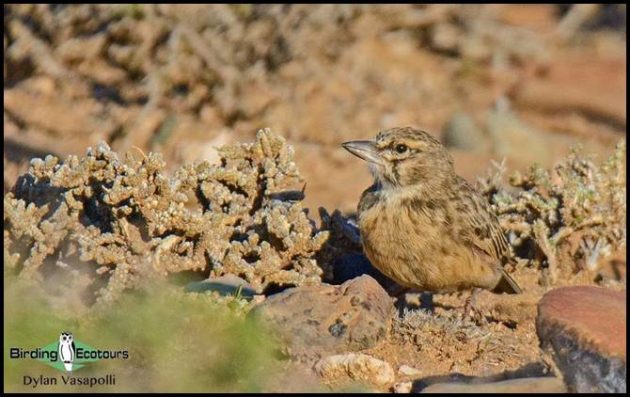
Sclater’s Lark, often found near water troughs in the Karoo (photo Dylan Vasapolli)
3. A night drive near Calvinia
Night drives in South Africa can be memorable, but the Karoo offers something distinct, largely because of its scale and the absence of light pollution.
We headed out from Calvinia with spotlights and made our way slowly along a quiet dirt road. Before the cloud cover fully settled in, we were able to take in a sky filled with stars, stretching endlessly above us in a way that is becoming increasingly rare to experience.
As we continued, the sightings began to build. Over the course of the drive we encountered Striped Polecat, Bat-eared Fox, African Wildcat, Aardwolf, and Cape Porcupine, along with the usual hares and Steenbok.
Although we did not record any owls on the drive, it did little to take away from the experience. The combination of the setting, the species, and the sense of isolation made it one of the most memorable nights I have spent in the field.
The Karoo is not a place that overwhelms you with constant activity or easy sightings. Instead, it works on a slower timescale, asking for patience, attention, and a willingness to settle into its rhythm. In return, it offers something that is far more lasting than a simple list of species.
Time spent in the Karoo may feel quiet while you are there, but it leaves a mark that stays with you long after you have left.
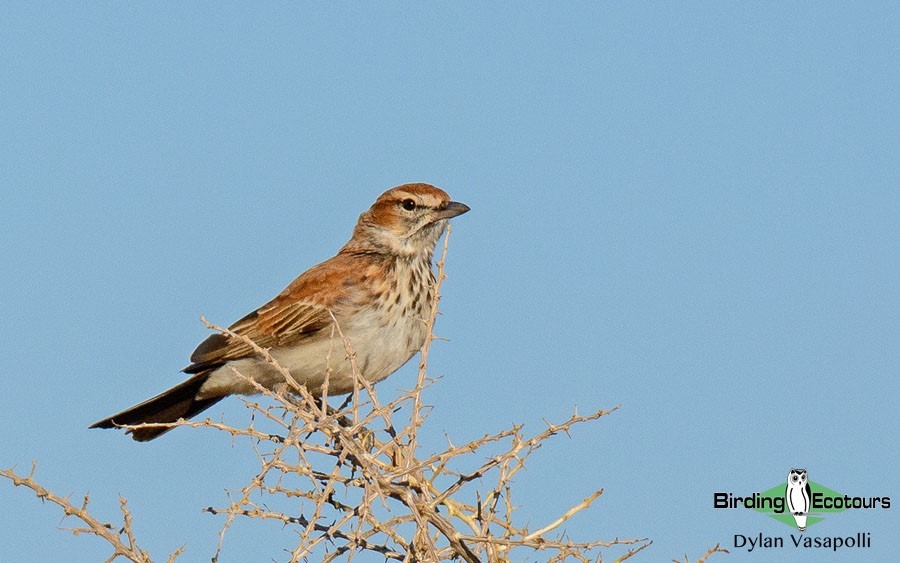
Cover Illustration: Red Lark (photo: Dylan Vasapolli)








Good read: makes me want to go.
Magical landscape with some iconic birds (sorry Kai)