

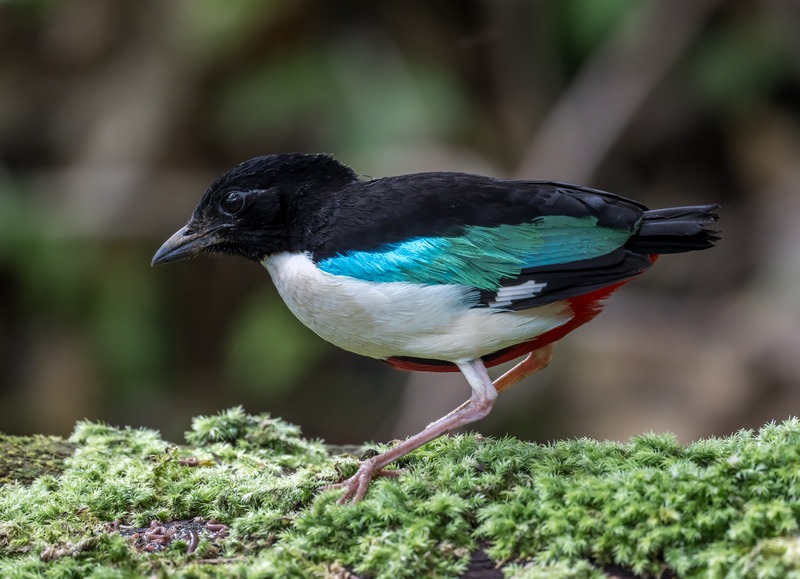
The short answer is that they’re not always more colorful, but it is correct as a trend statement. And the main hypothesis explaining why is mostly about visibility, or more accurately, the aim to reduce visibility, to reduce predation.
Let’s look at some scientific papers that look at the issue before moving to the rationale. Mainly, it has been phrased as a slightly different question: Are tropical birds more colorful than those in temperate climates?
A paper published in 1978 found that indeed, tropical passerines tend to have brighter and more varied colors while passerine species in temperate climates tend to be duller and more uniformly colored. Reasons provided for this trend included habitat structure, climate, and visibility, i.e., camouflage and signaling.
In 2022, the issue was addressed again in a much broader paper examining about 4500 passerine species. It found that indeed, birds closer to the equator are more colorful, and that this is true for both males and females. Several drivers are likely to be involved:
Habitat: Open habitat favors camouflage as protection, but is less relevant for forest birds, which may even want to be seen by potential mates at a near distance (this is probably the factor closest related to the question of forest birds versus Mediterranean birds).
Sexual Selection: In species with high sexual selection pressure, particularly males, will evolve to be more colorful. Such high pressure is more likely in rich tropical environments with their potential for uniparental care.
So, these first two factors could also be described as a tradeoff between predation pressure (requiring camouflage) and sexual selection pressure (requiring intense signaling).
Diet is another factor. Certain colorful pigments are more easily available in tropical climates.
Finally, climate provides another rationale. Dark melanin pigments offer some protection against bacterial degradation of feathers and intense UV – and both are more important in warm, humid climates.
But let’s keep in mind that open habitats and temperate climates still have their colorful birds – bee eaters, orioles – while many tropical birds are pretty drab (though it would be rude to tell that to them in their face).
Here are a few other interesting studies about birds and their colors:
One study found that urban environments may be unsuitable for the most colorful tropical bird species.
On the level of microhabitat, i.e., canopy and understory rainforest birds, there is also a strong influence on bird coloration (source). For example, for contrast, birds use short wavelengths in the canopy and long wavelengths in the understory. And they reduce detectability by matching the background color and contrast.
Sadly for birders, more colorful passerines are at a greater risk of extinction than more drab species, particularly in Indomalaya and Australasia (source).
A management consultant like me would also probably want to point out that birds only use a limited portion (26–30%) of the total available avian color space, i.e., all colors birds can see and discriminate. Imagine the opportunities for species yet to evolve!
Finally, there is even a study on which colors humans prefer in birds. Participants in the study were shown 43 colored bird pictures (pittas, actually) and the same 43 in black and white. Apparently, human preference is mostly based on the bird patterns. As for color, lighter colors are preferred, and humans seem to particularly like blue and green birds.
Photo: Ivory-breasted Pitta, Halmahera, July 2024









Leave a Comment