

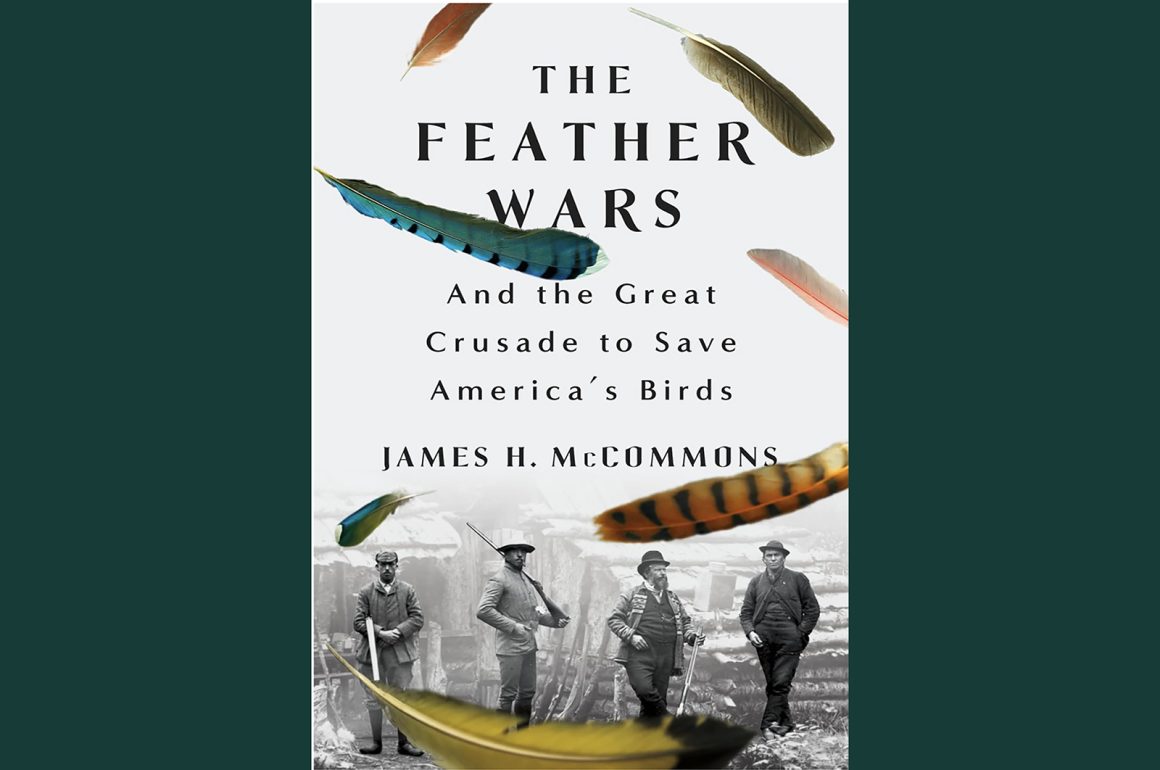
I was looking for news about the Kentucky Derby last weekend and all I saw were hats. Enormous hats, colorful hats, hats with bows, flounces, crimped lace, satin roses, paper peonies, and feathers–lots and lots of feathers. Long feathers, purple feathers, downy white feathers, yellow and pink curly lengthy feathers, feathers that resembled Motmot tails and feathers that reminded me of pheasants. Most of these feathers were clearly fake (hopefully all, it is legal to use captive game birds), but the momentary panic I felt when I saw these feathery hats was rooted in horror stories of another time, when the thirst for fashionable hats decorated with plumes and other bird parts decimated bird populations in North America, a part of what is known, and often celebrated, as the Gilded Age. Stories of how women and men, social figures and ornithologists, fought plume hunters, changed a profitable industry, and convinced women to give up their plumed hats have been the subject of well-illustrated stories in birding and history magazines and of a few museum exhibits. This is how Audubon societies were founded. This is how women became involved in the birding world. This is how the Migratory Bird Treaty Act came to be. But there is more, so much more–events, people, trends, and fights that contributed to and ultimately achieved landmark legislation and overall cultural change in our attitudes towards birds and conservation. This is the subject of The Feather Wars: And the Great Crusade to Save America’s Birds by James H. McCommons.
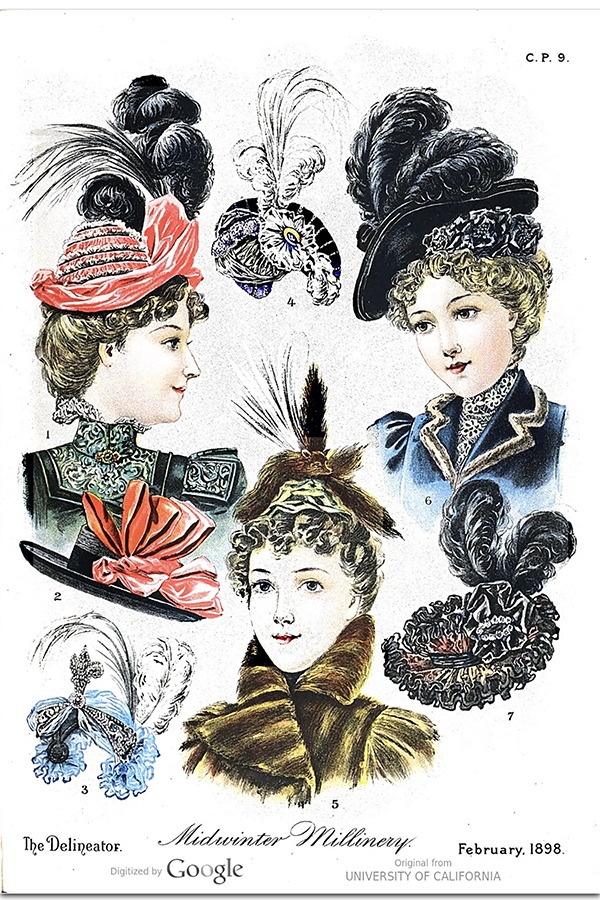 One of the images used in The Feather Wars to illustrate the popularity of plumed hats, this is from The Delineator, Feb. 1898 issue. A publication of the Butterick Publishing Company, The Delineator detailed the newest fashions and promoted its sewing patterns. I retrieved this image from the Hathaway Trust, the one used in the book is more colorful and without the Hathaway Trust notes at the bottom.
McCommons starts his history in the mid-19th century, when ornithologists shot birds for study (and often for sport too), when bird eggs were eagerly collected for science and status, when subsistence hunting developed with the help of cold storage and railroads into market hunting. He ends in early/mid-twentieth century, with the creation of national forests and bird refuges during the Great Depression and the publication of Peterson’s groundbreaking bird guide. In between he focuses on three main subjects: plume hunting, market hunting, and the political and legal strategies behind our landmark bird protection legislation. There is a lot more material here than you may imagine.
The 31 chapters focus on (1) the players in this bird conservation drama, heroes and villains (The Shotgun Ornithologists; Cold Storage Man; John “O’Birds” Burroughs; Florence Merriam and Bird Study; Bird Cranks: William Finley and Herman Bohlman); (2) the depressingly many ways in which birds were destroyed (The Tragedy of Passenger Pigeons; Punt Guns on the Chesapeake; Oology and Egg Mania; Bird Hats and the Voyage of the Bonton; Starlings and the Sparrow War; Lake Surprise and All the Ducks in the World); (3) the development of organizations (George Grinnell and the First Audubon Society; The Ethics of Boone and Crockett; The Audubon Movement Redux; The Rise of National Audubon); the development of legal theory on which bird conservation legislation could be created and enacted (The Lacey Act; The Weeks-McLean Act; The Plumage Amendment); (4) pushback by plume hunters, market hunters, subsistence hunters, politicians, and seemingly everybody in certain areas, which surprisingly included the Midwest (Songbirds and the Black Hand; The Reelfoot and Big Lake Duck Wars; “Backwoods Horseplay”: Missouri v. Holland); and (5) the development of bird refuges and tools for birding (Mister Ned’s Egrets; Pelican Island: The First Bird Refuge; Ludlow Griscom and Sight Recognition; Flappers, Bag Limits, and Game Refuges; Rosalie Edge, Audubon, and Hawk Mountain; The Peterson System; Ding Darling and the Great Depression).
McCommons tells the history of bird conservation through the players, mostly wealthy white men though he makes an effort to include women. (There are very few people of color in this book and I don’t have a deep enough knowledge to know if anyone has been overlooked. But seeing how meticulous McCommons is with his research and how cognizant he is of class and gender historical issues, I doubt it. ) He is clearly charmed by many of the larger-than-life personalities in this history, such as John Burroughs and Edward Avery McIlhenny (yes, of Tabasco Sauce fame), and impressed by the creative adventures of others, such as William Finley and Herman Bohlman, a writer and photographer team who risked their lives to obtain photographs of nesting seabirds and marsh birds on the West Coast, photographs that he sees as the reason for the establishment of three major Oregon refuges.
His deep research also gives us an opportunity to learn about lesser-known figures, such as Ray Holland, a hunter, writer, photographer, U.S. game warden, and longtime editor of Field & Stream who, when he was a game warden arresting duck hunters, lent his name to the landmark case that upheld the constitutionality of the Migratory Bird Treaty Act. McCommons uses Holland’s unpublished autobiography, located in Wesleyan University’s Special Collections, to add first person detail to his game warden experiences, which included arresting the Missouri attorney general. Of course, the most heartbreaking figure is Guy Bradley, the Florida woodsman and Audubon warden who was murdered while confronting plume hunter and neighbor Walter Smith. Even if you’re familiar with Bradley’s story, which was the subject of the book Death in the Everglades: The Murder of Guy Bradley, America’s First Martyr to Environmentalism by Stuart McIver (2009), this chapter is worth reading for its placement within the larger struggle to control the seemingly uncontrollable.
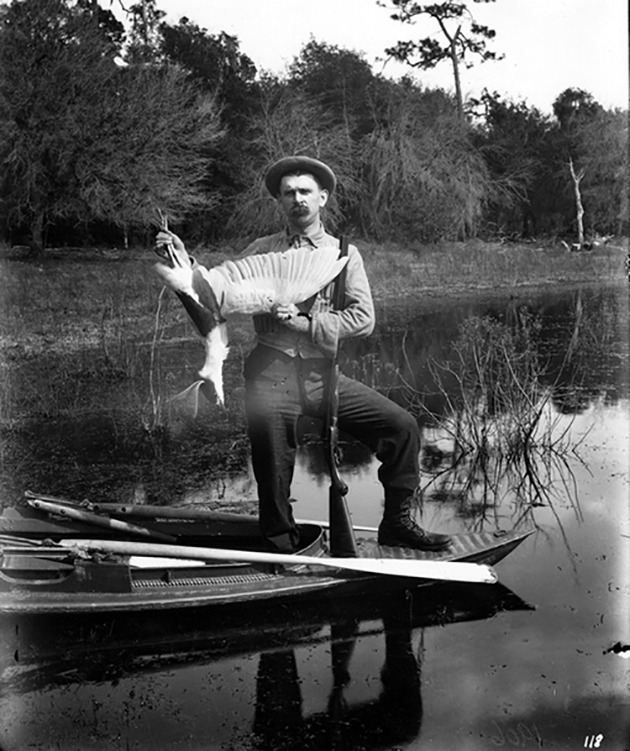
Illustration from book, captioned “A Florida plume hunter with a black-crowned night heron.” This public domain photograph, retrieved from the digital website of the State Library Archives of Florida, is captioned “Plume hunter Leigh M. Pearsall posting with a Black-crowned night heron on Santa Fe Lake” on the website.
McCommon’s text is highly detailed and although the use of personalities and film-ready stories livens up the material (the fights between conservation wardens and market hunters reminded me of the Harlan County coal wars), there are times when the level of detail feels overwhelming. Part of the reason for so much detail is that McCommons tries to pull together every little strand in every single story–the role of technology, changes in geography, politics, personalities, industrial trends, agricultural trends. The chapter on the sunklands of the Mississippi Delta, for example (The Reelfoot and Big Lake Duck Wars) starts with the 1811 earthquake that changed the land, creating the swamp that attracted hundreds of thousands of birds, then describes the living conditions of the first white settlers, called “swamp angels,” and then, finally, gets to market hunting on the fourth page of a 14-page chapter. The paragraphs are long, which also contributes to text exhaustion. We readers of online articles with one sentence paragraphs and bullet points are not used to good old fashioned historical writing. Fortunately, McCommons carries strands through the chapters and when we encounter personalities we’re read about before he reminds us of who they are. There is also a very good index, which I used extensively.
The book is fully documented with notes in the back. I do wish there was also a bibliography or list of recommended readings since it is often difficult to follow repeated citations. A list of recommended readings would also be helpful to those of us who want to read more, explore more. Sources are impressive, reflecting hundreds of hours spent in, as he writes in the Preface, “libraries, archives, museums, universities, national parks, wildlife refuges, hunt clubs, and iconic locations.” He also interviewed “professors, biologists, museum curators, and historians” (p. xx). This is a Pandemic years researched book, and McCommons’ research reflects both his background as a journalist and a university professor. As a journalist, he has written on ecology, the environment, and travel for a wide range of magazines and newspapers. He has also authored Waiting on a Train: The Embattled Future of Passenger Rail, A Year Spent Riding Across America (2009) and Camera Hunter: George Shiras III and the Birth of Wildlife Photography (2019, Shiras also appears in The Feather Wars). He taught journalism and nature writing at Northern Michigan University for 20 years and is currently a professor emeritus. 10,000 Birds beat writer Hannah Buschert interviewed McCommons for her Bird Nerd Book Club podcast, and it’s fascinating hearing him talk about how he wrote The Feather Wars.
Feather Wars is well illustrated, a delightful thing to behold in this age of limited illustration. Within the text we can see black-and-white photographs of the personalities profiled and a few other photographs from the National Conservation Training Center Museum/Archives. And two photographic inserts offer 19 images, including three colorful images of women’s plumed hats ask they were featured in magazines and sheet music (see above). This is, I think, an area that could have been improved with a little thought. Where are the depictions of Passenger Pigeons filling the skies? The books that came out in 2014 honoring the centennial of the death of the last Passenger Pigeon were full of painting and photographs of the now-extinct bird. Where are the photographs or paintings of the source of the plumes that men were killed for, our Snowy Egrets, Great Egrets, and Roseate Spoonbills? Or images of the waterfowl, game birds, and shore birds almost hunted to extinction by market hunters? Too many portraits of people and not enough illustrations of the birds themselves.
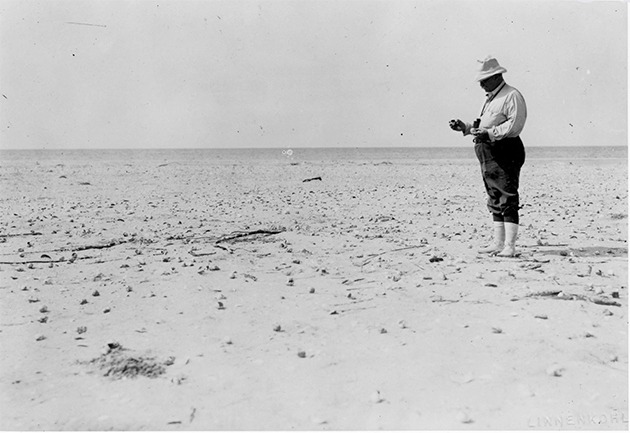 Theodore Roosevelt visiting Breton Island, 1915, retrieved from the U.S. Fish & Wildlife Service Facebook page. See above for comments on how the photograph is used in The Feather Wars.
In addition, captioning of some photographs is curiously vague. The caption of the image of Theodore Roosevelt above, for example, talks about how his passion for birds dates back to his childhood, but doesn’t tell us that the photograph itself was taken at Breton Island Bird Reservation in 1915, that this was the only refuge created during his administration that he visited. The image of the plume hunter shown above does not include details such as his name that are easily available from the source.
In the Epilogue of The Feather Wars, McCommons talks about The Crisis Today–the glass, the cats, pesticides and agriculture, habitat loss. Some of these are old issues (cats comes up as a known danger in the early 20th century), some are new (what would the early conservationists say about window strikes?). He’s concerned about funding for wildlife refuges wildlife management and suggests a “modest tax” on outdoor recreation items. He says cats are an invasive species and should be controlled. There is little about the pro-industry, exploitive nature of our government and their efforts to de-fang bird conservation legislation and programs, including the Endangered Species Act and the Migratory Bird Treaty Act, which surprises me because that is a major reason why I think we should all read this book. This legislation, our refuges, our bird protections did not come easily. Men were shot, some died. Rich and poor were literally at war, in the courts, in the towns, in the swamps. An industry was condemned and destroyed. Millions of dollars were spent buying land and giving it away to protect it. Egos may have ruled some of the events in The Feather Wars, but there was also passion, principle, and love of birds. Reading this book may be a challenge, but it is also often a delight. I’m very happy that we finally have this exhaustive, comprehensive history and hope that it provides many of us with tools and inspiration for holding the line and even going forward.
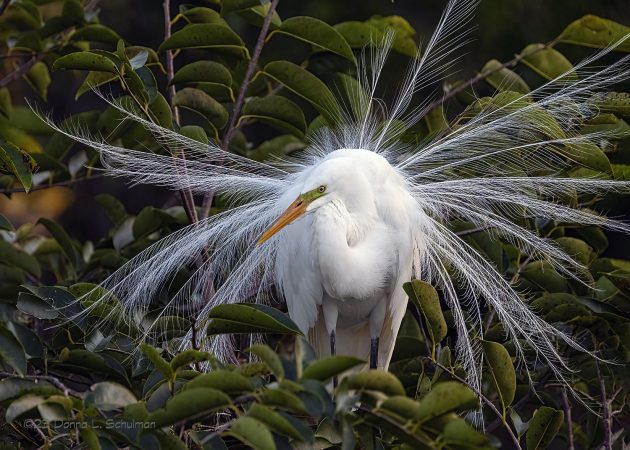
A photograph NOT from the book by me, breeding plumaged Great Egret, Wakodahatchee Wetlands, Feb. 2013. You can see what all the fuss is about, but I still wouldn’t want these feathers on my hats. © 2013 Donna L Schulman
The Feather Wars: And the Great Crusade to Save America’s Birds
by James H. McCommons
St. Martin’s Press, March 2026
416 pp.; illustrated
ISBN-10: 978-1250286895; ISBN-13: 978-1250286895








Leave a Comment