

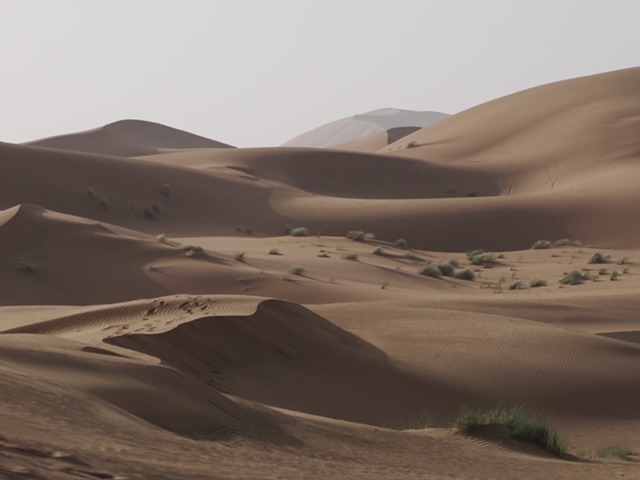
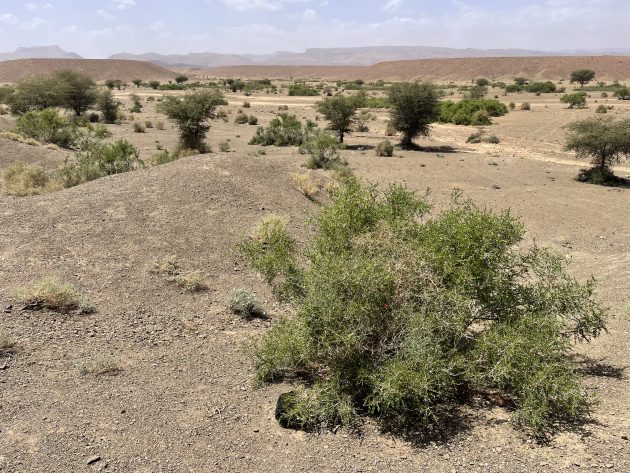
Most of us have an image in our minds of the Sahara, usually one of a succession of sand dunes ranging into the distance. The reality is that much of the Sahara is gravel desert, or at least varieties of such, and the dunes cover a mere 15%. The sand dunes are not as productive for birds as the gravel desert, but they do have their specialities, which is why we stayed for two nights near Erg-Chebbi on the edge of the dunes, close to the border with Algeria.
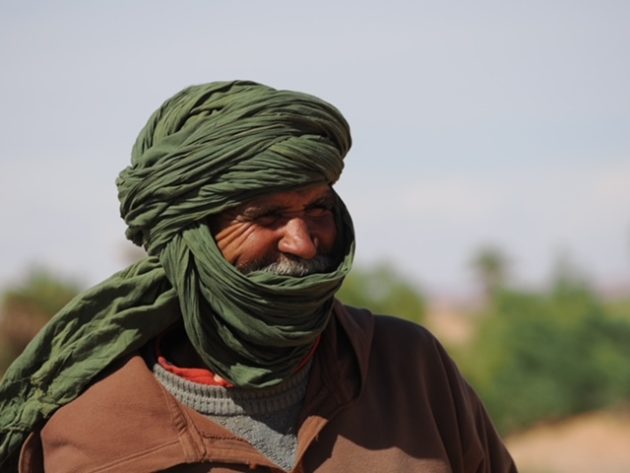
Mbarak, the man who knows where to find the Egyptian Nightjar
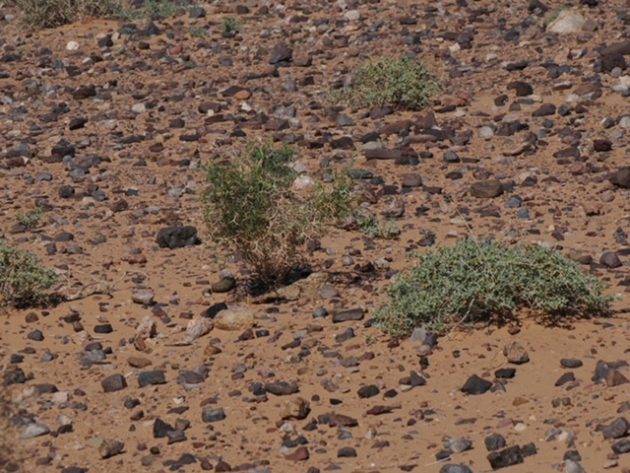
Can you see the nightjar?
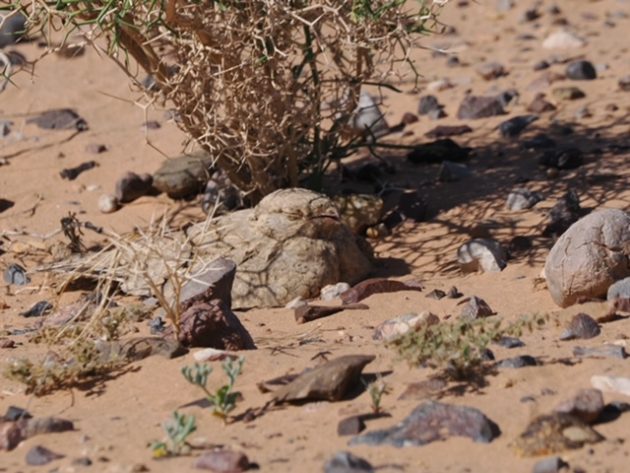
The elusive Egyptian Nightjar has near-perfect camouflage
The first of the desert specials we saw was Egyptian Nightjar. This is one of those birds that would be almost impossible to find without local knowledge. Our guide Omar took us off-road, deep into the desert, to meet a local shepherd, Mbarak, the man who knows where to find the roosting nightjars. He guided us across featureless sandy desert until we came to an area with a few palms and a little scrubby vegetation. Here we parked our 4×4 and then walked a couple of hundred yards to where the nightjar (just one) was roosting. There was no doubt about it: this was the best camouflaged bird that I’ve ever encountered, and I have seen a few. From a range of just a dozen paces it was virtually invisible, and so confident was it in its ability to merge with its surroundings that it didn’t move, nor even blink. Looked at closely through the telescope you could make out that it was breathing very gently, proving that we hadn’t been shown a stuffed bird. I would dearly like to have seen it flying, but that was clearly not something it did during the day.
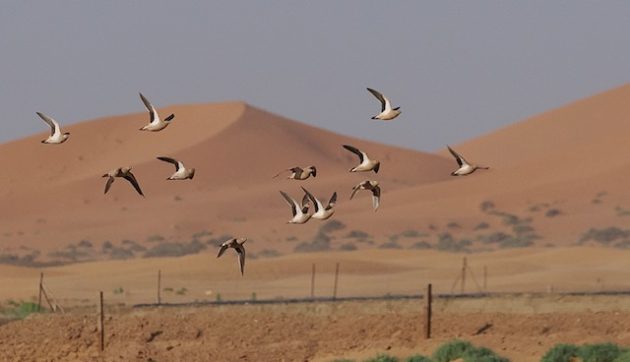
Crowned Sandgrouse and sand dunes
There’s no species that’s better equipped for desert life than a sandgrouse – the males have the remarkable ability to soak water into their breast feathers which they can then take back to their chicks. Here, close to the border with Algeria, we were promised two species: Crowned and Spotted. Both species drink in the early morning (some sandgrouse drink exclusively in the evening), so we were taken by Omar to a waterhole where we could expect to see these birds come into water. The waterhole was small, manmade and singularly unimpressive, and we sat for nearly 30 minutes without seeing a single sandgrouse, our only entertainment a passing pale-phase Booted Eagle. We started to get a little anxious. “Do they always come?” We asked Omar. “Always” he replied, and sure enough they did. The first pair sneaked in unseen (how did they do it?), landing 100 yards from the waterhole, and here they remained for some time. More birds started to join them, and they all followed the same pattern. They would sit and wait for a while, to make sure all was safe, before walking in a shuffling line to the water. Drinking was a remarkably quick affair – a few sips and they were away, flying back into the desert.
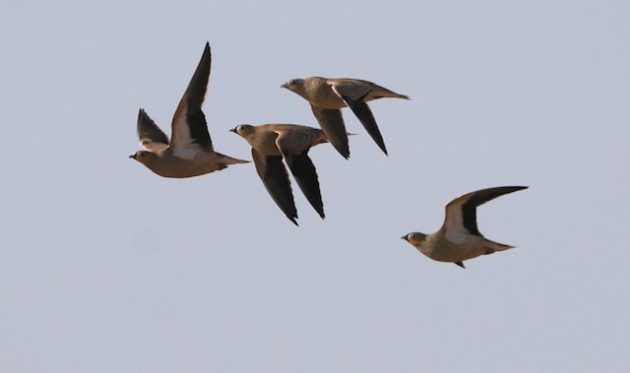
Crowned Sandgrouse flighting in to drink, and (below) waiting to do so
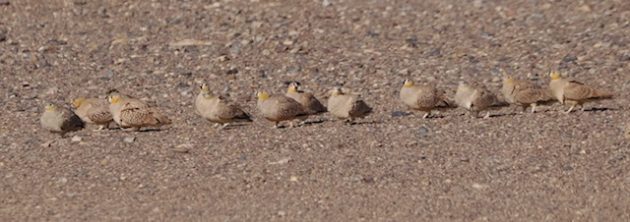
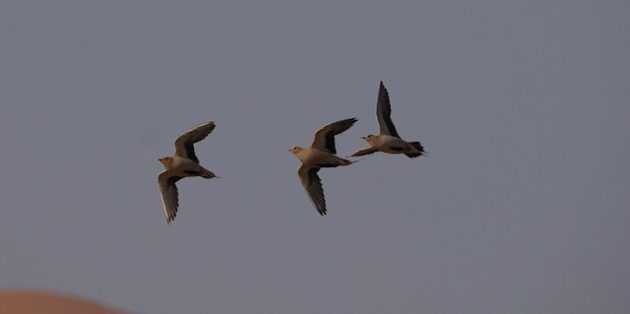
Spotted Sandgrouse
Crowned were more numerous than Spotted, but we eventually gained great views of both species, and enjoyed watching them approach, their flight fast and pigeon-like, their beautiful calls so evocative of the desert landscape. Seeing these two species completed my set of European and African sandgrouse. There are 16 species in the world, so I have now seen 14 of them. Sadly, the remaining two look likely to elude me, as I’ve no plans to travel to Madagascar or Tibet to try and see them.
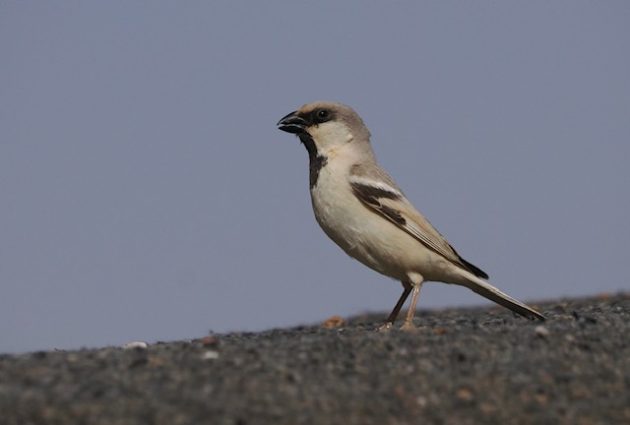
Desert Sparrow, cock above, hen below. They bear a strong resemblance to their cousin the House Sparrow
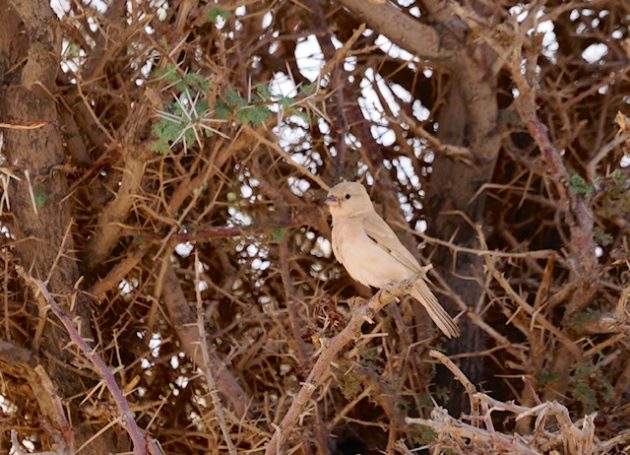
Our next bird was one with desert in its name: the aptly named Desert Sparrow. A member of the Passer family that includes the familiar House Sparrow, the Desert Sparrow has a huge range that goes from that Sahara to the great deserts of Asia. However, it’s a curious species in that it is never numerous, is absent from many places that look perfect for it, and is always a challenge to see. However, our guide Omar knew exactly where to find one, so off we drove deep into the desert to a small tented (tourist) camp where two pairs were coming to cake crumbs. The females were easy to photograph, but the males spent much of their time chasing each other so were more of a challenge. As you can see from my photograph, they look like a House Sparrow, but one that has adapted to the desert.
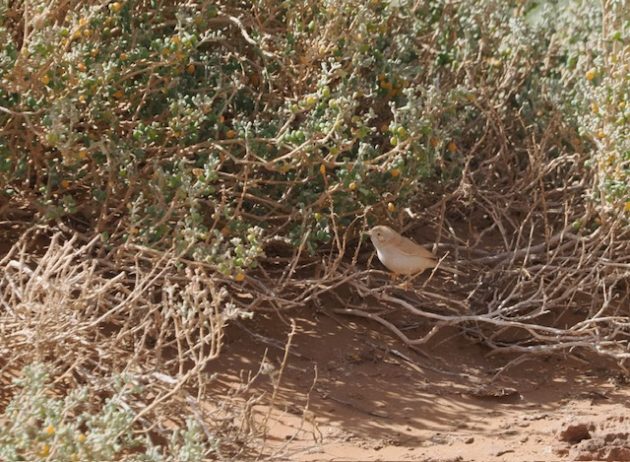
African Desert Warbler, a golden-buff Sylvia
Not far away we found our second desert bird: Desert Warbler. Omar was confident that he could find one for us without too much trouble, and this he managed. A North African endemic, this is a distinctly golden-buff Sylvia warbler, again beautifully adapted to its desert habitat. It’s a bird that spends much of its time either on the ground, or feeing in low scrub, so it can be a challenge to see. The bird we saw was feeding chicks, which possibly made viewing (and photographing) a little easier, but one had to be quick with both binoculars and camera. Close by we came across a pair of Desert Sparrows nesting in an isolated acacia tree – it was good to see these birds away from man.
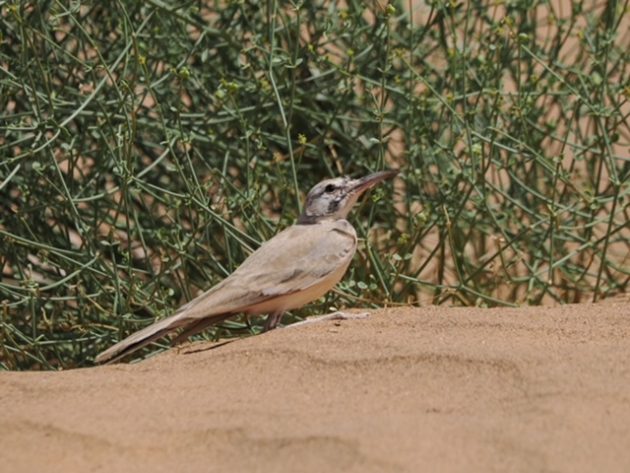
Hoopoe Lark (above) gets its name from its striking, Hoopoe-like, wing pattern (below)
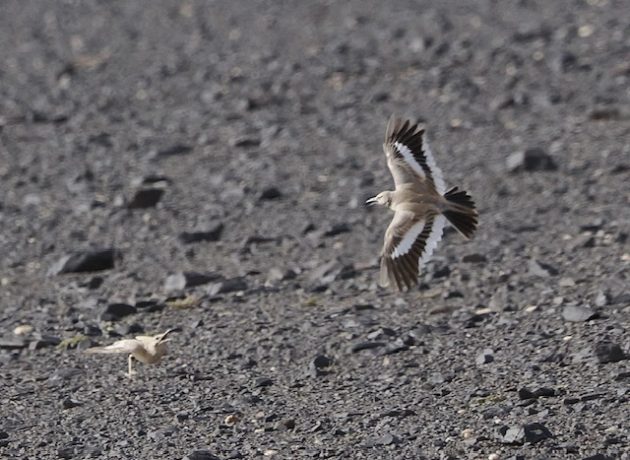
The desert may appear lifeless, but the more you look, the more you see. We went on to encounter several Hoopoe Larks, a species we had first seen a couple of days before. These are big larks that much prefer running to flying, and in our (limited) experience proved almost impossible to flush. When they do decide to fly they reveal black and white wings that do look a little like those of their namesake, the Hoopoe.
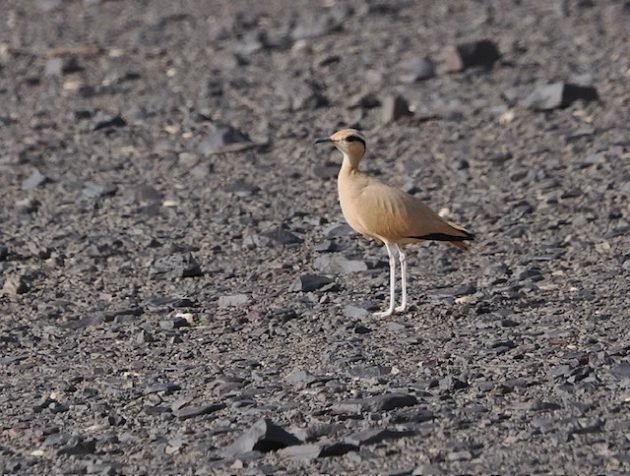
Cream-coloured Courser, a specialist wader of the desert
Another repeat encounter, and a very welcome one, was Cream-coloured Courser. This time photography was more satisfactory as the sun wasn’t as high in the sky as it had been for our previous sighting, while the birds stood out against the gravel-desert background.
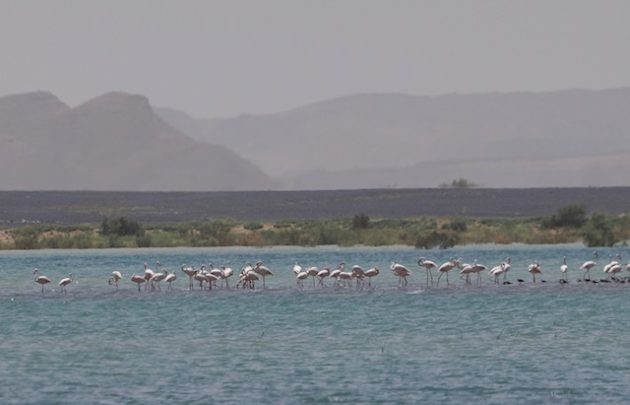
Greater Flamingoes on Dayet Srij, a desert lake
A highlight of our time here was a visit to an extensive desert lake called Dayet Srij. It’s a seasonal lake in the middle of the desert that only fills with water once or twice a decade. I’ve long read about such seasonal lakes, so it was wonderful to at last experience one. It lived up to expectations, too. First impressions were of flamingoes, lots of stilts and terns (Gull-billed, Whiskered and a single Black), but the more we looked the more we found. There were at least 20 Ruddy Shelducks, a trio of Little Egrets and about 80 Greater Flamingoes. The variety of waders was impressive: Avocet (4), Redshank (1), Wood Sandpiper (1), Little Stint (30+), Temminck’s Stint (1), Broad-billed Sandpiper (2, perhaps 3), Kentish Plover (12+), Sanderling (1). I was particularly pleased to find the Broad-billed Sandpipers, while the Temminck’s Stint was a bonus.
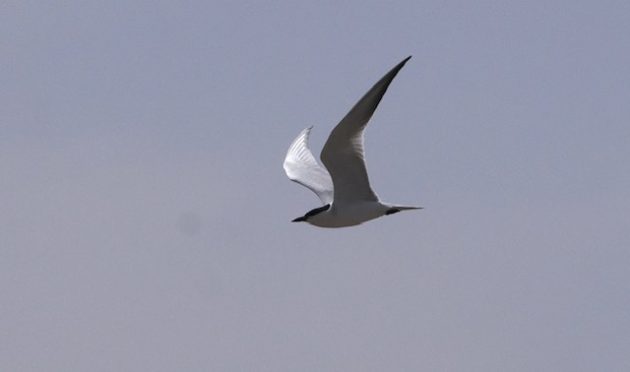
Gull-billed Tern – there were scores of them at Dayet Srij
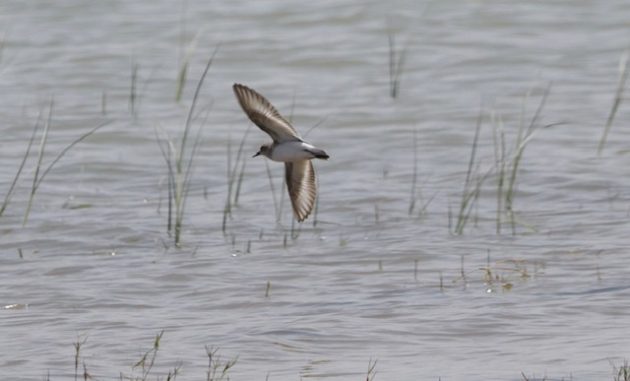
Temminck’s Stint – an arctic migrant in the desert
It’s 350 miles from Erg Chebbi back to Marrakesh, a drive that took us two days, passing through vast, empty landscapes, the long straight road often edged by spectacular mountain ridges that reminded me of Namibia in south-west Africa. We did stop for birds as we travelled, picking up a several more desert specials: a pair of Lanner Falcons, perched surveying their territory from an impressive mountain ridge, and later a pair of Barbary Falcons (looking just like small Peregrines) soaring over a mountain pass, plus several Great Grey Shrikes, here of the race elegans. We stopped in a date-palm oasis, where we found Fulvous Babblers, birds that are easy to see as they fly in small groups from tree to tree. Here there were also Rufous-tailed Bush Robins, attractive, showy birds that are difficult to find in Spain and Portugal, but were quite common here.
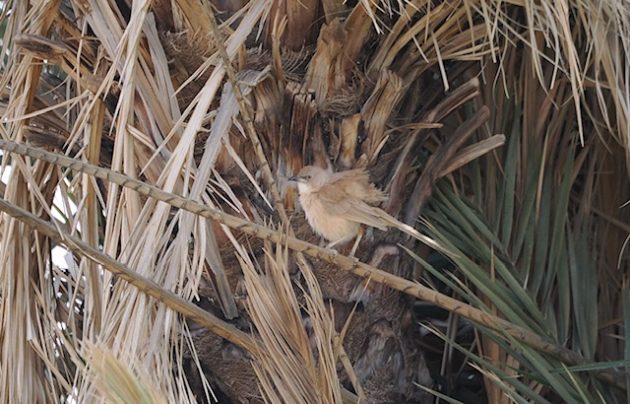
Fulvous Babbler, a conspicuous resident of the desert oases
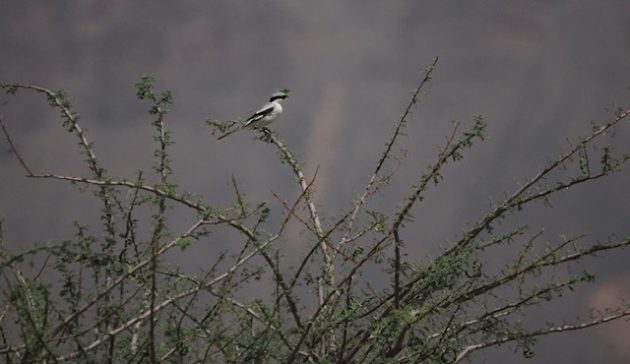
Great Grey Shrike of the North African race, elegans
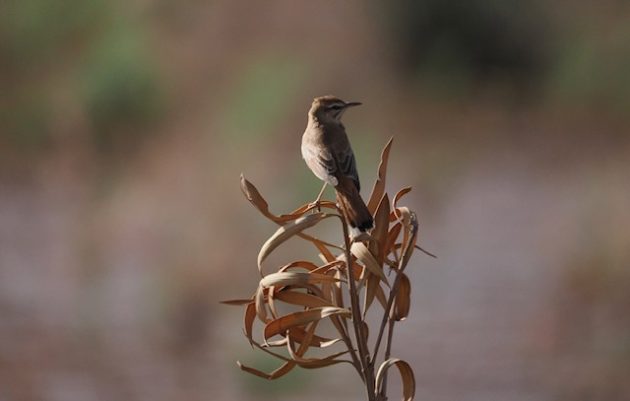
Rufous-tailed Bush Robin
All too soon we were back in Marrakesh, and our wonderful desert expedition was over. We had notched up 124 species, of which no fewer than 15 were new for me. It was full marks to our guide, Omar, as we had only missed a single species on our hope-to-see list (Bonelli’s Eagle) and had scored on every one of the North African specials and endemics that we had tried for. Our trip was organised for us by Gayuin Birding Tours, a local travel agency based in Marrakech. I can throughly recommend it.






David T. this is a spectacular post. What a trip, what a place and what birds—many, like the Cream-colored Courser and the sandgrouse, which I want to see but am unlikely to ever see. I did find the Egyptian Nightjar; initially in the second photo, then I could also make it out in in the first photo.
This series of posts was utterly enjoyable. Trip down memory lane, learning new things, nice photos, et cetera, it was all there.
Thank you Peter and Carroll – it was a great trip, and fun to write about.