
I am a failed artist. At the age of 18 my ambition was to become a bird artist and illustrator, I came as close to my dream as to be interviewed for a place at art school. I had always enjoyed drawing, and was quite good at it. However, note the word quite. Looking back, I don’t think I had sufficient talent to make a career of it, and I never tried, simply because I became friends with a young man called Tim Greenwood. Tim had far more artistic talent than I did, and he went on to make a living as a wildlife artist. I soon realised that I would struggle to produce work that was anything anywhere near as good as Tim’s, so I gave up the pencils and paint. I have hardly drawn since.
Instead I turned to writing, a sensible decision as it became the foundation of my career. However, I’ve always retained a strong interest in wildlife art, and have been a modest collector for all my adult life. At first my interest was largely in paintings, but over the years I’ve acquired a number of what I call bird sculptures, but what other people may call models (or even, heaven forbid, toys).
It’s a varied collection, and there’s nothing very valuable, but it does give me a great deal of pleasure. I am, I admit, a sad case. It’s not enough looking at birds when I’m out in the countryside, I want to enjoy them in my home, too.
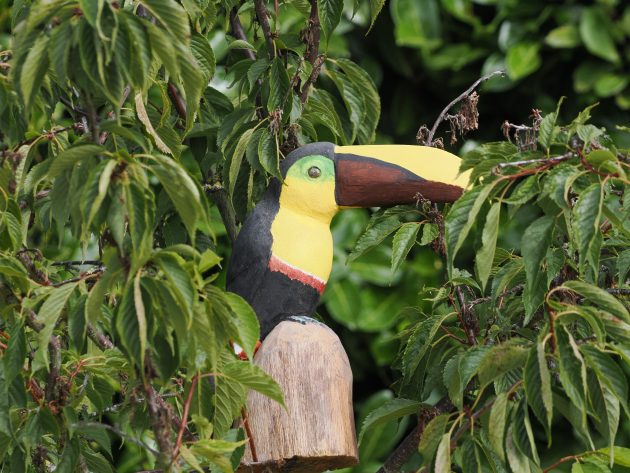
A Channel-billed Toucan from Costa Rica. It is carved in balsa wood
One of the first pieces I acquired was a life-sized sculpture of a Chanel-billed Toucan, bought on a birding trip to Costa Rica. It had been made by a resident guide at one of the lodges I was staying at. I can’t remember how much I paid for it, but I remember having to act quickly as one of my clients on the holiday I was leading also fancied it. Fortunately I beat him to it and didn’t become involved in a bidding war, as his pockets were certainly a lot deeper than mine. Bringing it home wasn’t a problem, as it’s carved from balsa wood so is remarkably light. It reminds me of happy times birding in this wonderful central-American country.
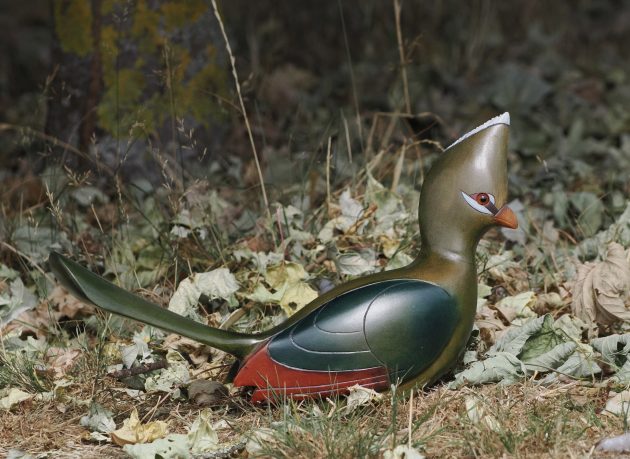
Kynsna Loerie, by The Feathers Gallery, South Africa
Another reminder of an overseas trip, this time to South Africa, is a wooden sculpture of a Kynsna Loerie, a handsome bird that I have watched in the forests of Knysna in the Western Cape. It is a product of the Feathers Gallery, which was based in Knysna but has now, I believe, closed. The gallery produced a varied assortment of hand-carved and hand-painted stylised birds produced in large limited editions by local artists. Birds from the Feathers Gallery are highly decorative and invite you to touch them, adding a textual dimension to their appeal.
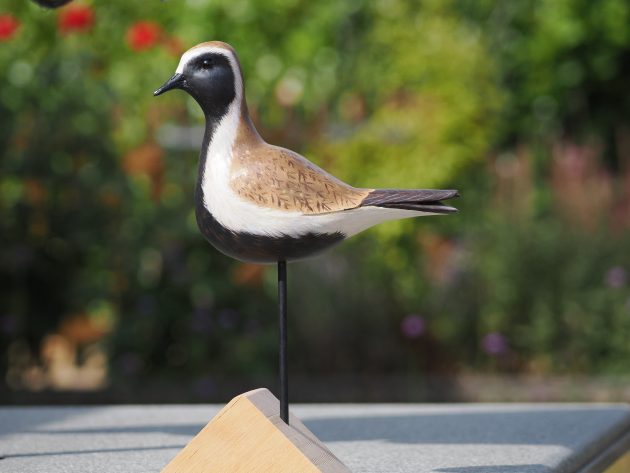
Golden Plover (above) and Curlew
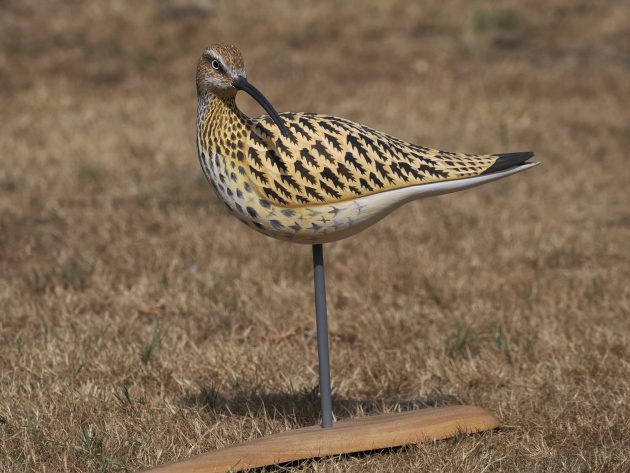
Collecting decoy ducks is big business in North America, where original decoys can sell for huge sums of money. I haven’t any proper decoys, but I do have several carved and painted birds made in a decoy style. My Curlew and Golden Plover are both simple and elegant, and capture the very essence of the birds they depict. Both were bought many years ago at the British Bird Fair, which always has an artists’ marquee. They were modestly priced, and neither is signed. It was at the Bird Fair where I bought the Teal (below), which is perhaps the closest I have to a decoy, though I’ve never checked to see if it floats.
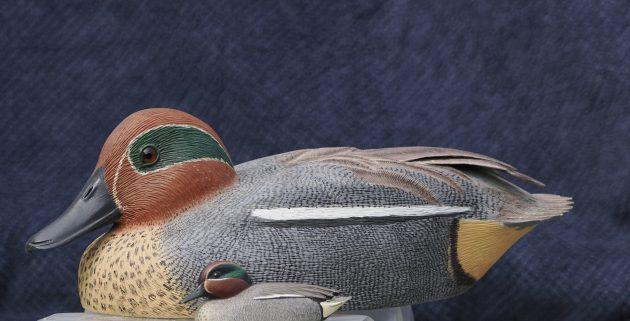
A life-size Eurasian Green-winged Teal, with an 8th-scale Teal by Val Bennet
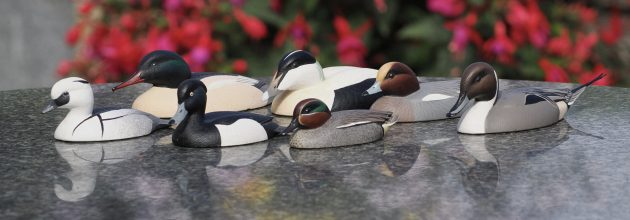
My Val Bennet duck flock. (Left to right) Smew, Goosander, Tufted Duck. Eider, European Green-winged Teal, European Wigeon, Pintail
One thing is certain: my flock of one-eighth-scale ducks, produced by wildlife artist Val Bennet (1923-2013), won’t float. Val was born on 14th February, St Valentine’s Day, so was christened Valentine. I got to know him well, and had the pleasure of staying with him in South Wales, where he lived, and watching him work in his studio. Val’s ducks are foundry-cast bronzes. He hand painted each one meticulously with enamel paints. As you can see, he knew his subjects well, and each duck is a perfect miniature. I have just seven species of ducks in my collection, but Val produced models of many more. Only a few species defeated him – the shaggy crest of the Red-breasted Merganser, for example, didn’t lend itself to modelling in bronze.
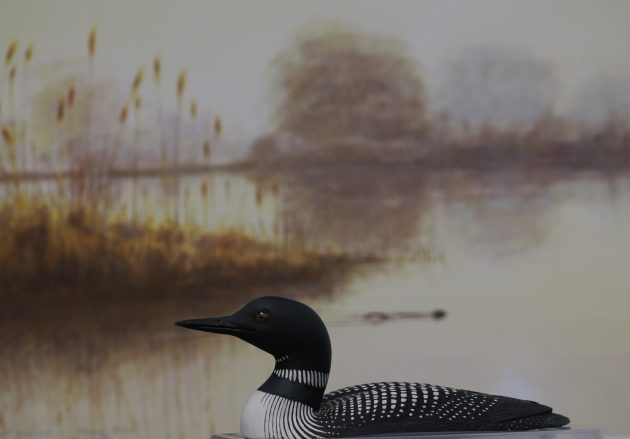
A Great Northern Diver (Common Loon) by Val Bennet
After working on ducks for many years, Val thought that he would try his hand at divers (or loons, if you are American). He sought my advice, and I managed to find a selection of photographs of Great Northern Divers for him to work from (this was long before the Internet). He produced the magnificent diver you see here, which he gave me as thanks for my help. I believe that he produced very few of these divers, as painting was them was such a tedious business (all those spots). My diver is a treasured possession.
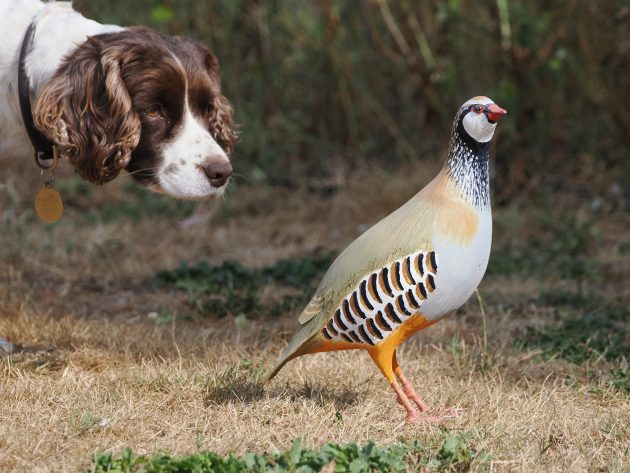
Red-legged Partridge from Spain, Good enough to fool a spaniel?
In complete contrast to my miniature ducks is my life-size Red-legged Partridge. This is a Spanish-made sculpture of one of the most typical of Spanish birds, and is made from dried agave leaves on a wire frame – it’s very light. A Madrid-based company called Coool markets a variety of birds made with the this material, ranging from a Greater Flamingo to a delightful Hoopoe with its crest raised. They are inexpensive (my partridge is priced at £43) and great fun.
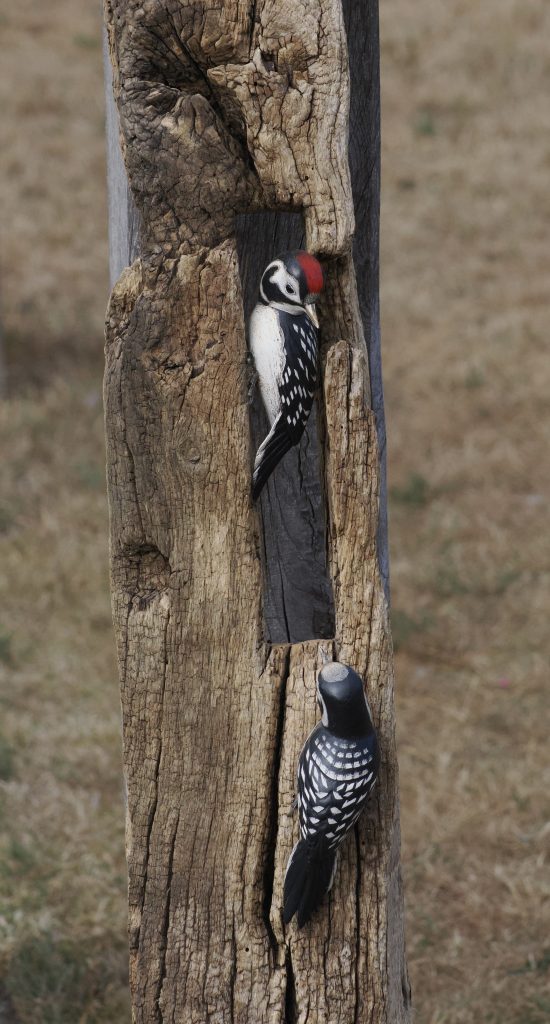
Lesser-spotted Woodpeckers (detail)
Every year the Society of Wildlife Artists holds an exhibition of its members’ work in the Mall Galleries in London. It’s a great exhibition and always hosts a wide variety of interesting work. I no longer go to London: the SWLA exhibition is the one thing I miss the most. I used to be a regular visitor, and it was here that I bought my sculpture of Lesser Spotted Woodpeckers. Part of the charm of this particular sculpture is the piece of wood the birds are featured on: the artist told me that it was an old fence post that he had found on a farm in Herefordshire. It certainly sets the birds off beautifully. In recent years these diminutive woodpeckers have become rare birds in Britain, so this sculpture is a reminder of birds I now see so seldom.
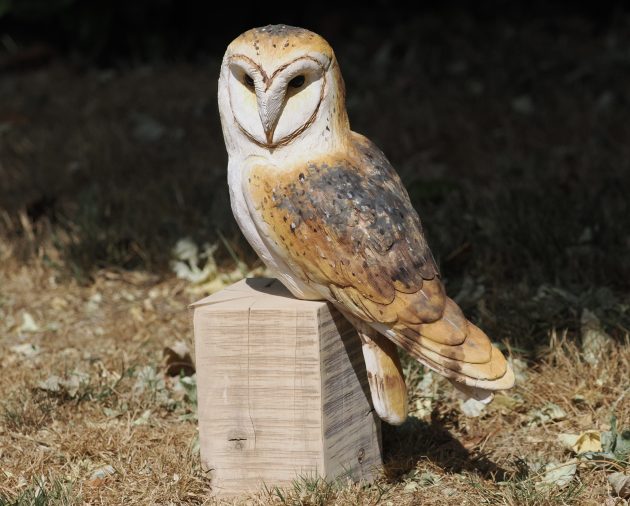
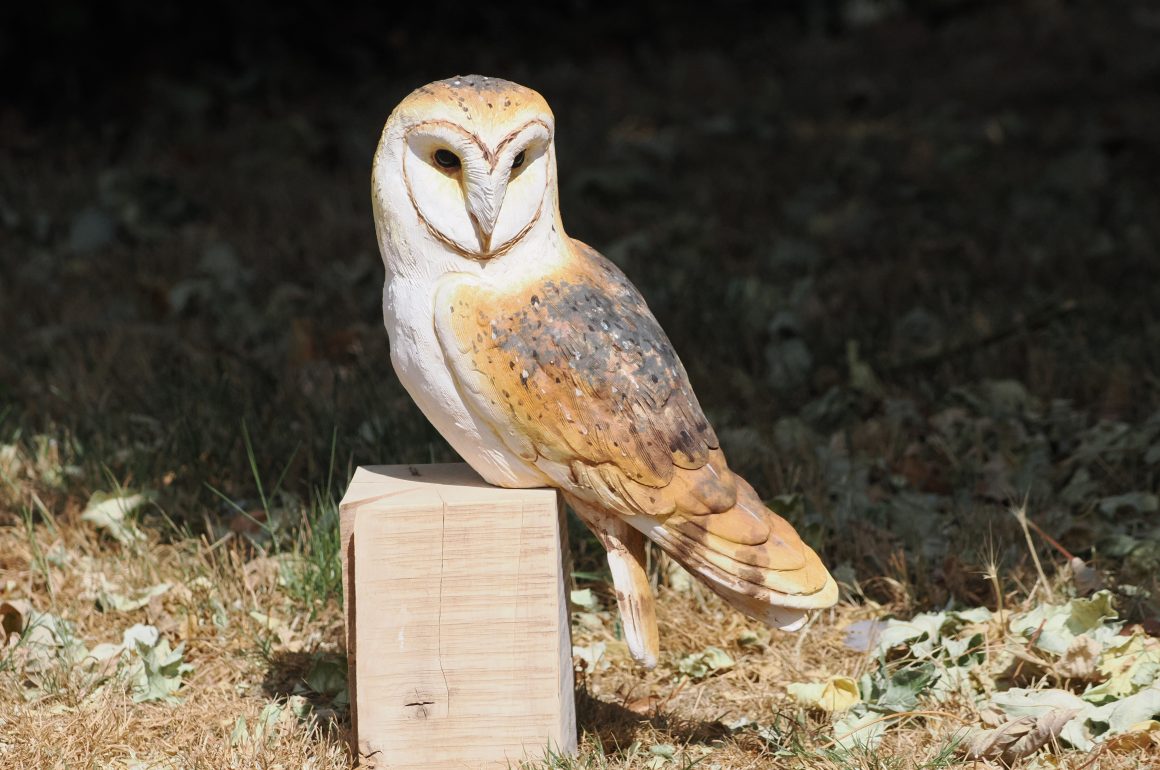
Barn Owl, a ceramic sculpture by Karen Fawcett
My most recent acquisition is another life-size sculpture, this time of a Barn Owl by Karen Fawcett. Karen is a prolific artist who produces sculptures of a wide variety of different birds and animals: to quote from her web site, she “aims to capture not just the look, but also the spirit or personality of the subject, making it appear much more alive – as though it could move at any moment!”. She has certainly succeeded with the Barn Owl, which lives on my kitchen windowsill, giving me something to enjoy when doing the washing up.
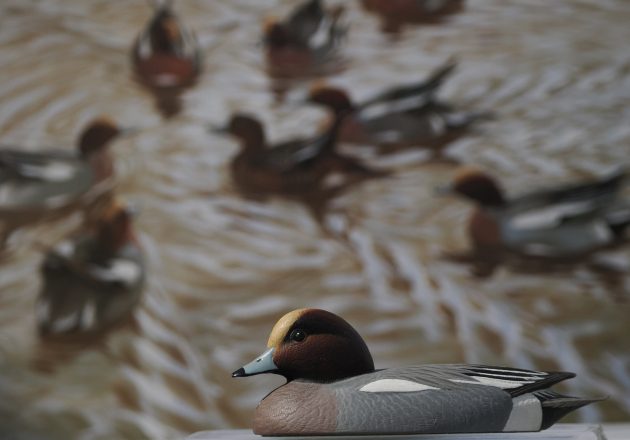
European Wigeon, by Val Bennett




I have wooden carvings around our home. I brought back a hummingbird piece by a British Columbia Haida artist. It was carved of Red Cedar and hangs on our living room wall. Years back in Qubec City, I found a wooden sculpture of a Great Grey Owl, perched on a branch. It was the start of a vacation, so I asked the vendor to wrap it well. It traveled many miles, before it ended up on top of the bookcase in our den. They are lovely pieces that bring back good memories.