
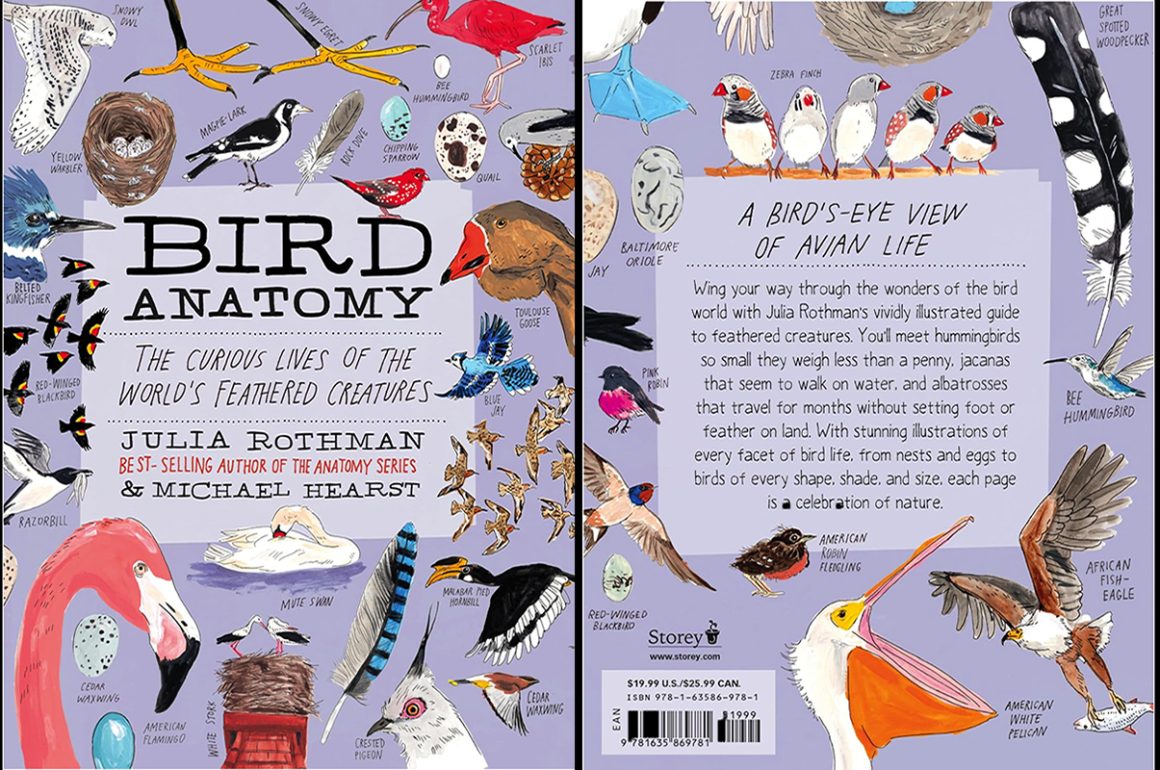
Bird Anatomy: The Curious Lives of the World’s Feathered Creatures has three elements that immediately won my attention: whimsical yet accurate artwork; high browsability within an organized framework; and tons of information about birds around the world, some info new to me, some known, all fascinating. As a longtime fan of Julia Rothman’s work, I’m thrilled that she has added birds to her “Anatomy” series (‘anatomy’ in the larger sense: part-by-part breakdown or analysis of a complex subject), which has taught me and my granddaughter many facts about ocean life, food, insects, mammals, and nature in general.
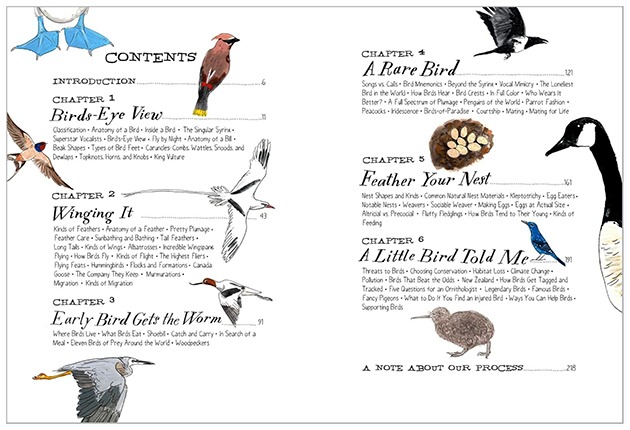
Contents ©2026 Julia Rothman
Bird Anatomy belongs to that category of nature book often described as “fun” and “really cool,” and it’s a tricky position for a book and an author. There are too many books that focus almost completely on the fun and coolness and very little on the accuracy. Rothman’s books definitely do not belong at that end of the “fun” spectrum. They remind me of the work of Rosemary Mosco, particularly A Pocket Guide to Pigeon Watching (2021), which showed us all how adorable cartoon-type drawings can teach us the serious history of Rock Pigeons. Rothman approaches her topics with curiosity and respect, both for her subject and her readers, and although there is always a personal bent to her selection of what birds or insects or foods on which to focus, there is also an acknowledgment that this is but a slice of a wider, more complex world. Her process for this book, and that of co-author, Michael Hearst, includes drawing from real-life birds and photographs, editing and factchecking. Hooray for factchecking!
The book is organized into six chapters, a structure followed loosely at times, but which gives the book an informational foundation. “Bird’s-Eye View” talks briefly about classification and illustrates bird anatomy (in the body structure definition of the word), from nervous system to syrinx to eyes to bill. “Winging It” is all about flight, from types of feathers to wings to how a bird flies to group names to migration. “Early Bird Gets the Worm” focuses on where birds live (habitats) and what they eat. “A Rare Bird” is a potpourri of topics, encompassing vocalization, uses of color, courtship and mating, and exceptional bird families such as parrots and birds-of-paradise. “Feather Your Nest” is about the variety and wonder of nests and the eggs incubated in those nests, plus care of nestlings and fledglings. Human involvement with birds is explored in the last chapter, “A Little Bird Told Me,” which is mainly about threats and conservation success stories, and also touches on human’s long history with birds, bird tracking, ornithologists (an interview with one of my favorite bird scientists, Dr. Mark E. Huber), ways individuals can help birds, resources, and a lovely look at the birds of New Zealand, where Rothman and her New Zealand-born husband lived for a short period.
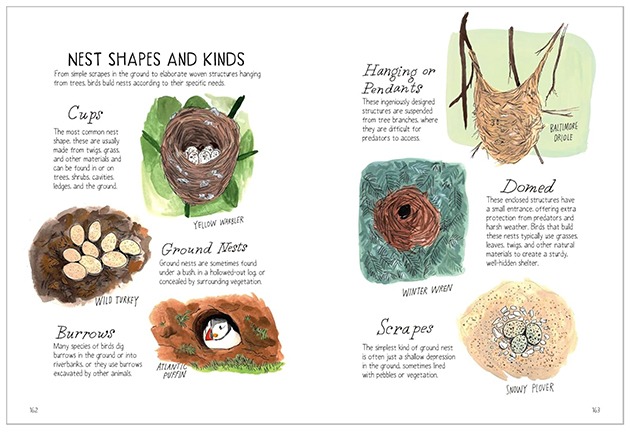
Art and facts complementing each other: Nest Shapes and Kinds, pages 162-163; ©2026 Julia Rothman
The New Zealand pages are part of a world-wide view which features birds from every corner of the world, from European Starling to Twelve-wired Bird-of-Paradise to Emperor Penguin. I was surprised at some of the species illustrated. Parrots, Puffins, Pelicans, and Penguins are charismatic and expected, as are owls hawks, cranes, flamingos, and hawks. However, you don’t see White-faced Storm-Petrels, Great Skuas, White-throated Needletails, Crab-Plovers, White-winged Guans, Satin Bowerbirds, or White-crested Helmetshrikes in a lot of “beginner’ bird books. And while Western Parotia, Greater Lophorina, Long-tailed Sylphs, Long-tailed Paradise Whydah, Asian Green Bee-eaters are exceptional looking birds, they are obscure enough not to make the cut in many titles either. If you’re wondering whether the ‘common bird’ is included, no worries. There is material on Canada Goose, Mute Swan, European Starling, Mallard Duck, Killdeer, Mourning Dove, and many more of our ‘everyday birds.’ I wish there was some way to give the geographic areas of all species portrayed, but I understand how difficult that would be, especially for species with wide distribution ranges or long migration routes. So, if you are interested in knowing where to find a White Bell-Bird or Blue Rock-Thrush, reading this book with a phone or laptop nearby is strongly recommended (and if you couple your search of the bird’s name with ‘eBird’ you’ll get a link to a trusted source).
Personally, my favorite parts of the book are the layouts illustrating the spectacular beauty of our birds and their diversity. “A Full Spectrum of Plumage,” a six-page spread, starts with a rapture of pink and red birds–Pink Robin, Chilean Flamingo, Red Avadavat, Western Tanager–all in relative size and distinct shape, the colors so beautiful you catch your breath in awe. The two-page spread on “Nest Shapes and Kinds” efficiently shows that there is more than one way to make a nest and a few pages down we’re treated to six pages of “Eggs At Actual Size,” a parade of huge and tiny ovoid shapes–some rounder, some longer, some speckled, some plain–in muted shades of pink, blue, green, and white. Also notable are pages illustrating birds in their various habitats, the avian figures reduced to one small part of a striking landscape, specific location noted in small seemingly hand-lettered print (I particularly love the shoutout to the Bronx, representing Urban and Suburban landscapes).
Rothman’s artwork combines spontaneity of observation with just the right amount of technical precision to create species-specific, unique illustrations. She describes how she creates these illustrations in “A Note About Our Process” at the end of the book and in a YouTube video. It was a long process (about a year) involving gouache painting (using Wikipedia and personal photographs for models), outlining in ink, computer scanning, designing layouts in Adobe Photoshop, creating fonts and hand lettering some titles. I highly recommend watching the video to see the original paintings–they are so bright and fresh! Rothman’s art permeates every aspect of the book, including wallpaper-type designed separation pages between chapters (maybe wrapping paper? I’d love to buy the woodpecker design), a fold-out cover, and individually designed section titles.
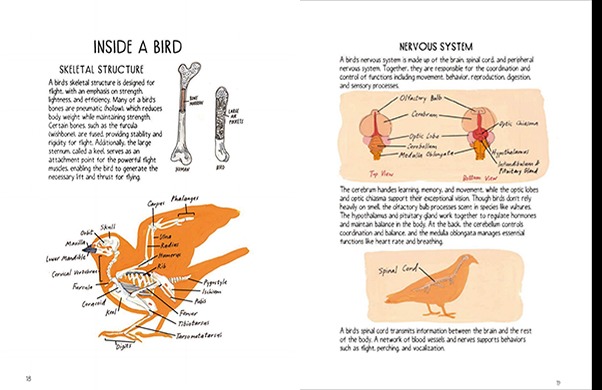
Science in a “fun” book: “Inside a Bird,” pages 18-19, ©2026 Julia Rothman
The text expands on the illustrations, adding specific details and background. A lot of this information was familiar to me, but I did learn or was reminded of a lot of facts too. And I’m sure it will be fascinating to newcomers to the bird world, young and old. I was glad to see that basic scientific terms and concepts are integrated into the text–terms like “sexual dimorphism” and “precocial,” concepts such as the “lift, drag, and thrust” of bird flight and recent research explaining why birds-of-paradise glow. We learn the basics of molt, including sequential and complete molt and when molt occurs; how birds hear; adaptations of night-flying birds; biological basics of fertilized eggs; the unfortunate effects of light, noise, and air pollution; why and how birds migrate, including, of course, the high-flying migration champions. Some species and bird families are given special attention, profiles of King Vulture, Canada Goose, Shoebill, Woodpeckers Peacocks, Birds-of-Paradise, Weavers which emphasize their unique behaviors and adaptability.
The text is co-authored by Michael Hearst, who also co-authored Rothman’s Insect Anatomy (2025). In the Note on Process at the end of the book, Rothman describes a productive creative partnership in which they discovered new topics as they worked. Hearst is a writer, composer, and “multi-instrumentalist” who has written at least seven books, and composed and recorded numerous musical compositions, film and dance scores.
I first became aware of Julia Rothman through her columns for the New York Times, entitled Scratch, in which she and co-author Shaina Feinberg drew and commented with affection and humor on small businesses, money, and how people make a living. I soon also discovered her book Ocean Anatomy: The Curious Parts & Pieces of the World under the Sea (2020), the perfect gift for my ocean-obsessed young granddaughter. At this point, Abigail has been gifted with almost all the main titles in the Anatomy series: Farm Anatomy (2011), Food Anatomy (2016), Nature Anatomy (2015), and Wildlife Anatomy (2023), with Insect Anatomy in the wings for Hannukah, plus a couple of the ancillary titles (there are sticker Anatomy books, activity Anatomy books, and poster Anatomy books). Rothman has written a number of non-Anatomy books, listed on her website, and created illustrations for magazines, newspapers, and organizations, including “wallpaper, bedding, billboards, fabric, clothing, dishes, pillows, newspapers, magazines, books, subway posters, umbrellas, towels, mugs and more”. She also runs The Figure Assembly, a design studio space, and has taught courses at the School for Visual Arts and Rhode Island School of Design.
I need to add that I also “know” Julia Rothman another way (we’ve never met or talked directly), through her father, Jack Rothman, a New York City birder well known for his longtime leadership of bird walks on City Island and Pelham Bay Park in the Bronx. Also, a friend. You can go on a short bird walk with Jack and Julia here. Or check the City Island Birds website for the next walk and explore the Bronx (you’d be amazed at all the birds you could see there)!
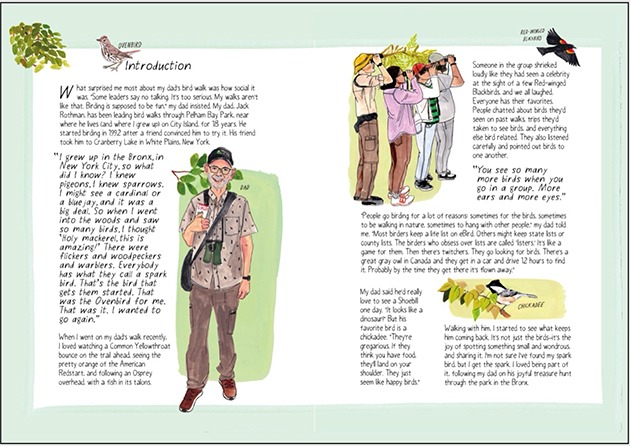 Introduction, pp. 6-7, ©2026 Julia Rothman
Bird Anatomy: The Curious Lives of the World’s Feathered Creatures by Julia Rothman and Michael Hearst is a delightful introduction to the beauty and science of birds around the world. There really is no age or skill range for this book, I think it’s perfect for children, students, beginning birders, and us cranky, experienced birders. Rothman’s unique illustrations and Hearst’s informative text are the perfect anecdote for an often crazy world, reminding us that there is order in beauty and that everyone can contribute their unique take on the birding world.
Bird Anatomy: The Curious Lives of the World’s Feathered Creatures
by Julia Rothman & Michael Hearst
Storey Publishing, Oct. 2026
224 pages; 6.6 x 0.81 x 9 inches
ISBN-10 : 1635869781; ISBN-13 : 978-1635869781
$19.99 U.S., also available in eBook & Kindle formats







Leave a Comment