

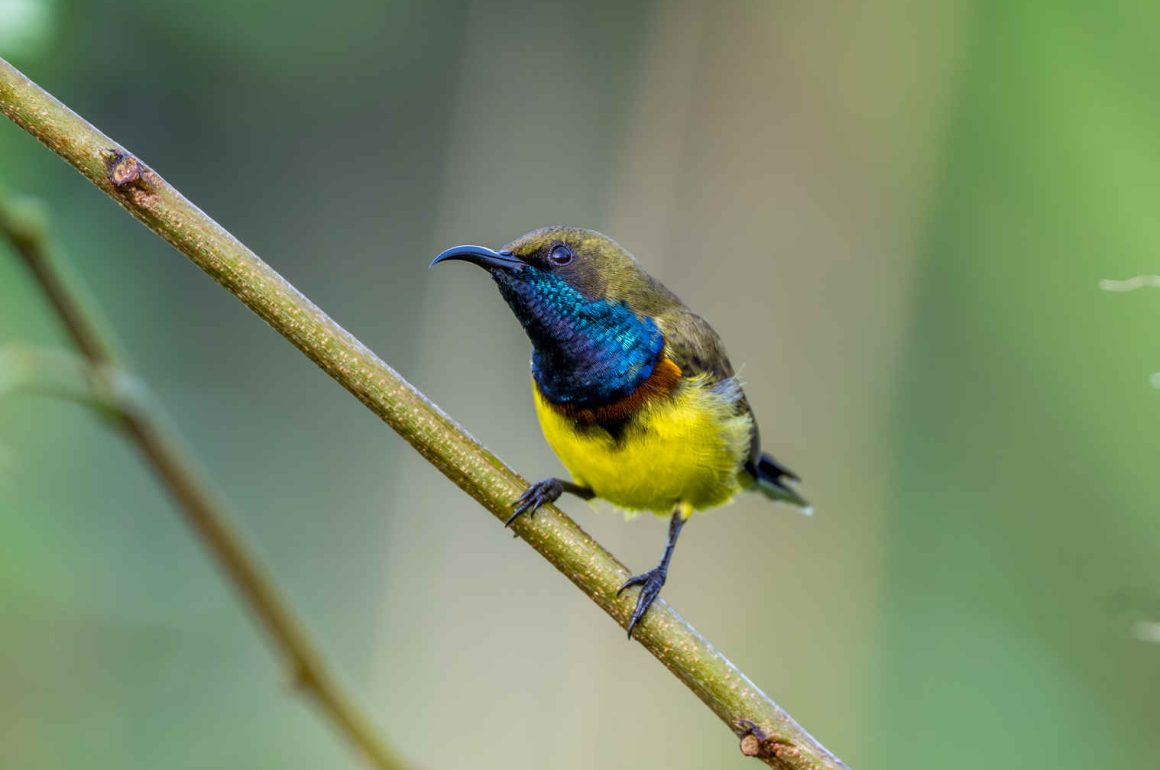
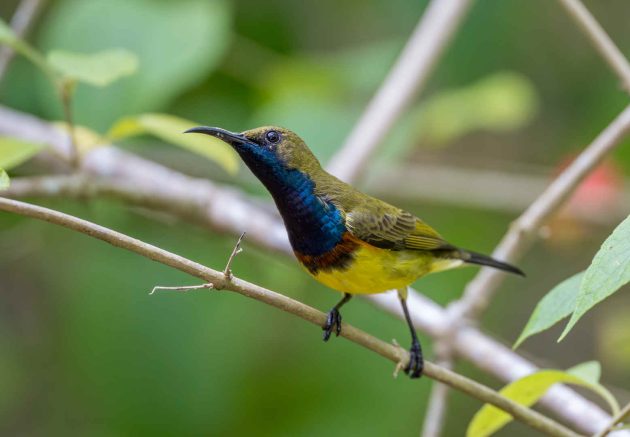
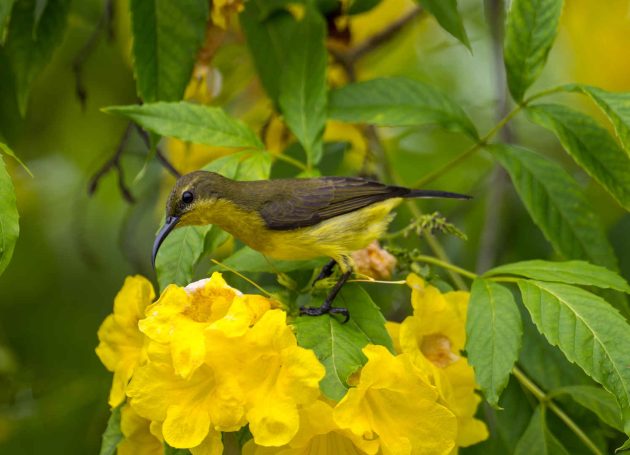
While the Ornate Sunbird still has an olive back, it is no longer called Olive-backed Sunbird. The latter was recently split into several species, all of which look somewhat similar. Or to quote the HBW: “Despite its gaudy appearance, the Ornate Sunbird closely resembles quite a number of other sunbird species, and this is true not only for females, but also for the males with their iridescent-blue throats.”
A rationale for the split can be found here – the paper emphasizes the importance of small islands as drivers of speciation.
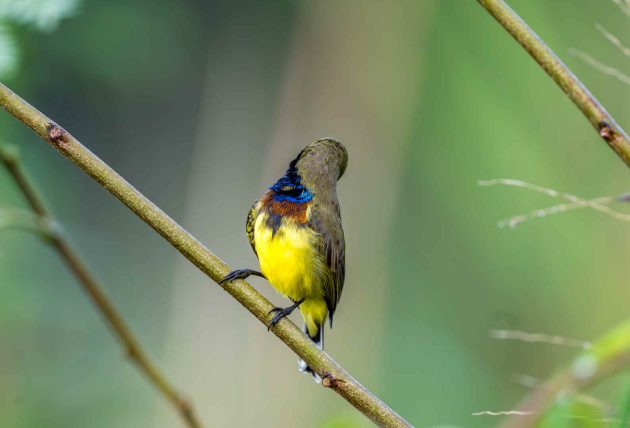
To add to the complexity, the Ornate Sunbird itself has seven subspecies, some of which look indeed quite distinctive.
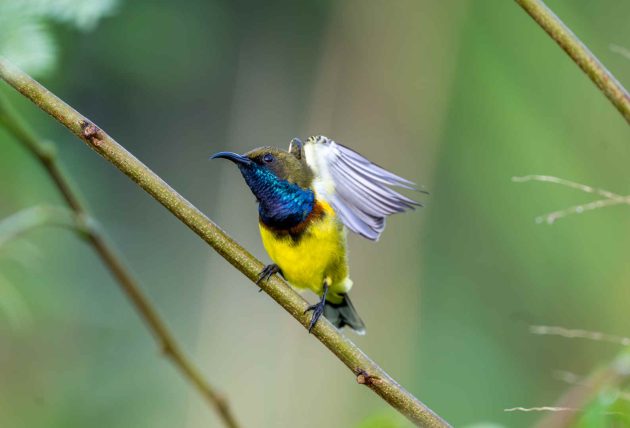
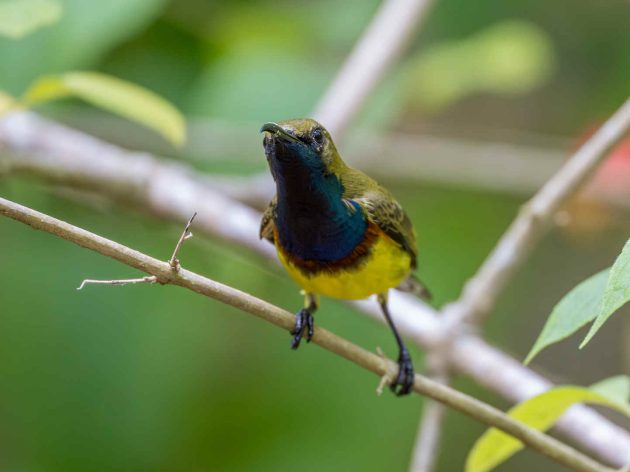
Take the subspecies Cinnyris ornatus flammaxillaris, which is the species present at Kaeng Krachan, Thailand, where all photos in this post were taken. The maroon band is what presumably gave the subspecies its name, even though the logic behind this (flammaxillaris indicates a flame-colored armpit) is a bit weird.
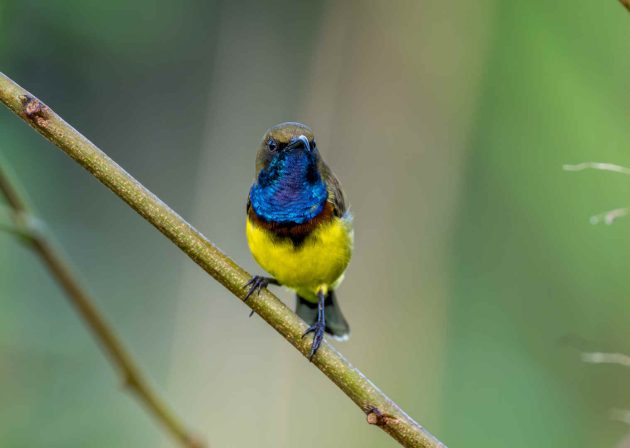
Unfortunately, being only recently split, not much is known about the species other than it is presumably quite similar to the “old” Olive-backed Sunbird.
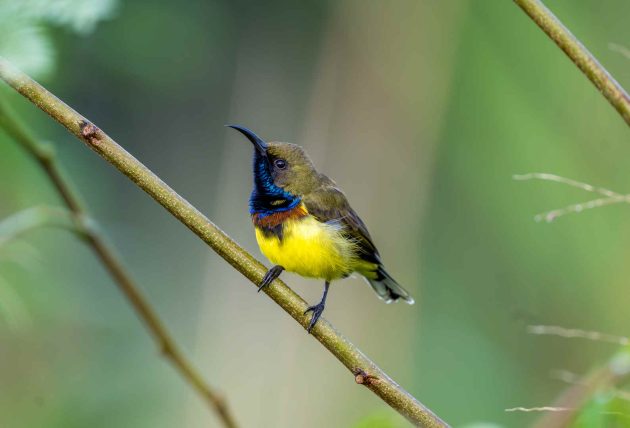
The Ornate Sunbird plays a support role in a few scientific papers – for example, it is used by Black-thighed Falconets to feed their nestlings.
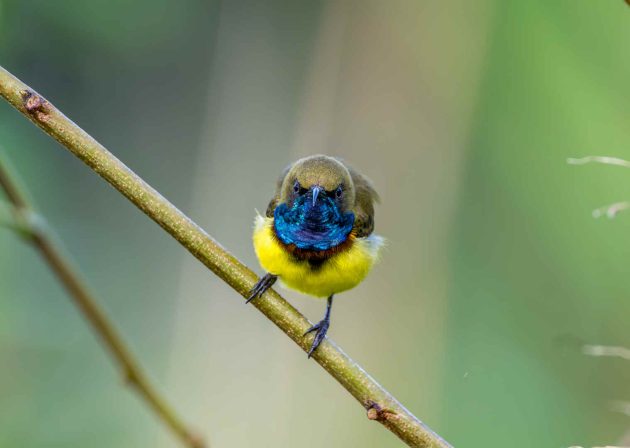
However, given the beauty of the male breeding plumage, the Ornate Sunbird is still worthy of its own profile – if only to show quite a few photos.
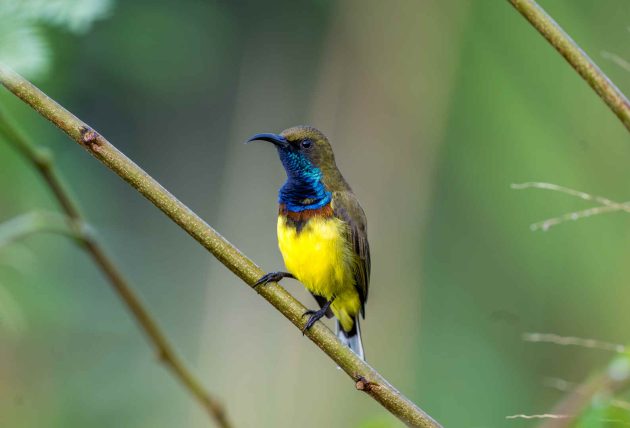
All of them taken at or very close to Baan Maka Nature Lodge at Kaeng Krachan, Thailand, in July 2025








Humans may “manipulate” the names of birds, but this is one stunning species. You got some great photos, Kai! I’ve always doubted that the birds give a damn what we call them, yet I know it’s in our human nature to do so. Helps us organize what we so little understand…