
By Jihun Oh
Jihun is a Korean developer and the creator of KoreAves, an English-first evidence atlas for birds recorded in South Korea. The project connects species, regional records, source provenance, and rights-cleared media while avoiding interpretation of occurrence records as abundance.
I started building a website about Korean birds because I thought the difficult part would be the data.
That turned out to be only partly true.
South Korea has a national bird list, public biodiversity records, maps, institutional databases, and a great deal of bird photography. International databases add still more. From a distance, the ingredients look abundant. I assumed the job was mostly technical: match names, connect records, build a search interface, and make the result usable in English.
Then I tried to put a photograph next to every bird.
Anyone who has searched for a bird online knows the paradox. Type a species name into an image search, and you can drown in photographs. Ask a slightly different question—Which of these photographs can I actually republish, with a clear source, a clear license, and enough evidence that it shows the exact taxon I am claiming it shows?—and the ocean becomes a puddle.
At one point I found myself considering a choice that felt absurd: use an attractive photograph whose reuse or identification trail was not solid enough, or use an uglier image—even a carcass or historical specimen-type image—that I could actually defend.
The second option began to look more honest.
That small problem changed how I thought about the whole project.
EXISTING IS NOT THE SAME AS BEING FINDABLE
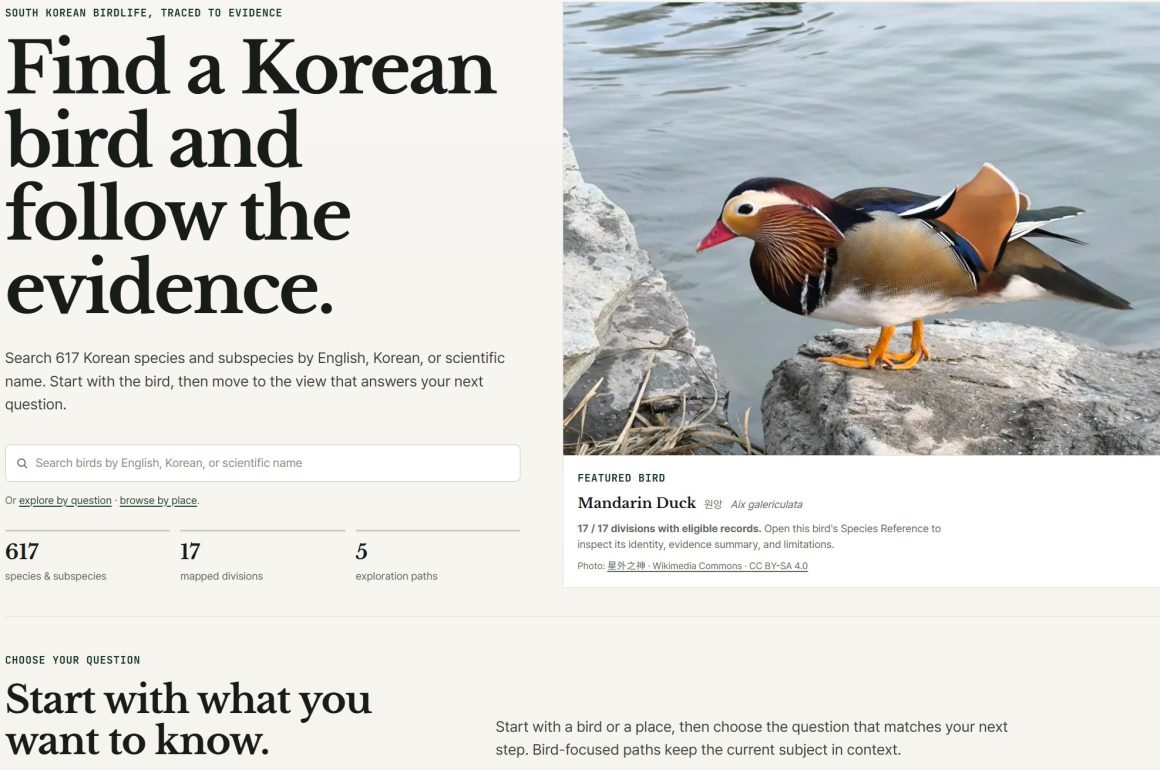
The site I eventually built is called KoreAves. It is an English-first evidence atlas for the birds on South Korea’s 2025 national list, 617 taxa in all.
I did not set out to create a new authority on Korean birds. Korea already has authorities and source datasets. The problem I kept encountering was the distance between those sources and an English-speaking birder who simply wants to answer a normal question.
What is this bird called in the Korean national list? Has it been recorded in this part of the country? Where did that record come from? Is the name in one database the same taxonomic concept used in another? Is the photograph attached to the species page actually reusable? Can I follow the claim back to something more substantial than another page repeating it?
The answers often existed. They just did not necessarily exist in the same place, in the same language, under the same taxonomy, or with the same assumptions.
This is a different kind of data gap. It is not a gap in observation. It is a gap in travel.
Birds cross borders without caring about database schemas. Bird information is less fortunate.
TAXONOMY IS WHERE APPARENTLY SIMPLE QUESTIONS STOP BEING SIMPLE
A birder searching for a species does not usually want a lecture on database normalization. I did not want one either.
But once I started connecting Korean records with international sources, names became unavoidable. A scientific name is not always a permanent ID. Names move, species are split or lumped, subspecies are promoted or demoted, and two sources can use the same-looking label while meaning slightly different things.
That matters because a beautiful interface can hide a bad join.
If I connect a regional record to the wrong taxon, the map may still render perfectly. The page may load instantly. The typography may be excellent. It will simply be wrong in a very polished way.
So the project became increasingly conservative. A record is not abundance. The absence of a public record is not proof that a bird is absent. A regional match is not evidence that two species occurred together. When a taxonomic connection is uncertain, uncertainty is better than a confident shortcut.
This sounds obvious when written down. It is surprisingly easy to violate when building software.
PHOTOGRAPHS TAUGHT THE SAME LESSON MORE BRUTALLY
Images made the abstract problem visible.
For each candidate photograph I wanted to know at least four things: who made it, where the original record lived, what the license actually allowed, and whether the bird in the image matched the taxon being represented.
Sometimes all four were easy. Wikimedia Commons and other open repositories can be excellent when the provenance chain is intact. Sometimes a photo had a permissive-looking label on one page but led to a source page that required more checking. Sometimes the license was fine, but the taxonomic identification was too broad. Sometimes the photo was visually perfect and evidentially useless.
The temptation, of course, is to say: nobody will notice.
That is exactly the temptation an evidence project should resist.
Birders are used to this instinct in the field. A distant shape does not become a rarity because you want it to be one. A call you almost recognize does not improve because the checklist would look better with another tick.
Image provenance deserves the same discipline.
There is also something mildly comic about spending hours searching the internet for a bird that is plainly not rare on the internet. The photo exists. Many photos exist. What may not exist is the specific combination of identity, permission, provenance, and resolution that lets you use one responsibly.
This is why “there are lots of bird photos online” and “there are lots of bird photos available for a public reference project” are very different statements.
THE MOST USEFUL FEATURE MAY BE THE BORING LINK
While building KoreAves, I initially thought the visible features would be the important part: search, species pages, regional views, GIS, comparison tools.
I still think those are useful. But I have become increasingly fond of the least glamorous part of the site: the source link.
A source link lets the reader leave.
That sounds like terrible product design. It is also the point.
If a page says that a species has a record associated with a Korean region, the reader should be able to inspect where that claim came from. If a photograph is displayed under an open license, the credit and source should not be decorative footnotes. If a taxonomy mapping is doing work behind the scenes, it should be possible to understand what was mapped.
A reference site should not try to become the final destination for every fact it contains. Sometimes its job is to shorten the path to the real source.
WHAT I DID NOT EXPECT TO LEARN
I am a developer, not an ornithologist, and I began this project with the usual developer bias: if the information exists, then enough engineering should make it usable.
Now I would phrase it differently.
Information can exist and still be functionally absent for a particular audience.
It can be locked behind language, inconsistent naming, interfaces designed for another purpose, unclear reuse rights, broken provenance, or simply too many browser tabs. None of those problems means the original data is bad. In Korea’s case, some of the underlying biodiversity information is strong. The missing piece is often the bridge.
That is what I hope KoreAves can be: not a replacement for Korean institutions, global bird databases, field guides, or local expertise, but a bridge that makes those sources easier to discover and check from outside Korea.
The project is still imperfect. That may be the most important reason to keep the evidence visible.
If I choose the wrong photograph, someone should be able to tell me why. If a name is outdated, the correction should have somewhere to attach. If a regional record has been misunderstood, the source should be close enough that the mistake can be found.
And if the most defensible image of a bird is less attractive than the one I wanted to use, I have learned to live with that.
A bird atlas should prefer an awkward truth to a beautiful guess.





Leave a Comment