

By Alfredo Fernandez
Alfredo Fernández is a biologist and nature photographer based in Lima, Peru. A National Geographic Explorer since 2017, when his project documented Peru’s threatened lomas, he guides birding and wildlife trips across the Peruvian coast, Andes, and Amazon with Wild Andes Tours. He publishes free eBird-derived bird checklists for the sites he guides, including all 134 species recorded at Lomas de Lachay. All photographs are his own.
You smell the islands before you see them. Off the Peruvian coast the fog usually arrives first, and out of it comes a sharpness of ammonia over salt — then the rocks themselves, painted white as if by an enormous, careless hand. The white is the whole story. It is the compressed residue of uncountable meals of fish, laid down by seabirds over centuries, and for a few strange decades of the nineteenth century it was among the most valuable substances on earth.
The engine behind it is the Humboldt Current. Cold water wells up along this coast and hauls nutrients into the sunlight, and the result is the anchoveta — a finger-sized fish that moves in schools measured in kilometres. Three birds turned that abundance into an economy. The Guanay Cormorant fishes in rafts so dense they blacken the water. The Peruvian Booby rains down on the schools in angled dives. The Peruvian Pelican, the heavyweight of the trio, scoops what the others drive up. Robert Cushman Murphy, the American ornithologist who worked these coasts a century ago, looked at the ledgers and called the guanay “the most valuable bird in the world.” He was not exaggerating; for a while, the treasury of a republic agreed with him.
Guano becomes treasure only where rain never falls. On most seabird coasts the droppings wash into the sea with every storm, and that is the end of it. But the Peruvian shore is one of the driest places on the planet, and on its islands nothing washed away — the deposits simply grew, season upon season, century upon century, until they stood tens of metres deep. Concentrated in them was what every farm on earth is hungry for: nitrogen and phosphorus in extraordinary strength. None of this was news to Peru. The chroniclers of the Inca empire record that the guano islands were managed and allocated with great care, and that disturbing the birds in the breeding season was punished with severity. The nineteenth century did not discover guano; it only discovered how to ship it.
Alexander von Humboldt carried samples to Europe in 1804; the chemists confirmed what Andean farmers had always known, and by the 1840s the rush was on. Over roughly forty years Peru exported some ten million tonnes of guano, most of it dug from the Chincha Islands, and at the height of the boom it provided the majority of the state’s revenue. Guano paid for railways, public buildings and the servicing of a young republic’s debts. It also became a strategic asset in the oldest sense: in 1864 a Spanish squadron seized the Chinchas, and Peru went to war to take its islands back. The dark side of the ledger belongs to the people who did the digging — thousands of indentured Chinese labourers who worked the deposits in conditions that remain a stain on the whole enterprise. Fortunes were made on the backs of birds, but they were carried on the backs of men.
By the end of the 1870s the ancient deposits were essentially gone, and the boom collapsed the way booms do. Here is the odd thing, though: the birds themselves came through the digging era largely intact. The shovels took old strata — the accumulation of centuries past — not the fish the living colonies depended on. The exception is worth naming. Humboldt Penguins had always burrowed their nests into that same soft, deep guano, and when the deposits went, so did much of their nesting ground. The penguin has been paying the boom’s bill ever since.
For the guano trio, the true reckoning came in the twentieth century, and it was about fish, not fertiliser. The colonies of these coasts were once estimated in the tens of millions of birds. Then, from the 1950s, the industrial anchoveta fleet grew into the largest single-species fishery the world had ever seen — and the birds found themselves competing for their own food supply with factory ships. In 1972, a strong El Niño met an unrestrained fleet, and the anchoveta stock collapsed, taking the fishery and a staggering number of seabirds with it. El Niño itself is nothing new to these birds; the warm water empties their larder every few years and always has. Guano birds are built for boom and bust — they crash, and they rebound. What they are not built for is crashing into a sea that stays half-empty. Today the colonies number a few million birds: still one of the great concentrations of seabird life on earth, and a fraction of what this coast carried a century ago.
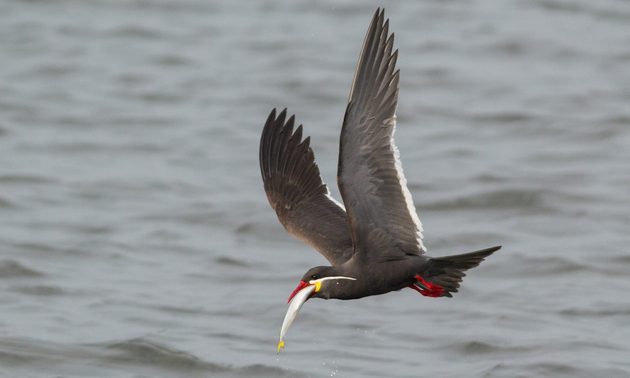
Inca Tern (also cover photo) carrying an anchoveta — the fish that powers the entire system
And yet this is not the usual decline story, because Peru did something in 1909 that nobody else had done: it put its seabirds under professional management. The Compañía Administradora del Guano was created to run the industry rationally, and in doing so it became arguably the world’s first large-scale seabird conservation programme. Wardens were stationed on the islands. Harvest moved to a strict rotation, taken only after the breeding season. Disturbance was banned, predators were controlled, and under that regime the colonies rebuilt to their twentieth-century peaks. The mantle has passed, but it has not been dropped: today the guano islands and headlands form a protected reserve system stitched along the entire coast — more than thirty islands and points — and guano is still harvested. It is done the old way, by hand, with shovels and sacks and barges, crews working island by island on a rotation of several years, timed around the birds’ breeding. No machines. The wardens are still there.
Which leaves Peru holding something close to unique: an extractive industry whose entire business case is that wild birds remain abundant and undisturbed. Every sack that leaves an island depends on the colonies staying huge, calm and well fed. The guano birds have what most seabirds never get — a constituency with an invoice. It is not sufficient on its own. The levers that will decide their future are set elsewhere: in the quotas granted to the anchoveta fleet, and in what a warming ocean does to the rhythm of El Niño. But interest and instinct point, for once, in the same direction, and that is a rarer alignment in conservation than we like to admit.
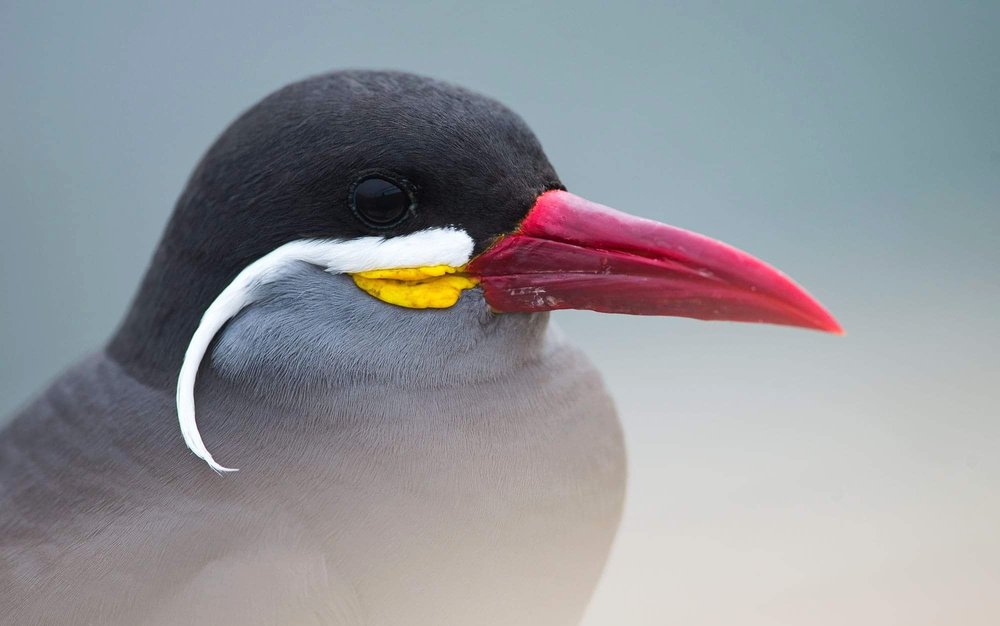
What remains is still a spectacle with few rivals. Stand on any headland south of Lima at dusk, and the guanays come home in rivers — skeins of black birds a metre above the water, unbroken for minutes at a time. Boobies stack themselves on the cliff ledges. Pelicans glide past in silent squadrons. And in the crevices and old retaining walls that the guano era left behind nests the coast’s most improbable ornament, the Inca Tern, moustached and carmine-billed, carrying anchovetas to chicks hidden in the very stonework of the boom. Sea lions roar from the rocks below; the fog rolls in; the islands go on turning fish into white stone. The nineteenth century mined the residue of the birds’ meals and called it wealth. The better trick — the one Peru has now been practising for over a century — is keeping the meals coming.
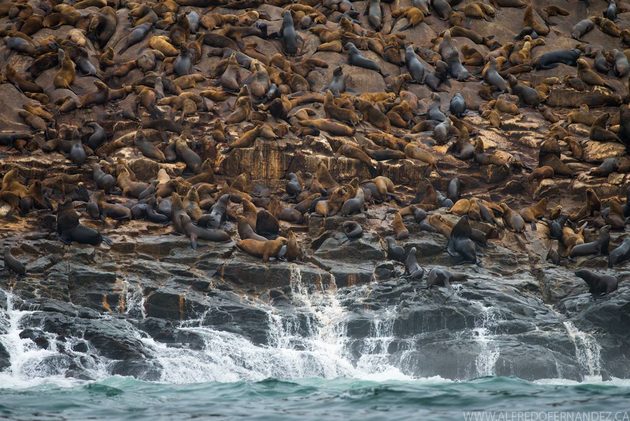
Sea Lion colony





Leave a Comment