

A few days ago I was birding along Gatun Lake in the Gamboa area of Panama. No guides, no crammed backpack with gear and nibbles etc., just my camera and me having a quiet walk. Casual Birding as fellow 10000birds writer Faraaz Abdool calls it.
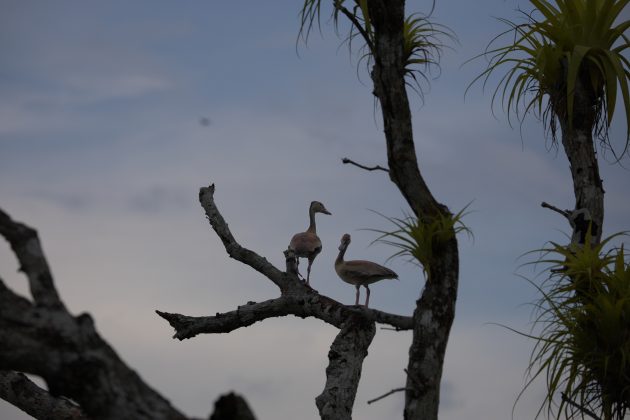
A few brown ducks kept circling low before eventually coming to rest in a dead tree on the edge of the lake just in front of me.
Then a couple of Wattled Jacanas appeared among the floating vegetation, and for a while the ducks were forgotten.
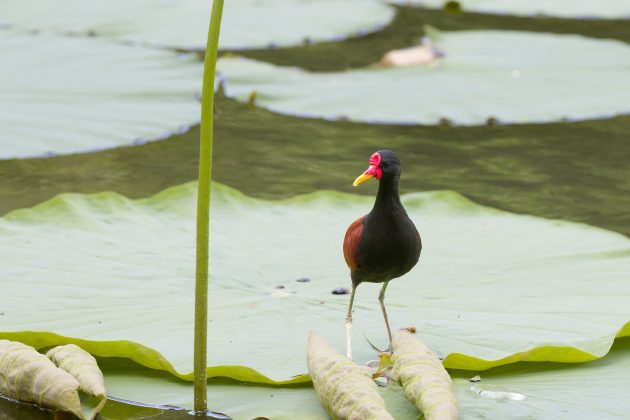
I have watched Wattled Jacanas in Trinidad, Panama, Costa Rica and a few other places along the way, and I have always thought they were rather smartly dressed birds.
The rich chestnut back, black head and breast, yellow bill and bright red wattle make for quite a combination. There is a lot of colour going on, but somehow they manage to pull it off.
They always look rather chic, in my opinion
Then you look at the feet.
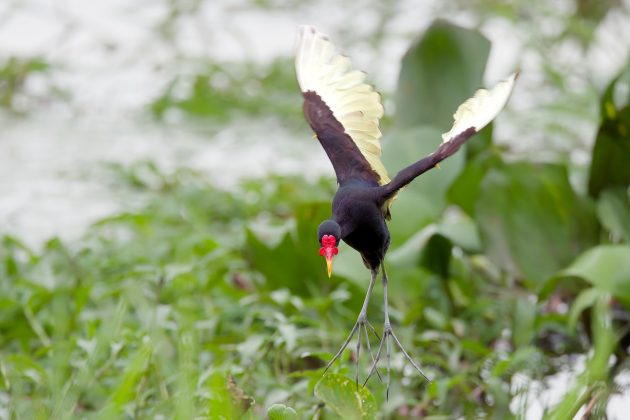
There is nothing particularly dainty about those.
The toes are extraordinarily long and seem to head off in every direction. On a bird that otherwise looks so neatly put together, they can appear almost comically oversized.
But watch a jacana moving through a patch of lilies and those enormous feet begin to make a lot more sense.
Those long toes spread the bird’s weight across the lilies and other floating vegetation. One foot goes down, the toes spread across the leaves and stems, and then the next follows.
I only recently came across the name lily-trotter for jacanas, and I rather like it.
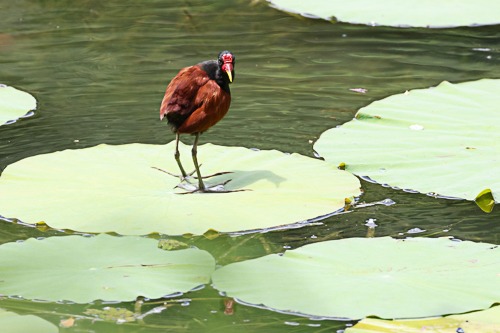
I have watched them picking their way through patches of lilies for years without knowing there was such an appropriate name for what they were doing.
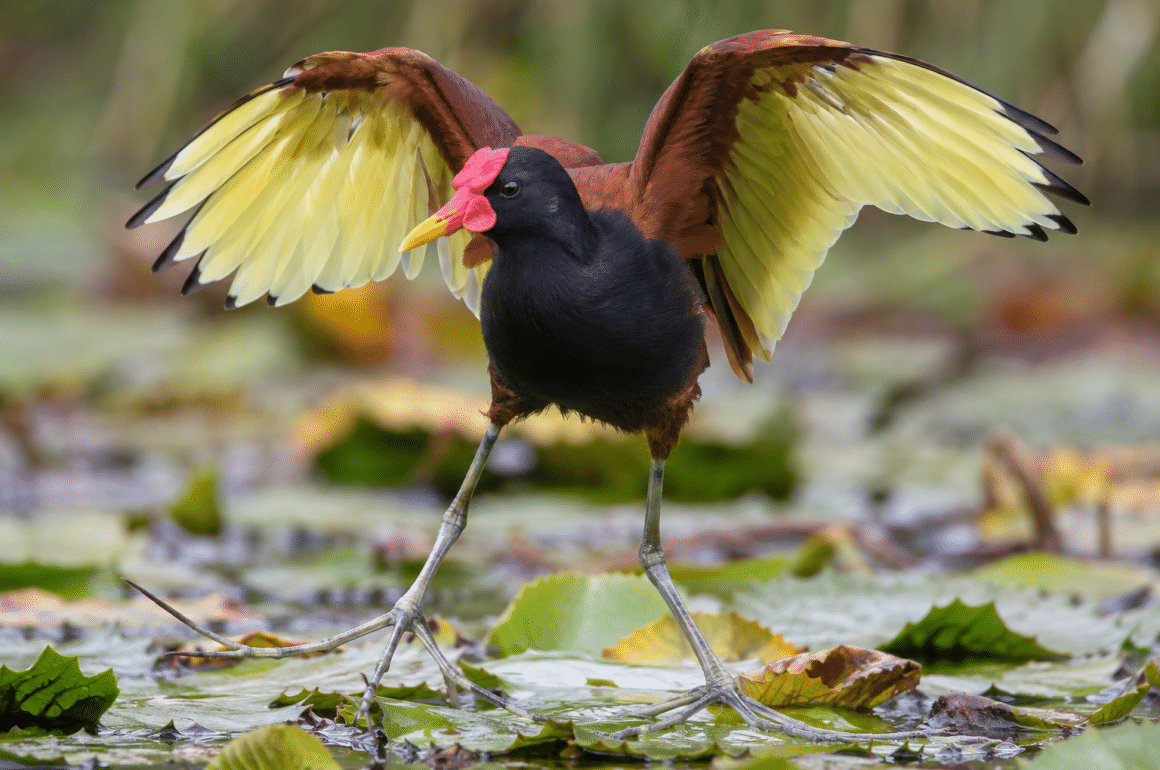
Most of the Wattled Jacana’s colours are pretty obvious. There is no hiding that red wattle or yellow bill, and the chestnut and black can be seen from some distance away.
But there is another colour that it keeps largely hidden.
You have to wait for it to open its wings.
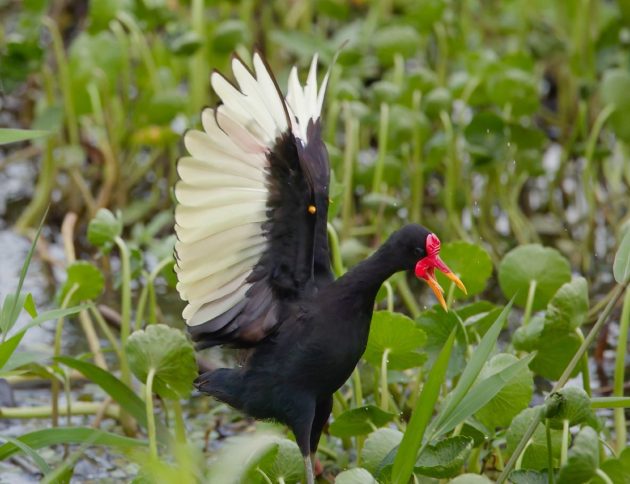
Suddenly there is a flash of yellow.
The flight feathers are a striking yellow-green, something you would hardly suspect when the bird is wandering around with its wings folded.
Those wings also hide something considerably less decorative.
Jacanas have a sharp spur at the bend of each wing, which can be used when fighting with one another. I have seen plenty of jacanas chasing each other over the years, although I can’t say that I have ever actually seen those spurs put to use.
Perhaps that is just as well.
For such a well-dressed bird, they are quite well armed.
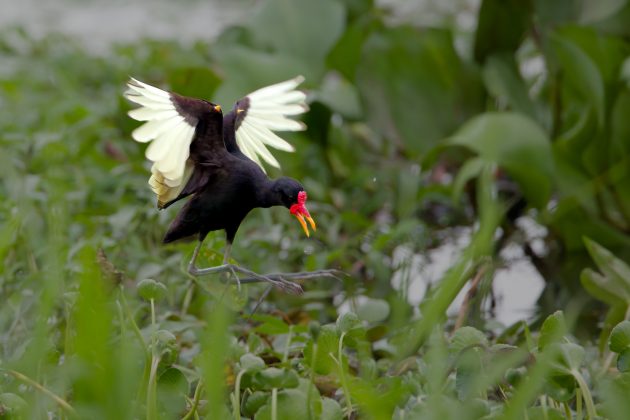
There was another reason the jacanas at Gatun Lake had caught my attention.
One of them had a chick.
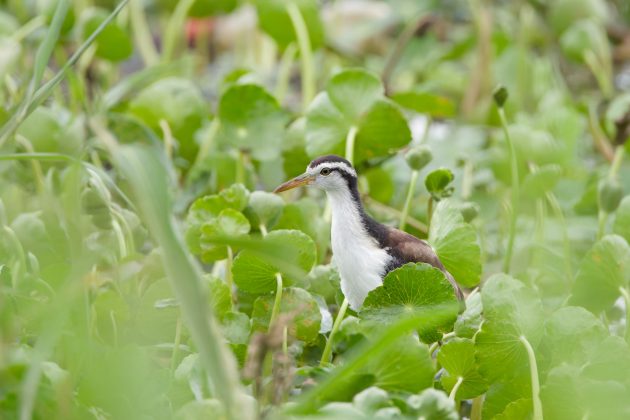
And with Wattled Jacanas, seeing an adult looking after a chick tells you something about which parent you are probably watching.
Dad.
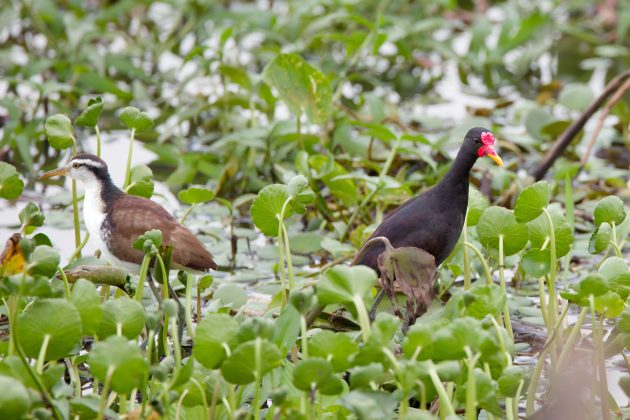
Wattled Jacanas have a rather unusual family arrangement. The female is larger than the male and may have several males within her territory.
The males incubate the eggs and then take responsibility for the chicks once they hatch.
So while the female has the larger territory to look after and defend, each male gets on with raising his family.
There is one bit of jacana behaviour I would particularly like to see. When his chicks are threatened, the male can gather them beneath his wings and carry them away to safety.
I haven’t seen it yet, but I will certainly be watching the next time I find a male with small chicks.
Eventually my attention returned to the ducks in the dead tree and the Jacanas went their merry way.








Leave a Comment