

Initially, I wanted to answer the question “Which bird species is the most stupid?” However, after a discussion with our team of legal advisors, we shied away from this topic – the risk of litigation is simply too high. This is partly because it is difficult to measure the intelligence of bird species – presented with a printed IQ test, most species will either ignore it, tear it into pieces, or possibly (as my cats would) sit on it.
However, that raises the question in the title: How do scientists measure the intelligence of birds? Basically, they use several parameters with separate tests, resulting in different “domains of intelligence” (a posh word presumably mostly used in grant applications).
Brain Size and Structure
The EQ (encephalization quotient) is basically the ratio of brain size to body size. Parrots and corvids have EQs close to those of great apes. Another measure is neuron density – how many neurons are in a given brain volume? Kind of the equivalent of the transistor density on a computer chip, though Moore’s Law does not apply here.
Problem Solving
Scientists confront birds with problems that, if solved, allow the birds to get food. In such experiments, good problem solvers such as New Caledonian Crows apply tools to get food. Similar experiments may require the birds to understand cause and effect (pulling a string to get food), or to perform several actions in the right order (unhook a latch, open a door, take out food).
Memory
Some bird species, such as Clark’s Nutcracker, are good at storing food in different locations and retrieving it later, which is also regarded as an aspect of intelligence.
Impulse Control
The famous marshmallow test – though nowadays seen as less revealing than originally thought – can also be used with birds. Some parrots and corvids can wait for a bigger reward rather than taking a smaller one immediately.
Self-Awareness
A few birds, including magpies, pass the mirror test, i.e., they understand that they see themselves in a mirror, which human babies typically only pass once about 18 months old.
Social Intelligence
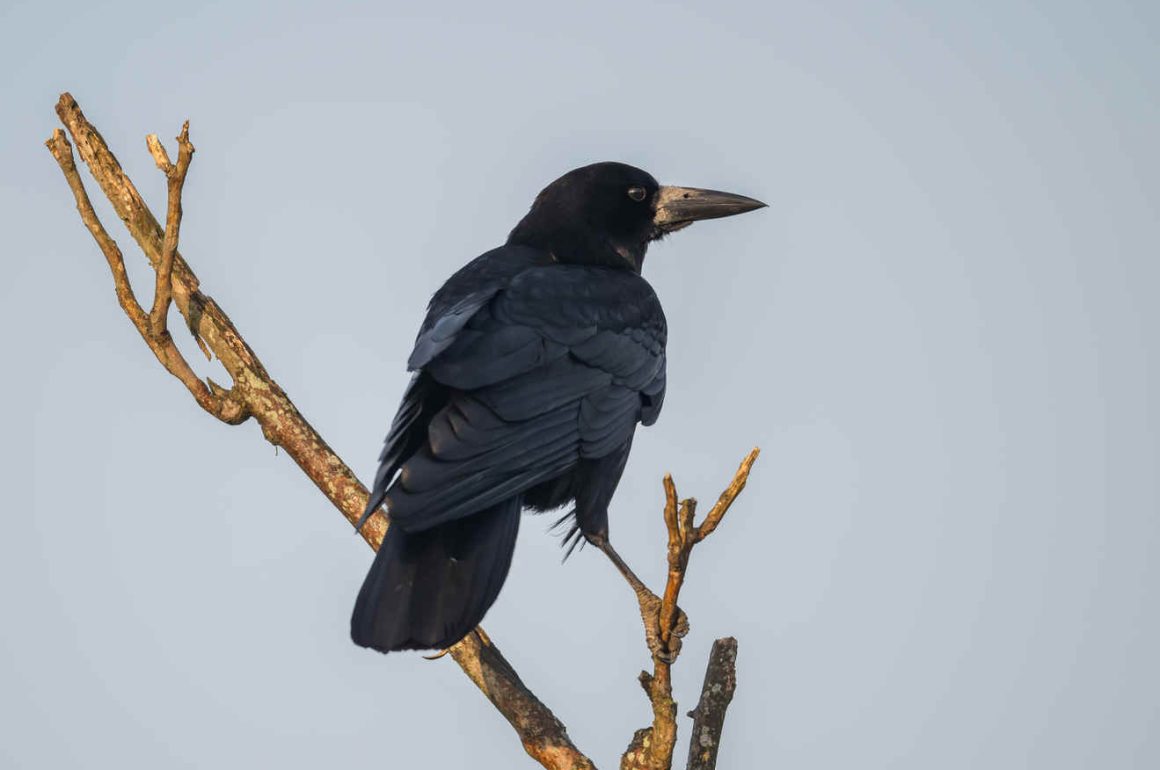
Some species, such as Ravens, are aware of potential actions of other birds – for example, when hiding food while another bird is watching, they will re-hide the food later. Some birds are able to cooperate. In one experiment, dishes of food were placed on a platform out of reach of a Rook enclosure. A single string looped from the enclosure to the platform and back again. Two Rooks managed to pull both ends at the same time to get the food (source).
Learning
The ability to learn complex songs is also regarded as a sign of cognitive ability. Other aspects of learning relate to understanding concepts and categories (such as the pigeons capable of distinguishing Monets from Picassos) or the way some parrots can count (source).
There is no generally accepted way to aggregate all these different aspects into a single number, leaving the original question somewhat unanswered.
However, there is something positive about this. Given these many different aspects of avian intelligence, even some species generally regarded as dumb (such as turkeys) may excel in one or the other – a message of hope to them. Personally, I always thought that for humans, the term “Emotional Intelligence” serves the same function.
Photo: Rook, Chongming, Shanghai, China, November 2024










Leave a Comment