

Recently, after a few very frustrating days at my “local” (about 100 km from where I live) patch, I asked myself exactly this question.
Let’s face it, a large share of the birding experience is unpleasant. Spending time walking in hot and humid places with not many birds after getting up at 2.30 am – a frustrating experience indeed. Why then do I feel I miss out by not going out the next day? Even the small chance of seeing an interesting bird and getting a good photo of it seems to be enough to trigger this feeling – almost like being addicted to a drug. So, I started wondering what the mechanism behind these feelings is, particularly keeping in mind that the evolutionary value of seeing a specific bird is probably very limited, but so is taking a potent drug (link to only marginally relevant but funny The Onion article here).
So, why does birding feel addictive?
Apparently, at the core of this is the dopamine system, about which the Cleveland Clinic says the following:
Dopamine is part of your reward system. This system is designed, from an evolutionary standpoint, to reward you when you’re doing the things you need to do to survive — eat, drink, compete to survive, and reproduce. As humans, our brains are hard-wired to seek out behaviors that release dopamine in our reward system. When you’re doing something pleasurable, your brain releases a large amount of dopamine. You feel good, and you seek more of that feeling.
So, the dopamine system regulates our motivation. That includes the drive to keep searching even if the results are uncertain. Psychologists apparently call the principle birding operates on a variable-ratio reinforcement schedule (which sounds a bit like something your shady financial advisor would want you to invest in).
But it is a type of reinforcement schedule where a behavior is reinforced after an unpredictable number of responses. By reinforcing behavior on an unpredictable basis, individuals are more likely to persist in their actions, as they never know exactly when reinforcement will occur (source).
So, when an unexpected bird appears, the brain registers what is called a “reward prediction error.” Basically, because the bird was unexpected, we get more dopamine than if the sighting was guaranteed. And that means it will feature much more strongly in your memory – even if it only lasted 15 seconds – than the 15 hours you spent experiencing this moment.
From an evolutionary perspective, this makes some sense. Our ancestors mainly engaged in foraging and hunting, activities that were only occasionally successful. Surviving thus required persistence despite repeated failure. Those who survived were those who could muster continued effort in the face of uncertainty – evolution at work.
Drugs like cocaine use the same dopamine pathways, but in a more direct way. Birding is a subtler version of this – an unpredictable and often frustrating pursuit punctuated by moments of disproportionate reward. And apparently, all the unpleasantness of birding (long walks, heat, mosquitoes, getting up early, etc.) is in some way necessary to lift up the positive moments.
Bonus thought – as it does not really fit in here: This makes birding sound a little bit like an inverted version of the description of war as “interminable boredom punctuated by moments of terror”.
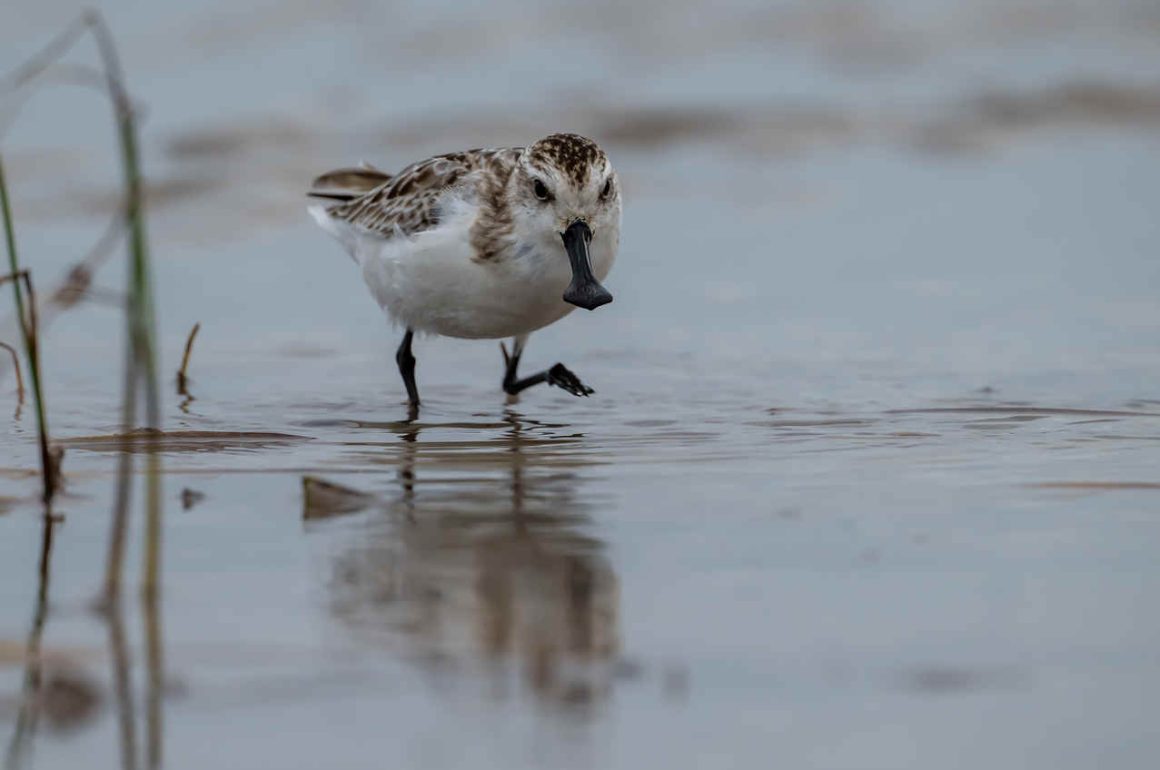
Photo: An unexpected Spoon-billed Sandpiper causing massive dopamine release in the photographer, Shanghai, October 2024






Which explains Nancy Reagan’s failure to relate to birders. “ Just say no” is not an option.